ShowNow cuts median world model latency to 208 ms in ViZDoom
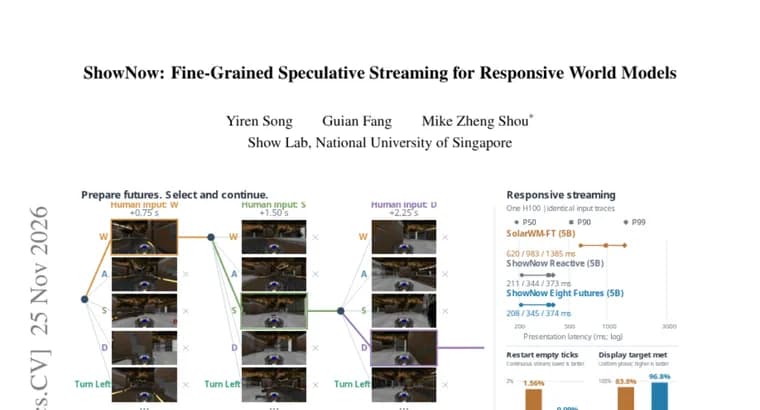
A paper listed on Hugging Face introduces ShowNow, a framework for what its authors call fine-grained speculative streaming in interactive world models. These models have to generate video continuously and also react quickly to what the user does.
The authors argue that real-time throughput alone does not solve input latency. Coarse generation blocks delay action updates, and generating only after input arrives adds work to the response path.
ShowNow instead uses the computation available while video is playing to prepare action-conditioned futures before the input arrives. It commits output a single latent at a time, which allows frequent decisions, and its preparation can be configured to cover one to eight actions. To train alternative continuations from a common state, the authors built a matched multi-future dataset. Two techniques, shared-history tree execution and fused commitment, make preparing those futures efficient.
On a single H100, the authors' 5B model sustains 480p generation at 16 fps with eight prepared futures. In ViZDoom, the complete ShowNow deployment reduced median input-to-display latency from 620 to 208 ms relative to the native-block SolarWM-FT deployment. In matched-policy experiments, restart empty ticks fell from 1.56% to 0.09%, a 94% reduction, and on-time responses to action changes also improved.
The authors conclude that fine-grained commitment and advance preparation play complementary roles, with measured trade-offs in visual fidelity and long-horizon consistency. The project page is at github.com/showlab/ShowNow.
Key facts
- ShowNow prepares action-conditioned futures during video playback, before user input arrives, with configurable coverage of one to eight actions.
- The authors' 5B model sustains 480p generation at 16 fps on a single H100 with eight prepared futures.
- In ViZDoom, median input-to-display latency fell from 620 to 208 ms for the complete ShowNow deployment compared with native-block SolarWM-FT.
- Matched-policy experiments cut restart empty ticks from 1.56% to 0.09% (94%) and improved on-time responses to action changes.
- The authors report measured trade-offs in visual fidelity and long-horizon consistency.
Why it matters
An interactive world model is only as responsive as the delay between a user's action and what appears on screen. The authors' point is that generating frames fast enough for real time leaves that delay unresolved. Their answer has two parts: commit output in fine steps, and use playback time to prepare possible next moves in advance. They describe the two as complementary.
Who it affects
The work is most relevant to researchers and engineers building interactive world models, particularly those who care about how quickly generated video reacts to input. The reported hardware setup is a single H100 running a 5B model.
How to use it
The paper points to a project page at github.com/showlab/ShowNow. The source gives that link but does not state that code, model weights or the dataset are released, nor any license. Teams with a similar problem can consider the ideas it describes: single-latent commitment, preparation covering one to eight actions, training on matched alternative continuations, shared-history tree execution and fused commitment.
How solid is it
These are the authors' own results. The headline latency figure is a median measured in ViZDoom, comparing the complete ShowNow deployment with one named baseline, the native-block SolarWM-FT deployment. The source does not say how much of the gain comes from each component. The drop in restart empty ticks comes from matched-policy experiments, and no figure is given for the improvement in on-time responses to action changes.
Risks and caveats
The authors acknowledge trade-offs in visual fidelity and long-horizon consistency, but their size is not quantified in the source text. The source also does not say that the latency or empty-tick results hold outside ViZDoom or the described experiments. The 480p at 16 fps figure is stated for a single H100 with eight prepared futures, so it should not be assumed for other hardware.
“Real-time throughput alone leaves input latency unresolved: coarse generation blocks delay action updates, and generation after input adds work to the response path.”
— The ShowNow authors, in the paper's abstract