SKILLER generates reusable skills for small language models via natural-language RL
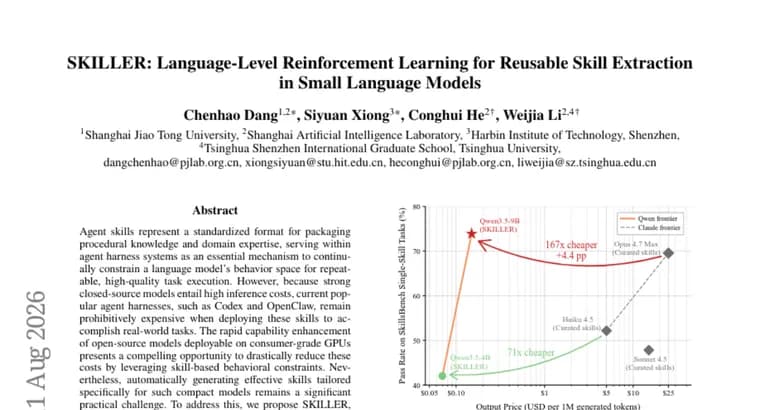
Agent skills are a standardized way to package procedural knowledge and domain expertise so an agent harness can repeatedly constrain a language model's behavior and get reliable, high-quality task execution. The problem, according to the paper introducing SKILLER, is cost: strong closed-source models carry high inference costs, so popular agent harnesses such as Codex and OpenClaw remain prohibitively expensive once they deploy skills on real-world tasks. Open-source models that run on consumer-grade GPUs are improving quickly and could cut that cost sharply if paired with the right skills, but automatically generating skills tailored to a specific small model has remained a hard, unsolved problem.
SKILLER is the paper's proposed answer: a natural-language-driven reinforcement learning framework that automatically generates skills customized to a particular small executor model. It uses a strong model as both actor and critic, while the small model's own agent system serves as the reinforcement-learning environment. Unlike conventional RL, which optimizes a numeric reward, SKILLER propagates every reinforcement-learning signal as natural language rather than a scalar score.
The authors tested SKILLER on two small open models, Qwen3.5-9B and Qwen3.5-4B, across five benchmarks, comparing it against three open-source and one closed-source skill generation or evolution method (none of the four baselines are named in the source). SKILLER outperformed all four, with absolute gains of 4.3 to 20.4 percentage points for the 9B model and 1.8 to 13.3 points for the 4B model, reported as an aggregate range across the five benchmarks rather than broken down per benchmark. On single-skill tasks within one of those five, the SkillsBench benchmark, SKILLER-equipped small models matched, though did not exceed, the performance of strong closed-source models.
The paper does not report training cost, compute budget, or the inference latency or cost of the resulting small-model system, so the inference-cost savings that motivate the work are not themselves quantified. No individual author names, institutional affiliations, publication venue or date appear in the text; the only attribution is the collective 'we'. The project's code is published at github.com/DANG-ai/SKILLER.
Key facts
- SKILLER is a natural-language-driven reinforcement learning framework that automatically generates executor-specific skills for small language models, using a strong model as actor and critic while treating the small model's own agent system as the RL environment.
- Instead of optimizing a numeric reward, SKILLER propagates every reinforcement-learning signal as natural language.
- Tested on Qwen3.5-9B and Qwen3.5-4B across five benchmarks, SKILLER outperformed three open-source and one closed-source skill generation or evolution method, none of which are named in the source.
- Absolute gains over those baselines ranged from 4.3 to 20.4 percentage points for the 9B model and 1.8 to 13.3 points for the 4B model.
- On single-skill tasks in the SkillsBench benchmark, SKILLER-equipped small models matched, but did not exceed, the performance of strong closed-source models.
Why it matters
Agent skills are how harnesses like Codex and OpenClaw package procedural knowledge to keep a language model's behavior reliable and repeatable, but running that on strong closed-source models is expensive, and the paper says this keeps such harnesses 'prohibitively expensive' for real-world deployment. Open-source models on consumer GPUs are getting stronger fast, so a way to automatically build good skills for them specifically could let cheaper, locally deployable models substitute for costly closed-source agents on a given task. SKILLER targets exactly that gap: automated, executor-specific skill generation for small models, trained through natural-language reinforcement learning rather than a conventional numeric-reward RL setup.
Who it affects
The paper is aimed at builders of agent harnesses and skill libraries, the kind of systems the source names as examples: Codex and OpenClaw. It matters to anyone weighing whether to run agents on expensive closed-source models versus cheaper open ones deployable on consumer-grade GPUs, and to researchers working on skill generation or evolution methods, since SKILLER is benchmarked directly against three open-source and one closed-source method in that space. In the paper's own experiments, the small models on the receiving end are Qwen3.5-9B and Qwen3.5-4B.
How to use it
The paper's code is published at github.com/DANG-ai/SKILLER. In the text, SKILLER is described as a method for automatically generating skills for a chosen small executor model, benchmarked by the authors against existing skill generation and evolution methods; the repository is the entry point given for anyone who wants to inspect or run it.
How solid is it
The claims rest on five benchmarks run against two model sizes, Qwen3.5-9B and Qwen3.5-4B, with SKILLER beating three open-source and one closed-source baseline skill generation or evolution method by 4.3 to 20.4 percentage points for the 9B model and 1.8 to 13.3 points for the 4B model, reported only as an aggregate range rather than per benchmark. The headline claim of matching closed-source performance is narrower than it might sound: it applies only to single-skill tasks within one of the five benchmarks, SkillsBench, not to performance generally. The source names none of the four baseline methods and gives no individual author names, institutional affiliations, publication venue, or date, which limits how far the results can be independently checked from the text alone.
Risks and caveats
The paper's own motivation is cutting inference cost, but it reports no training cost, compute budget, or inference latency or cost figures for the SKILLER-trained small models, so the cost savings it argues for are not themselves quantified. The 'matches closed-source models' result is scoped to single-skill tasks in one benchmark, SkillsBench, and should not be read as parity across all task types or benchmarks. Because the four baseline methods and the paper's authors are unnamed in the text, readers cannot independently weigh the strength of the comparison or the authors' track record from the source alone.
“Because strong closed-source models entail high inference costs, current popular agent harnesses, such as Codex and OpenClaw, remain prohibitively expensive when deploying these skills to accomplish real-world tasks.”
— the paper's abstract