SPADE trains an LLM to design and learn from its own environments
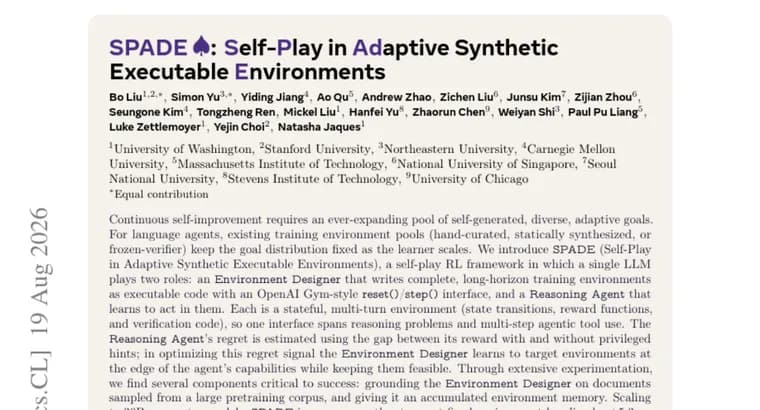
Continuous self-improvement for language agents depends on an ever-expanding pool of self-generated, diverse, adaptive training goals. Existing training environment pools are hand-curated, statically synthesized, or built around a frozen verifier, so the goal distribution stays fixed even as the model learning from it gets stronger.
Researchers introduced SPADE, short for Self-Play in Adaptive Synthetic Executable Environments, a self-play reinforcement-learning framework in which a single LLM plays two roles. An Environment Designer writes complete, long-horizon training environments as executable code, using an OpenAI Gym-style reset() and step() interface. A Reasoning Agent then learns to act inside the environments the Designer produces. Each environment is stateful and multi-turn, with its own state transitions, reward functions, and verification code, so one interface covers both pure reasoning problems and multi-step agentic tool use.
The training signal is the Reasoning Agent's regret, estimated as the gap between the reward it earns with privileged hints and the reward it earns without them. By optimizing this regret signal, the Environment Designer learns to target environments at the edge of the agent's current capability while keeping them feasible, so difficulty adapts as the agent improves.
Through extensive experimentation, the researchers found several components critical to making the approach succeed: grounding the Environment Designer on documents sampled from a large pretraining corpus, and giving it an accumulated memory of the environments it has already designed.
Scaled to 30B-parameter models, SPADE improves over the strongest fixed-environment baseline by +5.3 on average across eight held-out math, science, code, and reasoning benchmarks. In the tool-use setting it lifts performance by +5.7 on BFCL-v4 multi-turn and by +13.9 on ACEBench-Agent. In a separate games setting, SPADE's margin over the strongest baseline grows as model scale increases, though the source does not give a specific figure for that growth.
By making environment design itself a learnable component rather than a fixed, hand-built resource, the researchers describe SPADE as a concrete step toward open-ended self-improvement for language agents.
Key facts
- SPADE has a single LLM play two roles: an Environment Designer that writes complete, executable training environments as code, using an OpenAI Gym-style reset()/step() interface, and a Reasoning Agent that learns to act inside them.
- The Reasoning Agent's regret, the gap between its reward with and without privileged hints, is the signal the Environment Designer optimizes, pushing it to build environments at the edge of the agent's ability while keeping them solvable.
- Grounding the Designer on documents sampled from a large pretraining corpus, plus giving it an accumulated memory of environments it has built, are among the components the researchers found critical to making SPADE work.
- Scaled to 30B-parameter models, SPADE beats the strongest fixed-environment baseline by +5.3 on average across eight held-out math, science, code, and reasoning benchmarks, and by +5.7 on BFCL-v4 multi-turn and +13.9 on ACEBench-Agent.
- In a separate games setting, SPADE's advantage over the strongest baseline grows as model scale increases, though the source gives no specific figure for how much.
Why it matters
Continuous self-improvement for language agents needs an ever-expanding pool of self-generated, diverse, adaptive training goals. Existing pools, whether hand-curated, statically synthesized, or built around a frozen verifier, keep that goal distribution fixed even as the model training on them gets stronger. SPADE responds by making the environment itself a learnable, adaptive component: the same LLM being trained also designs the tasks it trains on. The researchers frame this as a concrete step toward open-ended self-improvement, since environment design is no longer fixed but learned.
Who it affects
Teams building reinforcement-learning pipelines for language agents, especially for tool use and multi-step reasoning, are the direct audience: SPADE's single reset()/step() interface is meant to cover both pure reasoning problems and agentic tool-use tasks. It also speaks to researchers studying how agent training scales with model size, since the paper reports that SPADE's advantage over fixed-environment baselines changes with scale in the games setting.
How to use it
SPADE works by having one LLM take on two roles during training: an Environment Designer that writes long-horizon, stateful environments as executable code, complete with their own state transitions, reward functions, and verification code, and a Reasoning Agent that trains inside the environments the Designer produces. The paper does not say whether code, model weights, or a release date will be made available, so what it describes is a training methodology and its results rather than a tool that can be adopted directly today.
How solid is it
The evidence comes from scaling experiments: at 30B parameters, SPADE beats the strongest fixed-environment baseline by +5.3 on average across eight held-out math, science, code, and reasoning benchmarks, adds +5.7 on BFCL-v4 multi-turn and +13.9 on ACEBench-Agent in the tool-use setting, and widens its lead over the baseline as model scale increases in a separate games setting. These are reported as point differences rather than absolute benchmark scores for either SPADE or the baseline, and the eight benchmarks behind the average are not individually named.
Risks and caveats
The paper does not say by how much the games-setting margin grows with model scale, only that it does, and it does not compare SPADE against any specific named prior system or method beyond the unnamed 'strongest fixed-environment baseline.' It also does not define 'privileged hints' beyond their role in estimating the Reasoning Agent's regret. No individual authors or institutions are named in the text, and no release date, code availability, or model and weights release is mentioned.