SpecOPD proposes branch-parallel distillation for faster speculative decoding
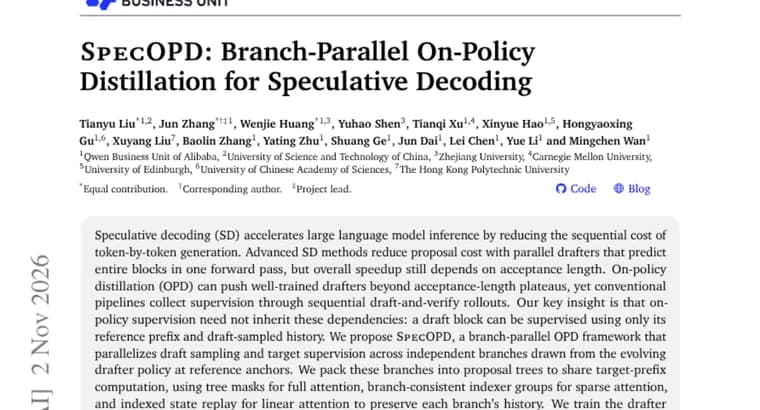
Speculative decoding (SD) speeds up large language model inference by cutting the sequential cost of generating one token at a time. A small drafter proposes tokens and the target model checks them. Newer SD methods use parallel drafters that predict a whole block of tokens in one forward pass, which lowers the cost of making proposals. Even so, the overall speedup still depends on acceptance length, meaning how many drafted tokens the target accepts.
On-policy distillation (OPD) can push well-trained drafters past the plateaus they reach in acceptance length. The catch, according to the paper, is that conventional OPD pipelines gather their supervision through sequential draft-and-verify rollouts, which is slow.
The paper's key insight is that on-policy supervision does not have to inherit those sequential dependencies: a draft block can be supervised using only its reference prefix and the history sampled by the draft. On that basis the authors propose SpecOPD, a branch-parallel OPD framework. It parallelizes draft sampling and target supervision across independent branches, which are drawn from the evolving drafter policy at reference anchors.
To keep this cheap, the branches are packed into proposal trees so they share the target model's prefix computation. Each branch's history is preserved differently depending on the attention type of the target: tree masks for full attention, branch-consistent indexer groups for sparse attention, and indexed state replay for linear attention. The drafter is trained with an E2E-TV surrogate that directly targets acceptance length.
The study covers three target models: an 8B full-attention (GQA) model, a 27B full-linear (GQA--GDN) model and a 125B sparse-linear (QSA--GDN) model. It also covers three parallel draft architectures (DFlash, DSpark and DFlash V2) and four task domains: dialogue, coding, mathematics and agentic tasks.
The headline results from the abstract: SpecOPD reaches up to 41.45% higher mean acceptance length, 16.09 times the supervised-token throughput of sequential-rollout OPD under native configurations, and up to 3.56x generation speedup over autoregressive decoding.
Key facts
- SpecOPD is a branch-parallel on-policy distillation framework for training drafters used in speculative decoding; it parallelizes draft sampling and target supervision across independent branches.
- Branches are packed into proposal trees to share target-prefix computation, with tree masks for full attention, branch-consistent indexer groups for sparse attention and indexed state replay for linear attention.
- Reported results: up to 41.45% higher mean acceptance length, 16.09 times the supervised-token throughput of sequential-rollout OPD under native configurations, and up to 3.56x generation speedup over autoregressive decoding.
- The study spans 8B (GQA), 27B (GQA--GDN) and 125B (QSA--GDN) targets, three parallel draft architectures (DFlash, DSpark, DFlash V2) and four domains: dialogue, coding, mathematics and agentic.
Why it matters
Speculative decoding speedups hinge on acceptance length, and the paper says on-policy distillation can lift drafters past acceptance-length plateaus. The obstacle is that supervision is normally collected through sequential draft-and-verify rollouts. SpecOPD's claim is that this sequential structure is not needed: a draft block can be supervised from its reference prefix and draft-sampled history alone. If that holds, the training step that improves drafters becomes much cheaper to run, with the reported 16.09 times supervised-token throughput over sequential-rollout OPD.
Who it affects
Mainly teams that train drafters for speculative decoding, especially parallel block drafters such as DFlash, DSpark and DFlash V2, which the study covers. The tested targets range from an 8B full-attention model to a 27B full-linear model and a 125B sparse-linear model, so the method is aimed at different attention designs, not one architecture.
How to use it
This is a training method, not a product. The abstract describes the recipe: sample independent branches from the evolving drafter policy at reference anchors, pack them into proposal trees, supervise them against the target with the attention-specific handling (tree masks, branch-consistent indexer groups, indexed state replay), and train with the E2E-TV surrogate that targets acceptance length. No code, model release or open-source availability is mentioned.
How solid is it
This is a preprint listed on Hugging Face Papers, and the account here rests on its abstract. The evaluation is broad on paper: three target sizes and attention types, three draft architectures and four task domains. But the 41.45% and 3.56x figures are stated as 'up to' maxima, and the abstract does not say which target model, drafter architecture or task domain produced them, nor typical values. It does not say which baseline the 41.45% gain is measured against. The 16.09 times throughput figure is given only 'under native configurations' and not per model or domain. No absolute acceptance lengths, tokens-per-second figures or training cost are given.
Risks and caveats
Treat the headline numbers as best cases. The abstract reports maxima for acceptance length and generation speedup, and one throughput multiple under unspecified native configurations, so results on a given model and workload may be smaller. The abstract does not define what 'native configurations' means, nor what the E2E-TV surrogate or the DFlash, DSpark and DFlash V2 architectures are. The 16.09 times figure compares supervision throughput during training with sequential-rollout OPD; it is a different measure from the generation speedup over autoregressive decoding at inference time.
“a draft block can be supervised using only its reference prefix and draft-sampled history”
— SpecOPD paper abstract