SpecWM speeds up streaming video world models 1.63x without retraining
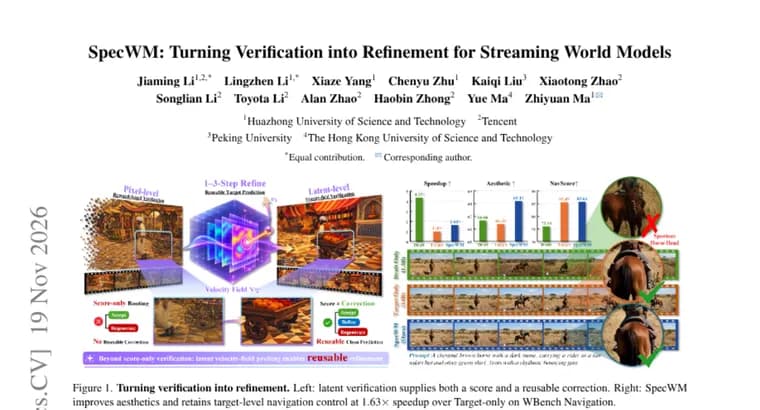
A paper on Hugging Face introduces Speculative World Model (SpecWM), an inference framework for streaming video world models. It needs no additional training.
The background is a trade-off. Video world models have advanced interactive generation: large models give higher quality, while smaller models run faster. Existing speculative methods try to get both. A small model quickly drafts the video, and the large target model regenerates only the parts that a reward score, computed on decoded frames, marks as poor.
The authors name two weaknesses in that setup. First, verification covers only the evaluation dimensions of the external scorer, and it adds decoding and scoring costs. Second, the scores give no correction, so a rejected draft means costly regeneration by the target model.
SpecWM changes the verification step. It checks draft chunks using the target model's latent velocity field, rather than scoring decoded frames. The same check also yields a reusable correction. Two thresholds then sort each draft chunk into Accept, Refine or Reject.
Refinement comes in two variants. One-step refinement reuses the correction to improve perceptual quality. Three-step refinement strengthens camera following and trajectory consistency. According to the abstract, these findings motivate what the authors call transition-aware refinement.
On WBench Navigation, the authors report that SpecWM improves visual quality at a 1.63x speedup over the target model. It raises NavScore from the draft model's 75.99 to 85.63, which they describe as the best quality-speed-control trade-off. They also present LongSpecBench, which they say shows sustained quality and control over long, multi-turn rollouts. Experiments on Hy-Nomas, they say, validate SpecWM across backbones and denoising budgets.
Key facts
- SpecWM is a training-free inference framework for streaming video world models that verifies draft chunks using the target model's latent velocity field.
- The verification also produces a reusable correction, and two thresholds sort each chunk into Accept, Refine or Reject.
- One-step refinement improves perceptual quality; three-step refinement strengthens camera following and trajectory consistency.
- On WBench Navigation the authors report a 1.63x speedup over the target and NavScore up from the draft's 75.99 to 85.63.
- The authors also introduce LongSpecBench for long, multi-turn rollouts and run experiments on Hy-Nomas across backbones and denoising budgets.
Why it matters
Streaming world models force a choice between large, slow, high-quality models and small, fast ones. Speculative methods try to combine them, but the authors say current versions pay extra decoding and scoring costs and judge drafts only along the scorer's own dimensions. SpecWM tries to remove both costs by verifying in the target's latent space and by turning a rejected or weak draft into a correction rather than a full regeneration.
Who it affects
The work is aimed at researchers and engineers building interactive video generation and world models, especially systems that stream video in chunks and need to run fast. The abstract names no specific company or product.
How to use it
The method is described as a training-free inference framework, so in principle it works with existing models without retraining. The abstract says it was tested across backbones and denoising budgets on Hy-Nomas. It mentions no code or model release, so anyone wanting to try it would need to wait for or look for an implementation.
How solid is it
The evidence is the authors' own reported results, taken from the abstract alone. They report NavScore of 75.99 for the draft and 85.63 for SpecWM on WBench Navigation, and a 1.63x speedup over the target. No NavScore for the target model is stated, and no absolute latency or frame rate is given for the speedup. The paper also appears to be new, and nothing in the abstract points to independent replication.
Risks and caveats
The abstract does not give the two threshold values or how often chunks are accepted, refined or rejected. It does not name the draft and target models, or the backbones used on Hy-Nomas. The best-trade-off claim is made by the authors on their own benchmarks, including LongSpecBench, which they introduce themselves. The speedup is relative to the target model only.