StableVQ fixes training instability in vector-quantized image tokenizers
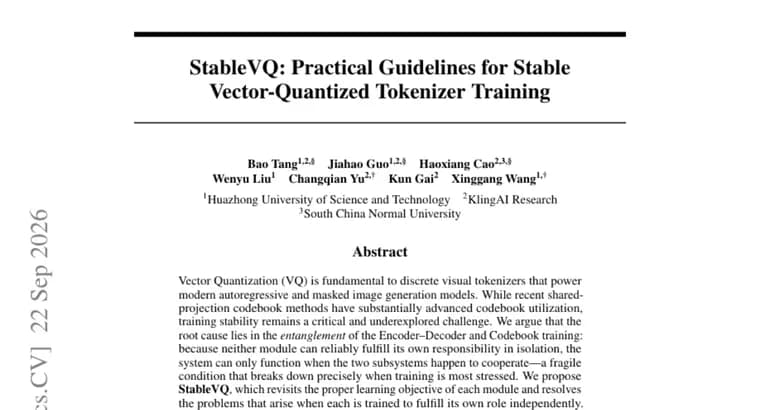
Vector quantization (VQ) underlies the discrete visual tokenizers used by modern autoregressive and masked image generation models: an encoder maps an image into a compact space, and a codebook of discrete entries represents that space. Recent methods that share projections across the codebook have made real gains in codebook utilization, meaning more of the codebook's entries actually get used during training rather than sitting idle. But the authors argue that a different problem, training stability, has stayed critical and underexplored. Their diagnosis is that the encoder-decoder and the codebook are entangled during training: neither module can reliably do its own job on its own, so the whole system only works when the two happen to cooperate. That cooperation is fragile, and it breaks down exactly when training is under the most stress.
The authors' fix, StableVQ, gives each module a learning objective it can satisfy independently, rather than relying on the two to prop each other up. It has three parts. Dynamic STE (straight-through estimator) corrects instability in the encoder's own learning objective, letting it optimize its reconstruction space under discrete regularization even when codebook utilization is low, so the encoder no longer needs a well-behaved codebook to train properly. Region VQ Loss reworks the codebook's learning objective so it can independently track the full distribution of encoder outputs, instead of depending on the encoder's oscillations to activate codebook entries. Decoupled Schedule treats the encoder-decoder and the codebook as having genuinely different jobs and gives each its own learning-rate schedule, rather than optimizing both under one shared schedule.
StableVQ is built on top of existing shared-projection codebooks and is described as lightweight, introducing no additional learnable parameters of its own. On ImageNet experiments, the authors report consistent improvements in training stability, codebook utilization, and reconstruction quality, holding across a range of codebook sizes and initialization settings. The paper does not give specific author names, institutions, numerical results, or comparisons against named baseline methods; it also makes no mention of released code, model weights, or a dataset.
Key facts
- StableVQ targets training instability in vector-quantized (VQ) visual tokenizers, a problem the authors say has stayed underexplored even as shared-projection codebook methods improved codebook utilization.
- The authors trace the instability to entanglement between encoder-decoder training and codebook training: each module can only function when the other happens to cooperate, and that cooperation breaks down under training stress.
- Dynamic STE corrects the encoder's learning objective so it optimizes its reconstruction space reliably even when codebook utilization is low.
- Region VQ Loss lets the codebook independently track the full encoder output distribution instead of depending on encoder oscillations to activate entries, and Decoupled Schedule gives the encoder-decoder and the codebook separate learning-rate schedules.
- StableVQ adds no learnable parameters and is reported to improve training stability, codebook utilization, and reconstruction quality on ImageNet across different codebook sizes and initializations.
Why it matters
Discrete visual tokenizers are the front end for a wide range of autoregressive and masked image generation models: how well the tokenizer trains sets a ceiling on everything built on top of it. Codebook utilization, getting more of the codebook's entries to actually activate, has been a focus of recent work, but the authors argue that training stability is the more fundamental and less examined problem. Their diagnosis reframes it as an architectural issue: the encoder and the codebook have been trained in a way that makes each depend on the other behaving well, rather than each being able to do its own job independently. Fixing that dependency, rather than tuning around it, is the paper's core contribution.
Who it affects
The paper does not name authors, institutions, or an affiliation, so the direct beneficiaries described here are researchers and engineers who build or train discrete visual tokenizers for image generation systems, since StableVQ is presented as a training technique for that specific stage of the pipeline rather than a new generative model or product.
How to use it
StableVQ is designed to slot onto existing shared-projection codebook setups: it changes the training objectives and schedules used for the encoder-decoder and the codebook, but introduces no new learnable parameters, so it does not add architecture or inference cost. The paper gives no information on released code, model weights, or a dataset, and no pricing or licensing applies since this is a research method rather than a product.
How solid is it
The claims come from a single paper without named authors, and the source text gives no numerical results (no accuracy, FID, or utilization figures) and no named baseline methods for comparison, so the size of the reported improvements cannot be checked here. The evaluation is described as ImageNet experiments across multiple codebook sizes and initialization settings, which supports generality within that one benchmark, but independent replication and comparison against specific alternative methods are not available from this source.
Risks and caveats
Because the paper withholds concrete numbers, readers cannot judge how large the stability, utilization, or reconstruction-quality gains actually are, only that the authors report them as consistent. There is also no mention of code or weights being released, which limits independent verification and reuse. The method is evaluated on ImageNet only, so it is not yet established how the approach performs on other datasets or at production scale.