StepAudio 3 Realtime thinks while it speaks
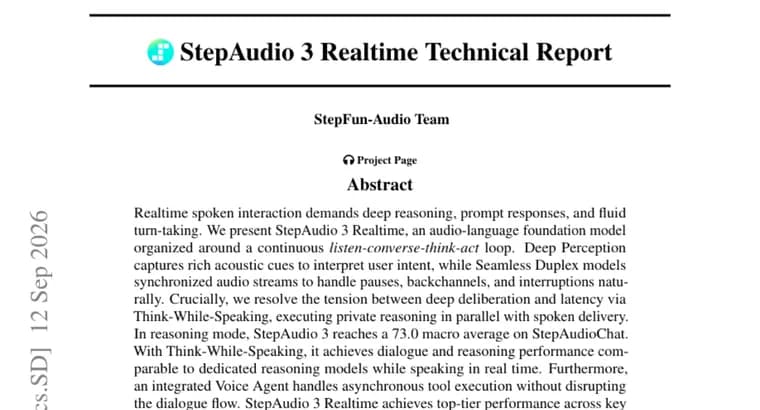
A technical report introduces StepAudio 3 Realtime, an audio-language foundation model built around a continuous listen-converse-think-act loop for spoken interaction. The system combines three named components. Deep Perception captures rich acoustic cues from the user's voice to interpret intent beyond the words themselves. Seamless Duplex models both sides of the audio stream at once, so the model can handle pauses, backchannels (the small "mm-hmm" acknowledgements of natural conversation) and interruptions without breaking the exchange. The central mechanism is Think-While-Speaking, which the authors describe as resolving the tension between deep deliberation and low latency: the model runs private reasoning in parallel with the spoken reply it is already delivering, rather than pausing to think before it answers. The report states that with Think-While-Speaking, the model reaches dialogue and reasoning performance comparable to dedicated reasoning models while still speaking in real time, though no specific baseline models are named for that comparison. Separately, the report gives a benchmark figure for reasoning mode: a 73.0 macro average on StepAudioChat. The system also includes an integrated Voice Agent that can execute tools asynchronously, meaning it can call external functions or services without stalling or breaking the ongoing dialogue. On top-tier benchmarks, the report cites 90.6 on the MMSU benchmark, 98.9 Overall on the Artificial Analysis Full-Duplex Bench, and a 56.0% macro task-success rate on tau-Voice. The text does not name the authors, their institutions, the model's size or architecture, its training data, or any release date, code or availability plan.
Key facts
- Think-While-Speaking runs private reasoning in parallel with spoken output, instead of pausing to think before answering
- Deep Perception reads acoustic cues for intent, and Seamless Duplex models both audio streams to handle pauses, backchannels and interruptions
- Reasoning mode reaches a 73.0 macro average on StepAudioChat
- The report cites 90.6 on MMSU, 98.9 Overall on the Artificial Analysis Full-Duplex Bench, and a 56.0% macro task-success rate on tau-Voice
- An integrated Voice Agent executes tools asynchronously without disrupting the dialogue
Why it matters
Real-time voice interaction has usually forced a trade-off: think longer and the reply lags, answer fast and the reasoning is shallow. StepAudio 3 Realtime's pitch is that Think-While-Speaking removes that trade-off by running reasoning alongside the spoken output rather than before it, while Deep Perception and Seamless Duplex aim to make the turn-taking itself feel natural, with pauses, backchannels and interruptions handled rather than treated as errors.
Who it affects
The report targets builders of voice assistants and other conversational AI systems where response latency matters, plus researchers who benchmark audio-language and speech-reasoning models against dedicated reasoning systems and duplex-dialogue benchmarks such as the Artificial Analysis Full-Duplex Bench and tau-Voice.
How to use it
The report does not state a release date, whether code or weights will be published, or any availability plan, so there is nothing yet to try or deploy.
How solid is it
The evidence is a set of self-reported benchmark numbers: a 73.0 macro average on StepAudioChat in reasoning mode, 90.6 on MMSU, 98.9 Overall on the Artificial Analysis Full-Duplex Bench, and a 56.0% macro task-success rate on tau-Voice. The claim that Think-While-Speaking matches dedicated reasoning models does not name which models it was measured against, and the report gives no model size, architecture detail or training data, so the results cannot be sized against comparable systems from the text alone.
Risks and caveats
The report names no authors and no institutional affiliation, which is unusual for a technical paper and means the claims cannot be traced to a specific team from the text. With no code, weights or release plan disclosed, none of the benchmark claims can be independently verified or reproduced for now.