SoL-Pi cuts coding-agent token traffic by up to 49%
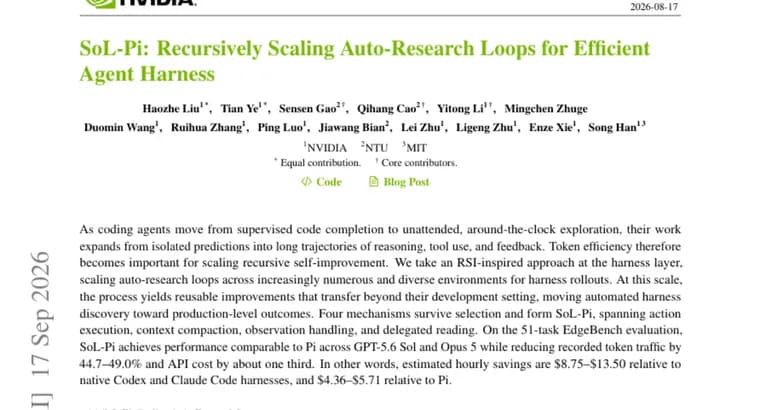
A paper posted to Hugging Face's papers section presents SoL-Pi, a technique aimed at making coding agents cheaper to run without giving up performance. Rather than changing the underlying model, it works at the level of the agent harness, the code that governs how an agent executes actions, manages its context window, handles what it observes, and reads through material. The approach takes a recursive self-improvement (RSI) mindset and applies it to harness design itself: it runs automated research loops across a large and varied set of environments, and at that scale the loops start producing improvements that hold up outside the exact setting they were built in, moving automated harness discovery closer to something usable in production. Four mechanisms survived this selection process and together form SoL-Pi: action execution, context compaction, observation handling, and delegated reading. Tested on the 51-task EdgeBench evaluation, SoL-Pi matches the performance of a baseline system called Pi across two model backends, GPT-5.6 Sol and Opus 5, while cutting recorded token traffic by 44.7-49.0% and reducing API cost by about a third. The paper translates that into estimated hourly savings of $8.75 to $13.50 compared with running native Codex and Claude Code harnesses, and $4.36 to $5.71 compared with running Pi itself. The text names no authors, institutions, or publication venue, and it does not explain what Pi is beyond using it as the point of comparison.
Key facts
- SoL-Pi is built from four mechanisms that survived a selection process: action execution, context compaction, observation handling, and delegated reading.
- On the 51-task EdgeBench evaluation, SoL-Pi matches the performance of baseline system Pi across two backends, GPT-5.6 Sol and Opus 5.
- Recorded token traffic drops by 44.7-49.0% versus Pi at matched performance, and API cost drops by about a third.
- Estimated hourly savings run $8.75-$13.50 versus native Codex and Claude Code harnesses, and $4.36-$5.71 versus Pi.
- The text discloses no authors, institutions, or publication venue, and does not define what Pi is beyond its role as the comparison baseline.
Why it matters
Coding agents that run unattended for hours accumulate long trajectories of reasoning, tool calls, and feedback, and every one of those steps is billed as tokens. That makes the harness itself, not just the model, a lever on cost: a change that shaves tokens off every action ripples across an entire long-running session. SoL-Pi's contribution is not a single trick but a way of finding such tricks automatically, at a scale where the resulting mechanisms transfer to settings they were not built for, which is what the paper frames as moving harness discovery toward production use rather than one-off tuning.
Who it affects
The direct audience is teams building or operating autonomous coding agents and the harnesses that drive them, including anyone currently paying per-token bills for systems like native Codex or Claude Code harnesses, or for the paper's own baseline, Pi. It also speaks to harness engineers looking for concrete components, rather than a full replacement framework, since the four mechanisms address separate parts of an agent loop.
How to use it
The paper describes SoL-Pi as four mechanisms spanning action execution, context compaction, observation handling, and delegated reading, evaluated against the Pi baseline on the EdgeBench task suite. The text does not state whether code, weights, or an integration for existing harnesses has been released, so nothing here should be read as availability information beyond what is described as an evaluated technique.
How solid is it
The result rests on one evaluation suite, 51 tasks in EdgeBench, and one named baseline, Pi, tested across two model backends. The text does not say who built SoL-Pi, what institution if any is behind it, where it will be or was published, or what Pi is beyond being the thing SoL-Pi is compared against. That absence of authorship and venue information, combined with a single benchmark and a single baseline, means the token- and cost-reduction figures have not been shown to generalize beyond this one comparison.
Risks and caveats
The efficiency numbers are relative to Pi specifically, not an absolute measure of quality, and percentages of token reduction should not be read as percentages of cost or of task accuracy; the paper keeps these as separate figures (44.7-49.0% token traffic, about a third for API cost, and separate dollar ranges for hourly savings). With no disclosed authorship, institution, or venue, and no independent replication mentioned in the text, the claims currently rest on the paper's own reporting.