StepFun's Step 5 Preview, a 600B MoE for agentic work, appears on OpenRouter
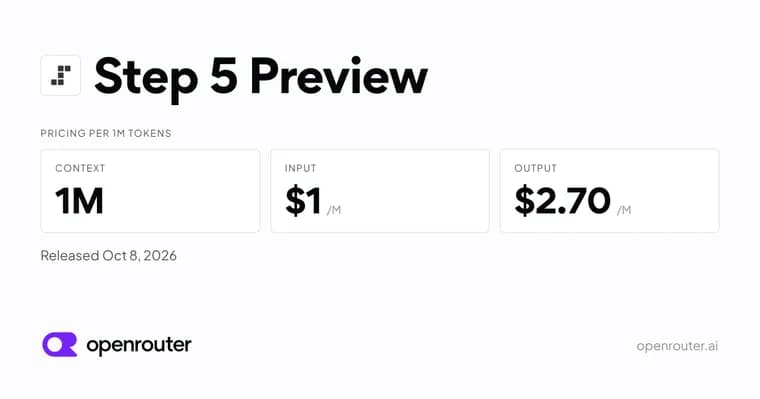
OpenRouter now carries a model page for Step 5 Preview from StepFun. The page's description calls it StepFun's flagship model for agentic work, built on a sparse Mixture-of-Experts architecture with 27B active and 600B total parameters. In a sparse MoE, only part of the network runs for each token, which is what the 27B active figure refers to.
The description makes three claims about what the model is for. It says the model performs strongly in software engineering and professional knowledge work, with particular strength in finance. It also says the model is designed for extended tasks that span large codebases and documents, using tools and refining results over multiple steps. No benchmark scores or comparisons with other models back these statements; they are descriptive text on the page.
The rest of the page is OpenRouter's standard platform text. It carries latency labels, "P50, best across providers" and "P50, best provider", but the text gives no figures for them. It also explains that when an upstream provider returns an error, OpenRouter can recover by routing to another healthy provider, if the request's filters allow it. Per-provider uptime data can be accessed programmatically through the Endpoints API.
The page does not list prices, release date, licence, or the providers serving the model, so for now the listing establishes that the model is reachable through OpenRouter and what its maker says it is for.
Key facts
- OpenRouter lists Step 5 Preview, described as StepFun's flagship model for agentic work.
- Architecture: sparse Mixture-of-Experts with 27B active and 600B total parameters.
- The description claims strong software engineering and professional knowledge work, with particular strength in finance, but gives no benchmark figures.
- It is described as designed for extended tasks across large codebases and documents, using tools and refining results over multiple steps.
- OpenRouter can reroute a request to another healthy provider if an upstream provider errors, and exposes per-provider uptime through the Endpoints API.
Why it matters
Step 5 Preview is positioned by its description as StepFun's flagship for agentic work, and it uses a sparse MoE design: 600B total parameters, but only 27B active. Its appearance on OpenRouter makes the model reachable through a widely used routing platform. The emphasis on long tasks across large codebases and documents, tool use and multi-step refinement places it among models aimed at coding and professional work agents.
Who it affects
Developers building coding agents and tools for professional knowledge work are the audience the description addresses, with finance singled out as a particular strength. Teams that already route model calls through OpenRouter can see the model in the same place as their other options.
How to use it
The model is listed on OpenRouter under the StepFun name, so access goes through that platform. OpenRouter says it can recover from upstream provider errors by routing to another healthy provider, if your request filters allow it, and that per-provider uptime data is available through the Endpoints API. No pricing, per-token costs, or latency and throughput values are given on the page, so check the live listing before planning around it.
How solid is it
The listing itself is concrete: a model page exists and states the parameter counts. The performance statements are descriptive text with no benchmark scores or comparisons behind them, so treat them as the maker's positioning rather than measured results. The source text does not state a context window size.
Risks and caveats
The name says Preview, and the page does not say whether this is a preview-only or generally available release. No release date, licence or open-weights status is stated, and the upstream providers are not named. The claims of strength in software engineering and finance are unverified, and the latency labels carry no numbers.
“It is designed for extended tasks that span large codebases and documents, using tools and refining results over multiple steps.”
— OpenRouter model page for Step 5 Preview