StepX-OPD merges capability and step distillation for text-to-image diffusion
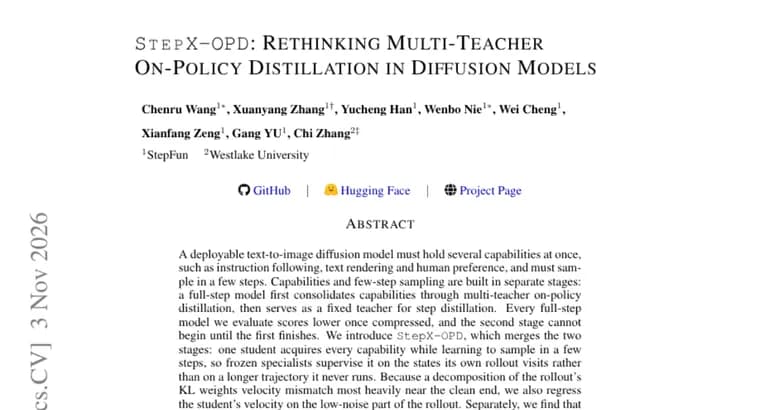
A text-to-image diffusion model that is ready to deploy has to hold several capabilities at once, such as instruction following, text rendering and human preference, and it has to sample in a few steps. The paper argues that current pipelines build these two things in separate stages. A full-step model first consolidates the capabilities through multi-teacher on-policy distillation, then serves as a fixed teacher for step distillation. The authors point to two costs of this split: every full-step model they evaluate scores lower once compressed, and the second stage cannot begin until the first finishes.
Their answer is StepX-OPD, which merges the two stages. One student acquires every capability while it learns to sample in a few steps. Frozen specialist models supervise the student on the states its own rollout visits, rather than on a longer trajectory the student never runs. A further technique follows from a decomposition of the rollout's KL, which weights velocity mismatch most heavily near the clean end of the trajectory. For that reason the authors also regress the student's velocity on the low-noise part of the rollout.
The paper reports a separate finding as well: integrating capabilities makes models write prompt words into images on prompts that never asked for text. The authors give a variant of the method that lowers this effect.
Evaluation uses two architectures, SD3.5-Medium and FLUX.1-dev, across instruction following, text rendering, image quality and human preference. On both, StepX-OPD attains the highest normalized average score among the four-step methods compared, and it exceeds the forty-step Flow-OPD model. On SD3.5-Medium it trains with about 37% fewer GPU-hours than sequential DiffusionOPD followed by step distillation.
Key facts
- StepX-OPD merges multi-teacher on-policy distillation (capability consolidation) and step distillation into a single stage for text-to-image diffusion models.
- Frozen specialists supervise the student on the states its own rollout visits; the student's velocity is also regressed on the low-noise part of the rollout.
- On SD3.5-Medium and FLUX.1-dev, it has the highest normalized average score among the four-step methods compared and exceeds the forty-step Flow-OPD model.
- On SD3.5-Medium, training takes about 37% fewer GPU-hours than sequential DiffusionOPD followed by step distillation.
- The authors find that capability integration makes models write prompt words into images on prompts that never asked for text, and offer a variant that lowers it.
Why it matters
The standard route to a deployable image model is two sequential jobs: build a capable full-step model, then compress it into a few-step sampler. The authors say this loses quality, since every full-step model they evaluate scores lower once compressed, and that it forces the second stage to wait for the first. StepX-OPD removes that dependency by teaching capabilities and few-step sampling together. The headline result is that a four-step student beats a forty-step Flow-OPD model on the paper's normalized average score.
Who it affects
Researchers and engineers who train or distill text-to-image diffusion models, especially those working with SD3.5-Medium or FLUX.1-dev-class architectures and with several specialist teachers for abilities like text rendering and human preference. Teams that pay for GPU time on the two-stage pipeline are the most direct audience for the reported saving.
How to use it
The practical idea is to run a single distillation stage in which a few-step student is supervised by frozen specialists on its own rollout states, instead of first building a full-step teacher. The source gives no mention of code, model release or dataset availability, so anyone wanting to apply it would need to follow the method as described in the paper.
How solid is it
This is the authors' own report of results on two architectures, SD3.5-Medium and FLUX.1-dev, across instruction following, text rendering, image quality and human preference. The text gives only the claim of the highest normalized average score among the four-step methods compared; it gives no actual score values, benchmark names or per-benchmark results. The roughly 37% GPU-hour saving is stated for SD3.5-Medium only, with no figure for FLUX.1-dev and no absolute GPU-hour numbers.
Risks and caveats
The superiority claims are relative to the methods the authors chose to compare, and the details of those comparisons are not given in the abstract. The text-in-image artifact, where models write prompt words into images that never asked for text, is lowered by the authors' variant but not eliminated, and no figure is given for the reduction. The GPU-hour saving is reported for one of the two models only.
“Every full-step model we evaluate scores lower once compressed, and the second stage cannot begin until the first finishes.”
— StepX-OPD paper abstract