Structured language, not prompt length, drives image-generation quality, study finds
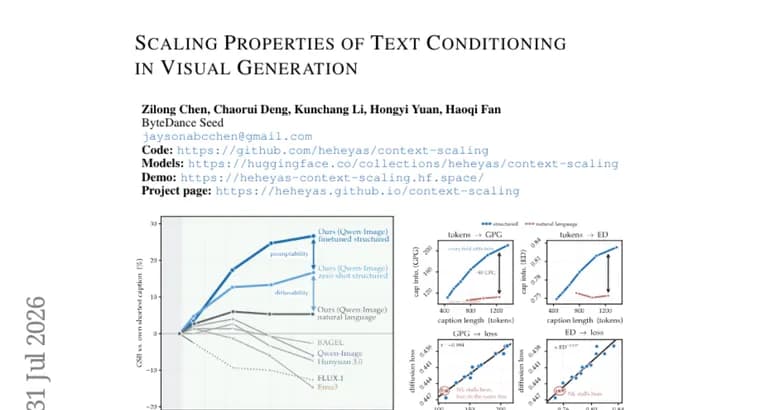
A group of researchers led by Zilong Chen and co-authors set out to measure something rarely quantified: how the quality of text conditioning in visual generation actually scales. The obvious guess, that more words in a prompt make for a better image, turns out to be wrong. Diffusion loss (the training metric that tracks how well a model has converged) does not scale with the number of tokens in a natural-language prompt at all. Instead, the authors found that converged diffusion loss scales with the amount of structured language the prompt contains. To measure that structure, they adapted two complementary metrics: a white-box likelihood measure called GPG, and a black-box attribute measure called ED. Across controlled training runs, converged diffusion loss fell approximately linearly as GPG increased, and followed a power-law relationship with ED. The team then used these scaling properties to build a working system. On the image side, they improved what they call diffusability by constructing structured prompts carrying semantic and geometric annotations derived from the images themselves, rather than relying on free-form captions. On the language side, they improved promptability by training a dedicated prompter model, using a pipeline of supervised fine-tuning, a cold-start stage, and verifier-gated on-policy distillation, so that a casual user query gets converted into the kind of structured prompt the scaling results show works best. The resulting system outperforms every open-weight model the authors evaluated on nearly every compositional, reasoning, and world-knowledge benchmark they tested, and matches or surpasses the strongest closed-weight models on most of those evaluations. The abstract does not name the specific benchmarks, the compared models, or the numeric scores behind these claims.
Key facts
- Diffusion loss for text-to-image generation does not scale with prompt token count, contrary to the intuitive assumption.
- Converged diffusion loss instead scales with the amount of structured language in the prompt, measured via two adapted metrics: GPG (white-box likelihood) and ED (black-box attribute).
- Loss falls approximately linearly with GPG and follows a power law with ED across controlled training runs.
- The team built structured prompts with semantic and geometric annotations derived from images to improve diffusability, and trained a prompter via supervised fine-tuning, cold-start, and verifier-gated on-policy distillation to improve promptability.
- The resulting system beats all evaluated open-weight models on nearly every compositional, reasoning, and world-knowledge benchmark, and matches or exceeds the strongest closed-weight models on most evaluations.
Why it matters
The finding overturns a common assumption in text-to-image work: that richer, longer prompts automatically train or guide better models. The study shows the relevant variable is structure, not length, and gives it two measurable proxies (GPG and ED) with a clean mathematical relationship to training loss. That turns prompt design from a matter of taste into something with a quantified scaling curve, which is the kind of result that tends to reshape how training data and prompting pipelines get built.
Who it affects
Teams building or fine-tuning text-to-image and text-to-video diffusion models, researchers working on prompt engineering and data curation for generative systems, and product teams building the prompt-rewriting layers that sit in front of consumer image generators.
How to use it
The paper does not ship a product; it demonstrates a method. The practical takeaway is a two-part recipe: annotate training prompts with structured semantic and geometric information derived from the images (to improve what the authors call diffusability), and train a separate prompter model, via supervised fine-tuning, a cold-start phase, and verifier-gated on-policy distillation, that rewrites casual user input into that kind of structured prompt (to improve promptability) before it reaches the generator.
How solid is it
The results come from controlled training runs comparing loss against the GPG and ED metrics, plus benchmark comparisons against open-weight and closed-weight models on compositional, reasoning, and world-knowledge tasks. The system is reported to beat all evaluated open-weight models on nearly every such benchmark and to match or surpass the strongest closed-weight models on most. The abstract text available does not name the specific benchmarks, the compared models, or any numeric scores, so those claims cannot be checked against hard numbers from this source alone.
Risks and caveats
The available text is the paper's abstract: it gives no author affiliations or institutions, no benchmark names or datasets, no numeric results, no definitions of GPG and ED beyond their one-line descriptions, no publication venue or date, and no names for the open-weight or closed-weight models used for comparison. The claims should be read as the authors' own summary of their results pending the full paper.
“the converged diffusion loss scales with the amount of structured language in the prompt”
— the paper's authors