SwanTale generates multi-speaker speech from captions or reference voices
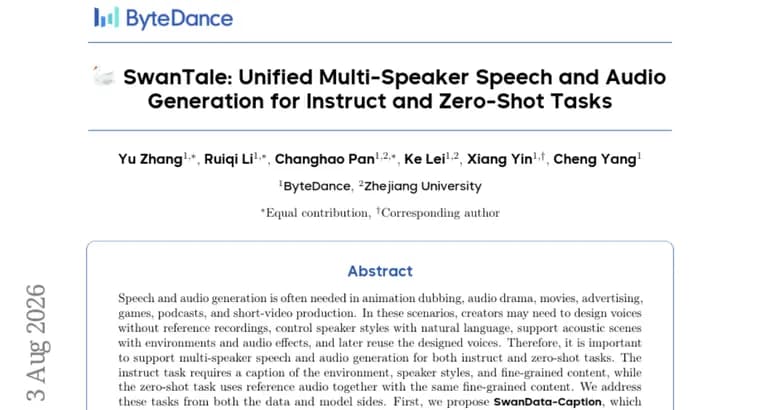
Speech and audio generation is used across animation dubbing, audio drama, movies, advertising, games, podcasts and short-video production. Creators in these fields often need to design voices without reference recordings, control speaker style with natural language, add environmental sounds and audio effects, and later reuse a voice they designed. A team of researchers argues this requires supporting two different tasks in one system: an instruct task, where a caption describes the environment, the speaker's style and the fine-grained content, and a zero-shot task, where a reference audio clip stands in for the voice while the same kind of fine-grained content description is used. The authors address this from both the data side and the model side. On the data side, they build SwanData-Caption, a pipeline that cleans raw speech and audio data, adds targeted synthetic coverage where real data is thin, and annotates the material with diverse, accurate multi-level captions. On the model side, they introduce SwanTale, a multi-speaker expressive speech and audio generation model that handles both the zero-shot and instruct tasks. SwanTale is built around SwanVAE, a component meant to support high-quality generation across multiple audio modalities. On top of that, the model uses reward-conditioned quality control, a technique called Engram conditioning, and a Unified MoE (mixture-of-experts) architecture to handle multiple tasks and audio modalities within a single network. Training proceeds through curriculum learning followed by GRPO post-training, letting the model build up its capabilities in stages rather than all at once. According to the authors' own experimental results, SwanTale leads on multiple key metrics for both the zero-shot and instruct tasks, achieves the best expressiveness scores in both, and can handle complex instruct generation involving multiple speakers combined with audio effects. The paper does not give specific benchmark numbers, dataset sizes or named baseline systems for these comparisons, does not name any authors or their institutions, and does not state a release date, license, or whether code or model weights will be made available; it only points to a demo page.
Key facts
- SwanTale is a single model that handles both zero-shot generation (cloning a voice from a reference audio clip) and instruct generation (building a voice and scene from a text caption describing environment, speaker style and content).
- A companion data pipeline, SwanData-Caption, cleans raw speech and audio data, adds targeted synthetic data where coverage is thin, and annotates material with multi-level captions.
- The model architecture combines SwanVAE for multi-audio-modality generation, reward-conditioned quality control, Engram conditioning and a Unified MoE for multi-task modeling.
- Training uses curriculum learning followed by GRPO post-training to build up the model's capabilities progressively.
- The authors report SwanTale leads on multiple key zero-shot and instruct metrics and achieves the best expressiveness scores in both tasks, but the paper gives no specific benchmark numbers, dataset sizes or named baselines for that claim.
Why it matters
Voice and audio generation for dubbing, audio drama, film, advertising, games, podcasts and short video has typically split into separate tools: ones that clone an existing voice from a reference recording, and ones that generate a voice from a text description when no reference exists. SwanTale's authors frame their contribution as unifying both needs, plus the ability to add environmental sound and reuse a previously designed voice, inside one model rather than requiring creators to switch between systems.
Who it affects
The paper targets creators and production pipelines in animation dubbing, audio drama, movies, advertising, games, podcasts and short-video content who need multi-speaker speech and audio generation, whether starting from a written description or from an existing voice sample.
How to use it
Two input modes are described: the instruct task takes a caption specifying the environment, the speaker's style and the fine-grained content to be spoken; the zero-shot task takes a reference audio clip together with the same kind of content description. Demos are posted on the project's page at swanaigc.github.io. The text does not state a release date, license terms, pricing, or whether code or model weights will be published.
How solid is it
The claims come from the authors' own experimental results: they report SwanTale leading on multiple key zero-shot and instruct metrics and achieving the best expressiveness scores in both tasks, plus support for complex multi-speaker instruct generation. No benchmark numbers, dataset sizes or named baseline systems are given in the text to back these comparisons, so the strength of the lead cannot be checked from the paper as summarized here.
Risks and caveats
The available text names no authors, no institutions, no parameter count and no training or compute cost, and gives no benchmark figures for the metrics it claims to lead on. The performance claims are self-reported by the team behind the model and are not corroborated by independent numbers in the source material.
“Experimental results show that SwanTale leads on multiple key zero-shot and instruct metrics, achieves the best expressiveness scores in both tasks, and supports complex instruct generation involving multi-speaker speech and audio.”
— the authors