Study finds in-context learning emerges across six modalities
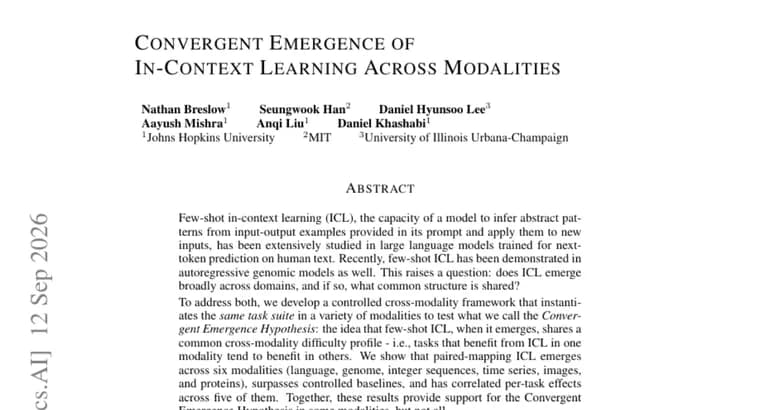
Few-shot in-context learning, the ability of a model to pick up a pattern from examples given in its prompt and apply it to new inputs, has mostly been studied in large language models trained to predict text. It has also recently been shown to emerge in autoregressive genomic models, which raised a broader question for a group of researchers: does in-context learning show up across many kinds of data, and if it does, does it follow the same underlying structure wherever it appears?
To test this, the researchers built a controlled cross-modality framework: the same suite of tasks, run in parallel across several different types of data. They call this the Convergent Emergence Hypothesis, the idea that when few-shot in-context learning emerges, the tasks that benefit from it in one modality tend to be the same tasks that benefit from it in others, meaning the underlying difficulty profile is shared rather than modality-specific.
The six modalities tested were language, genome sequences, integer sequences, time series, images and proteins. Across all six, a form of the skill called paired-mapping in-context learning emerged and beat controlled baselines. When the researchers compared which specific tasks benefited most within each modality, five of the six modalities showed correlated per-task effects, meaning the same tasks tended to be easy or hard for in-context learning regardless of the modality.
The paper does not name which one or two modalities failed to show that correlation, nor does it report accuracy numbers, effect sizes or statistical significance for any modality, and it does not describe what the controlled baselines consisted of or give an example of the shared task suite. The authors conclude that their results support the Convergent Emergence Hypothesis in some modalities, but not in all of them.
Key facts
- Researchers tested few-shot in-context learning across six modalities: language, genome, integer sequences, time series, images and proteins.
- Paired-mapping in-context learning emerged in all six modalities and beat controlled baselines.
- Five of the six modalities showed correlated per-task effects, meaning the same tasks tend to be easy or hard for in-context learning regardless of modality.
- The authors say the results support their Convergent Emergence Hypothesis in some modalities but not all.
- The paper does not report accuracy numbers, effect sizes, or say which modality broke the correlation.
Why it matters
In-context learning is central to how modern models are used, and its origin is poorly understood. This study is one of the first to test it as a cross-modality phenomenon rather than a language-specific quirk, comparing language against genome sequences, integer sequences, time series, images and proteins under the same controlled task suite. Finding that the skill emerges in all six, with a correlated difficulty pattern in five of them, suggests in-context learning may reflect a general property of how these models process structured input-output pairs, not something particular to text.
Who it affects
Directly, researchers building or studying models on non-language data, including autoregressive genomic and protein models, time-series forecasters and sequence-based image models: the framework gives them a way to check whether their models pick up patterns the same way language models do. Indirectly, anyone relying on foundation models trained on non-text data, since a shared underlying mechanism would mean techniques developed for prompting language models could transfer more broadly.
How to use it
The paper is a research contribution, not a tool or a product. The text does not mention a code, model or dataset release, and no pricing or licence terms apply. Its practical use for now is as a reference framework and hypothesis for anyone designing a few-shot evaluation on a modality outside language.
How solid is it
The claims come from the authors' own controlled framework: paired-mapping in-context learning is reported to beat controlled baselines in all six modalities, with correlated per-task effects in five of them. The available text gives no accuracy figures, effect sizes or statistical tests behind these claims, and does not name which modality broke the correlation, so the strength of the result cannot be judged from this description alone.
Risks and caveats
The text does not describe what the controlled baselines consist of, nor does it give an example of the shared task suite, both needed to judge whether the comparison across modalities is fair. It also does not identify the one or two modalities that failed to show correlated per-task effects, which limits how far the convergent emergence claim can be generalized. The authors themselves state the hypothesis holds in some modalities, but not all.