Study maps cognition-induced risks in agentic AI systems
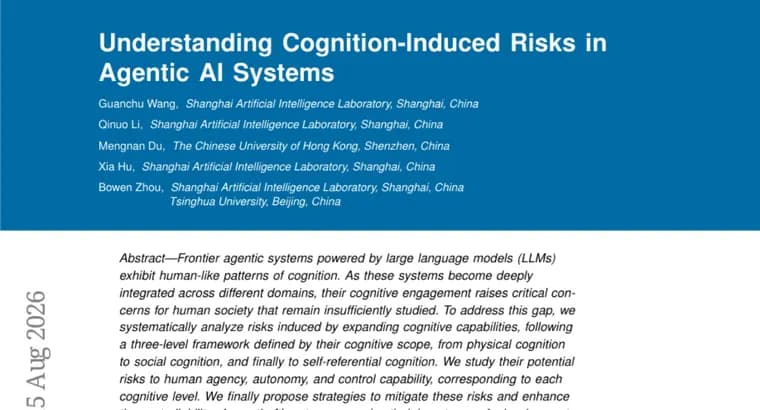
Frontier agentic systems built on large language models are starting to show human-like patterns of cognition, and as those systems get woven more deeply into different domains, the risks tied to that cognitive engagement have not been studied enough, according to the paper. The authors set out to close that gap with a systematic risk analysis.
The analysis is organized into a three-level framework defined by cognitive scope: physical cognition, social cognition, and finally self-referential cognition. For each of the three levels, the authors examine the potential risks to human agency, autonomy, and control capability that come with that level of cognitive engagement. Building on that analysis, the paper proposes strategies meant to mitigate these risks and to make agentic AI systems more controllable, with the stated aim of supporting their long-term safe development.
Key facts
- The paper argues that frontier agentic LLM systems exhibit human-like patterns of cognition, a trend the authors say raises concerns for human society that remain insufficiently studied.
- It organizes the risk analysis into a three-level framework by cognitive scope: physical cognition, social cognition, and self-referential cognition.
- For each of the three levels, the study examines potential risks to human agency, autonomy, and control capability.
- The authors propose strategies to mitigate these risks and improve the controllability of agentic AI systems, aimed at their long-term safe development.
Why it matters
As agentic AI systems, ones that plan, act, and pursue goals with an LLM at the core, get integrated more deeply across different domains, the human-like cognitive behavior they display becomes a growing concern that the authors say has not been studied enough. The paper's contribution is a systematic way to reason about that risk across a system's full cognitive range rather than treating each incident case by case.
Who it affects
The framework is aimed at people building and deploying agentic AI systems, who need a structured way to locate where cognitive risk sits in a given system, and by extension the humans whose agency, autonomy, and control the paper says are at stake as such systems act with growing independence. The available text does not name specific companies, industries, or affected groups beyond referring broadly to human society.
How to use it
The paper proposes strategies to mitigate the risks it identifies and to make agentic AI systems more controllable, but the text does not itemize what those strategies are or how to apply them, so nothing more specific can be reported here without going beyond the source.
How solid is it
The available text is the paper's abstract. It does not include experiment results, benchmarks, or numerical evidence, so the framework's real-world validation is not demonstrated in what's available; it reads as a conceptual, top-down risk framework rather than an empirical study.
Risks and caveats
The visible text carries no author names, institutions, or publication date, which limits how readers can weigh the authors' background or place the work in context. The three-tier split between physical, social, and self-referential cognition is also framework-specific terminology that the abstract does not define beyond stating the scope, so the boundaries between the levels are hard to judge from what's available.
“Frontier agentic systems powered by large language models (LLMs) exhibit human-like patterns of cognition.”
— the paper's abstract