UI-Mate-27B tops open-weight GUI agents with 77% OSWorld score
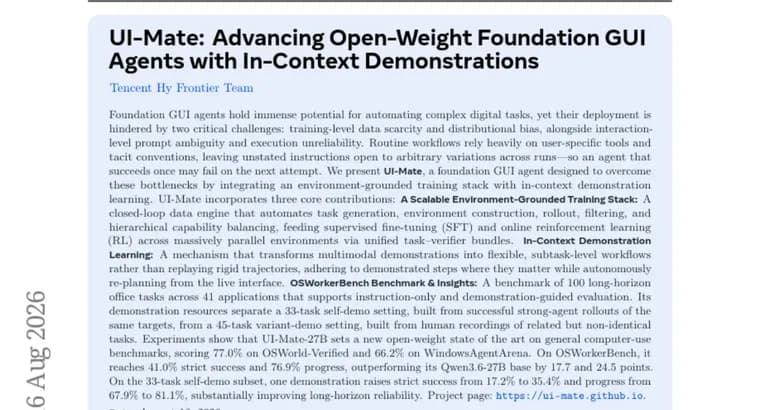
A team led by Zihan Ding presented UI-Mate, a foundation GUI agent aimed at the practical failure points of automating computer tasks: scarce and biased training data, ambiguous prompts, and unreliable execution. The paper notes that routine workflows depend on user-specific tools and tacit conventions, so instructions that leave things unstated can cause an agent's behavior to vary arbitrarily between runs. UI-Mate addresses this with three pieces. The first is a scalable environment-grounded training stack: a closed-loop data engine that automates task generation, environment construction, rollout, filtering, capability balancing, supervised fine-tuning, and online reinforcement learning across massively parallel environments, using unified task-verifier bundles. The second is in-context demonstration learning, a mechanism that turns multimodal demonstrations into flexible, subtask-level workflows, follows the relevant demonstrated steps, and re-plans against the live interface as it goes. The third is a new benchmark, OSWorkerBench, covering 100 long-horizon office tasks across 41 applications, built to support both instruction-only and demonstration-guided evaluation.
On general computer-use benchmarks, UI-Mate-27B scores 77.0% on OSWorld-Verified and 66.2% on WindowsAgentArena, which the authors describe as a new open-weight state of the art. On OSWorkerBench itself it reaches 41.0% strict success and 76.9% progress, beating its Qwen3.6-27B base model by 17.7 points on strict success and 24.5 points on progress.
OSWorkerBench's demonstration data is split into two settings: a 33-task self-demo setting built from successful rollouts of strong agents on the same target tasks, and a 45-task variant-demo setting built from human recordings of related but non-identical tasks. On the 33-task self-demo subset, giving UI-Mate a single demonstration raises strict success from 17.2% to 35.4% and progress from 67.9% to 81.1%, which the authors say substantially improves reliability on long, multi-step jobs. Further details are hosted on the project page at ui-mate.github.io; the source text does not state a release date, the authors' institutional affiliation, or any licensing or code-release terms beyond that link.
Key facts
- UI-Mate is an open-weight foundation GUI agent combining an environment-grounded training stack with in-context demonstration learning.
- UI-Mate-27B scores 77.0% on OSWorld-Verified and 66.2% on WindowsAgentArena, described as a new open-weight state of the art on general computer-use benchmarks.
- On the new OSWorkerBench benchmark (100 long-horizon office tasks across 41 applications), it reaches 41.0% strict success and 76.9% progress, beating its Qwen3.6-27B base by 17.7 and 24.5 points respectively.
- On OSWorkerBench's 33-task self-demo subset, a single demonstration lifts strict success from 17.2% to 35.4% and progress from 67.9% to 81.1%.
- OSWorkerBench separates a 33-task self-demo setting built from strong-agent rollouts from a 45-task variant-demo setting built from human recordings of related but non-identical tasks.
Why it matters
GUI agents that automate desktop and office work keep failing for mundane reasons: too little (and skewed) training data, prompts that leave real steps unstated, and execution that drifts between runs because routine work leans on tacit, user-specific conventions. UI-Mate targets exactly that gap by combining a closed-loop, environment-grounded training pipeline with in-context demonstration learning, a mechanism that lets the agent take a multimodal demonstration, break it into flexible subtask-level steps, follow the relevant ones, and re-plan against whatever the live interface actually shows. The result, on the authors' own numbers, is the strongest open-weight computer-use agent reported so far on OSWorld-Verified and WindowsAgentArena.
Who it affects
Anyone building or evaluating GUI and computer-use agents on open weights: researchers comparing against an open baseline, and teams weighing an open-weight agent against closed alternatives for automating office-style, multi-application tasks. The source text does not name an institution or lab affiliation for the authors.
How to use it
The paper points to a project page, ui-mate.github.io, for further material, and describes UI-Mate as open-weight. The source text gives no pricing, license terms, or code-release details beyond that link, so anyone wanting to run it will need to check the project page directly.
How solid is it
All figures come from the authors' own paper: OSWorld-Verified and WindowsAgentArena scores for UI-Mate-27B, plus OSWorkerBench results measured against its own Qwen3.6-27B base model rather than against third-party or closed-weight systems. The claim of a new state of the art is scoped explicitly to open-weight agents, not to computer-use agents overall.
Risks and caveats
The source makes no comparison to closed-weight, proprietary agents, only to open-weight ones, so where UI-Mate stands against closed frontier agents on the market is unstated. No inference-time cost or latency figures are given for the in-context demonstration mechanism, and the large jump from demonstrations (for example 17.2% to 35.4% strict success) is measured only on the 33-task self-demo subset, built from the same agent family's own successful rollouts rather than independent tasks.