SwarmEvolve uses latent-space agent swarms to speed up program search
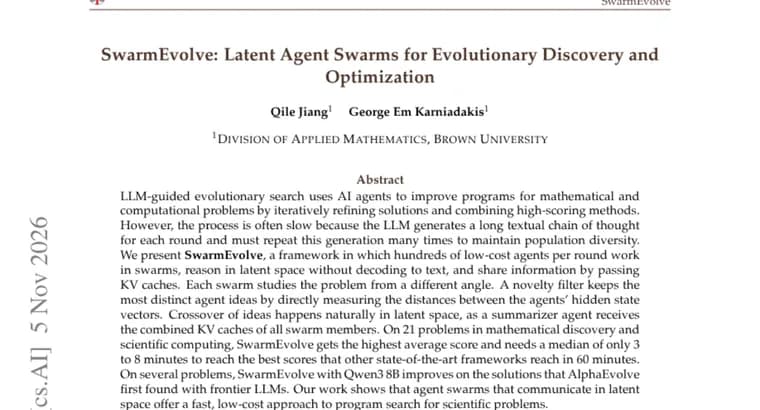
LLM-guided evolutionary search uses AI agents to improve programs for mathematical and computational problems. The agents refine solutions over many rounds and combine the high-scoring methods. The paper says the process is often slow: the LLM writes a long textual chain of thought for each round, and has to repeat that many times to keep the population of candidate programs diverse.
SwarmEvolve is the authors' answer. In it, hundreds of low-cost agents per round work in swarms. They reason in latent space, meaning they do not decode their thinking into text, and they share information by passing KV caches. Each swarm studies the problem from a different angle.
Two mechanisms replace the text-heavy steps. A novelty filter keeps the most distinct agent ideas by directly measuring the distances between the agents' hidden state vectors. Crossover, the combining of ideas, happens in latent space: a summarizer agent receives the combined KV caches of all swarm members.
The results come from 21 problems in mathematical discovery and scientific computing. According to the abstract, SwarmEvolve gets the highest average score, and it needs a median of only 3 to 8 minutes to reach the best scores that other state-of-the-art frameworks reach in 60 minutes. On several problems, SwarmEvolve running with Qwen3 8B improves on the solutions that AlphaEvolve first found with frontier LLMs. The authors conclude that agent swarms communicating in latent space offer a fast, low-cost approach to program search for scientific problems.
Key facts
- SwarmEvolve runs hundreds of low-cost agents per round in swarms that reason in latent space and pass KV caches instead of decoding to text.
- A novelty filter keeps the most distinct ideas by measuring distances between agents' hidden state vectors; a summarizer agent receiving all members' combined KV caches does the crossover.
- On 21 problems in mathematical discovery and scientific computing, it gets the highest average score.
- It needs a median of 3 to 8 minutes to reach the best scores that other state-of-the-art frameworks reach in 60 minutes.
- On several problems, SwarmEvolve with Qwen3 8B improves on solutions AlphaEvolve first found with frontier LLMs.
Why it matters
LLM-guided evolutionary search, the approach behind systems such as AlphaEvolve, is slow because each round needs a long written chain of thought, repeated many times to keep candidates diverse. SwarmEvolve attacks that cost directly by moving the reasoning and the exchange of ideas into latent space. The headline claim is speed: a median of 3 to 8 minutes to match what other state-of-the-art frameworks reach in 60 minutes. A second claim is that a small model, Qwen3 8B, can improve on some solutions that AlphaEvolve first found with frontier LLMs.
Who it affects
The work targets people who use LLM-guided program search for mathematical discovery and scientific computing problems, and researchers building multi-agent systems that need agents to share information cheaply. It also speaks to anyone weighing whether small models can stand in for frontier LLMs in this kind of search.
How to use it
The abstract describes a framework and its results but does not mention a code release or availability. In practice, the useful takeaways for builders are the design ideas: run many cheap agents in parallel swarms, pass KV caches rather than text between them, filter for novelty using distances between hidden states, and let a summarizer agent handle crossover.
How solid is it
Every figure here comes from the paper's abstract, written by the authors themselves, so these are self-reported results. The abstract does not name the competing state-of-the-art frameworks, list the 21 problems, or give the average score or the margin over rivals. It says SwarmEvolve improves on AlphaEvolve's solutions on "several" problems, without a count or the size of the gains. It also does not say whether the 3 to 8 minute median is wall-clock time on specific hardware.
Risks and caveats
"Low-cost" is not backed by cost figures in the abstract: no dollars, tokens or GPU hours are given. The improvement over AlphaEvolve applies to several problems, not all 21, and the abstract does not say which frontier LLMs AlphaEvolve used. The speed claim is a median across problems, so individual problems may differ. Independent replication would be needed to confirm the comparison.
“Our work shows that agent swarms that communicate in latent space offer a fast, low-cost approach to program search for scientific problems.”
— SwarmEvolve paper abstract