TabFM paper claims zero-shot tabular model beats tuned AutoML
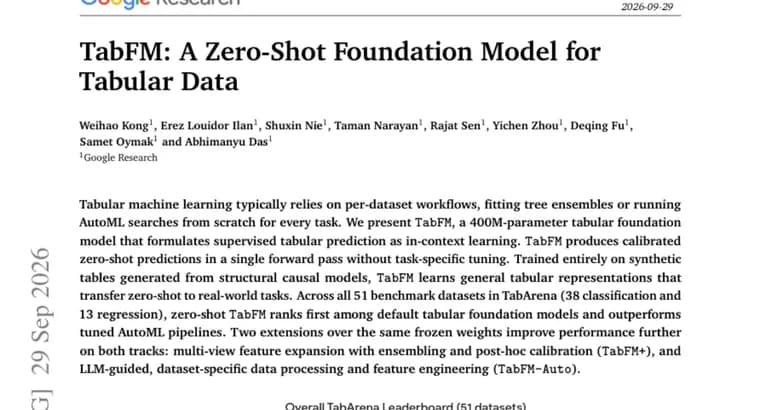
Tabular machine learning usually means a separate workflow for every dataset: fitting tree ensembles or running an AutoML search from scratch for each task. A new paper presents TabFM, a 400M-parameter tabular foundation model that tries to replace that routine.
TabFM formulates supervised tabular prediction as in-context learning. Instead of being tuned per task, it produces calibrated zero-shot predictions in a single forward pass, with no task-specific tuning. The model is trained entirely on synthetic tables generated from structural causal models. The authors say this teaches it general tabular representations that transfer zero-shot to real-world tasks.
The evaluation uses TabArena, a benchmark of 51 datasets: 38 classification and 13 regression. Across all 51, the authors report that zero-shot TabFM ranks first among default tabular foundation models and outperforms tuned AutoML pipelines.
The paper also describes two extensions that keep the same frozen weights and, according to the authors, improve performance further on both tracks. TabFM+ adds multi-view feature expansion with ensembling and post-hoc calibration. TabFM-Auto adds LLM-guided, dataset-specific data processing and feature engineering.
Key facts
- TabFM is a 400M-parameter tabular foundation model that treats supervised tabular prediction as in-context learning.
- It gives calibrated zero-shot predictions in a single forward pass, without task-specific tuning.
- It is trained entirely on synthetic tables generated from structural causal models.
- On all 51 TabArena datasets (38 classification, 13 regression), the authors report it ranks first among default tabular foundation models and outperforms tuned AutoML pipelines.
- Two extensions on the same frozen weights, TabFM+ (multi-view feature expansion, ensembling, post-hoc calibration) and TabFM-Auto (LLM-guided data processing and feature engineering), improve results further.
Why it matters
Tabular data is the everyday format of business machine learning, and the usual approach is to fit tree ensembles or run an AutoML search anew for every task. TabFM is presented as a different route: one pretrained model that reads the training rows as context and predicts in a single forward pass. The authors' headline claim is that this zero-shot approach beats tuned AutoML pipelines across the whole TabArena benchmark. Training on synthetic tables alone, with no real datasets, is the other notable design choice.
Who it affects
Practitioners who build predictive models on tables, from classification to regression, and teams that currently depend on per-dataset tuning or AutoML searches. It also concerns researchers working on tabular foundation models, since TabFM is compared against other default tabular foundation models.
How to use it
According to the authors, TabFM needs no task-specific tuning: the task is framed as in-context learning and predictions come from a single forward pass. For more accuracy they describe TabFM+ (multi-view feature expansion with ensembling and post-hoc calibration) and TabFM-Auto (LLM-guided, dataset-specific data processing and feature engineering), both built on the same frozen weights. The abstract does not say whether weights or code are released.
How solid is it
This is a paper abstract, and the results are the authors' own claims. The benchmark, TabArena with 51 datasets, is broad, and the claim covers all of them. But the abstract names no authors or institutions, gives no numeric scores, rank values or margins over AutoML pipelines or other foundation models, and does not name which systems were compared against. The gains of TabFM+ and TabFM-Auto are not quantified either.
Risks and caveats
Without scores or named baselines, the size of the advantage cannot be judged from the abstract. It gives no training cost, compute, inference latency, or limits on table size. The claim is that TabFM ranks first among default tabular foundation models and beats tuned AutoML; it is not a claim of superiority in every setting. Independent replication would be needed to confirm how well synthetic pretraining transfers beyond this benchmark.
“TabFM produces calibrated zero-shot predictions in a single forward pass without task-specific tuning.”
— TabFM paper abstract