TailSteer trains image editors to resist drift over 15-20 edits
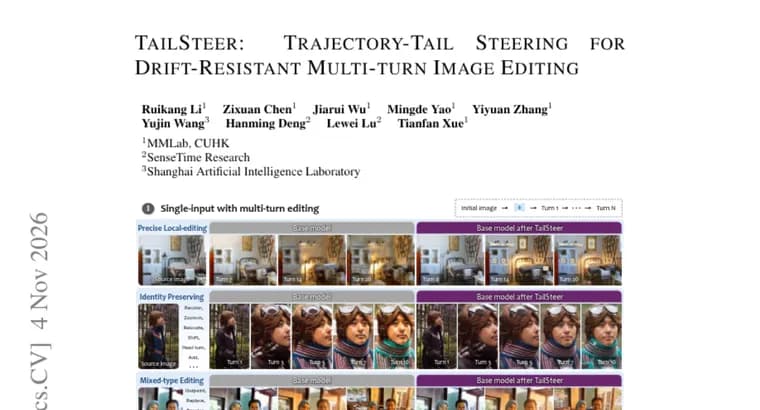
A paper on Hugging Face introduces TailSteer, a final-stage training framework for image-editing foundation models. It targets a specific failure: a model can edit well in a single turn and still fall apart in a long session. When edited outputs are fed back in again and again, the authors say, small unintended changes can accumulate into severe visual drift.
The paper describes the usual fixes and their costs. Drift is often tackled by training on multi-turn data or cross-turn rollouts, which can alter the model's pretrained priors. The other route is specialized inference-time mechanisms, which the authors describe as difficult to scale to foundation models.
TailSteer takes a different path. It is applied after earlier training is done and aims to improve multi-turn robustness while keeping the generative and editing abilities the model already has. The principle is to keep early denoising dynamics close to those of the base model and to concentrate preservation corrections near the trajectory tail, where fine-grained deviations can be suppressed.
The corrections are learned from the editor's own on-policy denoising rollouts. Unchanged source content serves as the preservation reference, so no curated ground-truth editing pairs are needed.
The authors report experiments across the FLUX, SenseNova and Qwen families. According to them, TailSteer substantially reduces cumulative drift over 15-20 editing turns while largely preserving base-model performance on extensive text-to-image and single-image editing benchmarks. They conclude that long-horizon editing robustness can be unlocked in foundation models after TailSteer, rather than by relearning their existing capabilities.
Key facts
- TailSteer is a final-stage training framework meant to cut cumulative visual drift when an image editor's outputs are reused over many turns.
- The core idea: keep early denoising dynamics close to the base model and concentrate preservation corrections near the trajectory tail.
- Corrections are learned from the editor's own on-policy denoising rollouts, with unchanged source content as the reference, and no curated ground-truth editing pairs.
- The authors report substantially reduced drift over 15-20 editing turns on the FLUX, SenseNova and Qwen families.
- Base-model performance on text-to-image and single-image editing benchmarks is described as largely preserved.
Why it matters
Single-turn editing quality is what most benchmarks measure, but real editing is iterative: users keep refining the same image. The paper's point is that strong single-turn results do not guarantee reliable multi-turn behavior, because small unintended changes pile up into severe drift. TailSteer is pitched as a way to fix this without the costs of existing approaches, which the authors say can alter pretrained priors (multi-turn training) or are hard to scale to foundation models (inference-time mechanisms).
Who it affects
Teams that train or fine-tune image-editing foundation models are the direct audience, since TailSteer is a final-stage training step. The families tested are FLUX, SenseNova and Qwen. People who edit an image through many successive prompts are the ones who would feel the difference, if the method holds up.
How to use it
The abstract describes a recipe rather than a product. After a model has finished its earlier training, TailSteer adds a final stage. It learns preservation corrections from the editor's own on-policy denoising rollouts, using unchanged source content as the reference, so no curated editing pairs are required. Concentrate those corrections near the trajectory tail and keep early denoising close to the base model.
How solid is it
The claims come from the paper's own abstract, as listed on Hugging Face. The authors report substantial drift reduction over 15-20 editing turns across three model families, and largely preserved base-model performance on text-to-image and single-image editing benchmarks. No figures for drift or benchmark scores are given in the text, so "substantially" and "largely" are unquantified. The benchmarks and drift metrics are not named, and no author names or institutions are given.
Risks and caveats
"Largely preserving" base performance means some loss is not ruled out. The text states no limitations or failure cases. It does not name the specific model versions or sizes tested, and it mentions no release of code, weights or data. The 15-20 turn range is the horizon reported; behavior beyond it is not described.