The Biological Computing Company's rat-brain AI reaches AWS customers
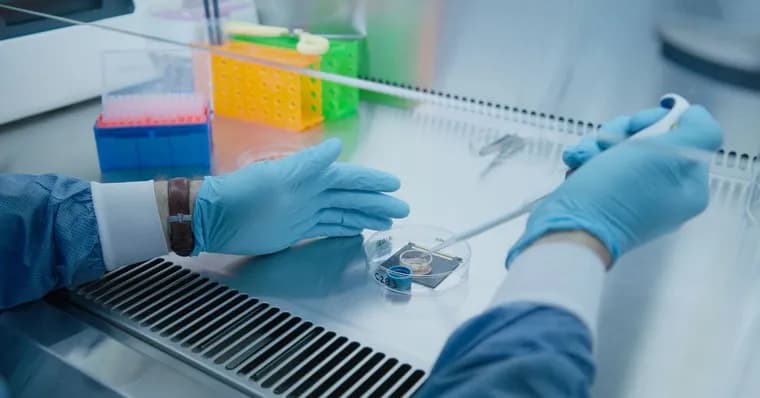
The Biological Computing Company, known as TBC, builds AI models by recording how living neurons process information and translating those patterns into software. Starting Tuesday, select AWS customers get access to TBC's model in a limited preview, and Amazon and TBC both say they expect it to reach all AWS enterprise customers soon. TBC was founded four years ago in Baltimore, Maryland by two neuroscientists and neurosurgeons: Alexander Ksendzovsky, now CEO, and Jon Pomeraniec, president and COO. The company raised $25 million earlier this year, led by Primary Venture Partners, its first significant round; shortly after that round closed in March, it secured another $25 million, bringing total funding to more than $50 million, a second round not previously reported. TBC has about 35 employees and opened a San Francisco office and small research lab last year, where staff work with rat brain cells and human stem cells placed on multi-electrode silicon arrays made by the Swiss biotech firm 3Brain. Researchers send electrical stimulation patterns into the neurons, record the response, and analyze it for computational patterns that can be built into software. TBC chose to focus first on video rather than text or other AI tasks partly because of the physical layout of its silicon arrays, which maps visual information onto the grid more naturally, and partly on the advice of Jeff Dean, a prominent AI researcher and TBC investor. Pomeraniec says Dean suggested fine-tuning video-generation models first because established industry benchmarks would let TBC prove a real scientific advance on problems that are already solved, before attempting broader applications. TBC claims its model is up to five times faster at video generation than the open-source model it runs on and significantly lowers inference cost, though the company will not name that comparison model beyond calling it one of the "frontier" video-generation models. TBC's technology was previously available only through a neocloud provider called Bluesky Compute. Deap Ubhi, Amazon Web Services' global director of technology for startups, says TBC is not the first biological computing platform AWS has carried in its marketplace: it also works with the Australia-based Cortical Labs, which combines lab-grown neurons with silicon chips and sells access as "wetware as a service," along with a multi-thousand-dollar biological computer that can supposedly keep neurons alive for six months. Ubhi says TBC appealed to Amazon because of its pragmatic approach: rather than trying to reinvent the transformer architecture behind large language models, the startup works within existing generative AI standards to make current video models more efficient. He also flags an open question about scaling: whether TBC's gains hold up as customers push toward longer videos, ten minutes or an hour, without losing fidelity over time. The article was updated on September 22, 2026 to clarify that not all of TBC's employees work directly with biological cells in the San Francisco lab.
Key facts
- TBC's rat-brain-cell AI model enters limited preview for select AWS customers starting Tuesday, with Amazon and TBC expecting a wider enterprise rollout soon.
- TBC has raised more than $50 million total: a first $25 million round led by Primary Venture Partners earlier this year, then an additional, previously unreported $25 million shortly after it closed in March.
- TBC records neural activity from rat brain cells and human stem cells on 3Brain silicon arrays, then turns the patterns into software that TBC claims makes video generation up to five times faster than the unnamed open-source model it benchmarks against.
- AWS's Deap Ubhi says TBC is not the only biological computing platform in Amazon's marketplace; Australia's Cortical Labs sells lab-grown-neuron hardware as a "wetware as a service."
- AI researcher and TBC investor Jeff Dean reportedly pushed the startup to prove itself on video generation first, since established benchmarks let it show a measurable advance before attempting broader uses.
Why it matters
This is one of the first times a biological computing startup has moved past lab demonstrations into a real cloud distribution deal with a major provider. Amazon's willingness to carry TBC's model, alongside Cortical Labs, signals that treating living neurons as a computing substrate is being taken seriously as one route to cheaper, faster AI inference at a moment when the industry is hunting for efficiency gains beyond simply scaling up transformer models.
Who it affects
AWS enterprise customers who generate video through the platform are the immediate audience, since they gain access to a claimed cheaper, faster inference option. It also affects TBC's investors, including Jeff Dean, and positions TBC against Cortical Labs in the small biological computing field. Bluesky Compute, the neocloud provider that previously offered exclusive access to TBC's technology, loses that exclusivity.
How to use it
Access runs through AWS's own marketplace as a limited preview for select customers starting Tuesday, with a wider enterprise rollout described only as coming "soon." No pricing, tiers or contract terms are given in the source, and none should be assumed.
How solid is it
The funding and the Amazon partnership are concrete and confirmed on the record by both TBC and a named AWS director, Deap Ubhi. The performance claim is less settled: the "up to five times faster" figure and the lower inference cost come from TBC itself, measured against an open-source model the company declines to name, so there is no independent benchmark to check it against. Even Ubhi, while positive about the partnership, raises an open question about whether the gains hold up at longer video lengths.
Risks and caveats
TBC withholds the identity of the model it compares itself to, which makes its speed and cost claims impossible to verify independently. No results are given yet for longer-form video, the exact scenario Ubhi says is the real test. Biological computing as a field also carries operational risk beyond any one company: it requires running working biology labs to keep brain cells, stem cells or synthetic biomaterials alive and monitored, and translating their activity into reliable digital signals remains difficult industry-wide.
“I think with any model like this, the one thing you have to ask is, if you push it to the extremes, will you still see improvements? If you have customers who want to generate longer-form videos, ten minutes, an hour, what's the potential loss in fidelity over the course of time?”
— Deap Ubhi, global director of technology for startups at Amazon Web Services