ThoughtDAG turns LLM chat history into an editable context graph
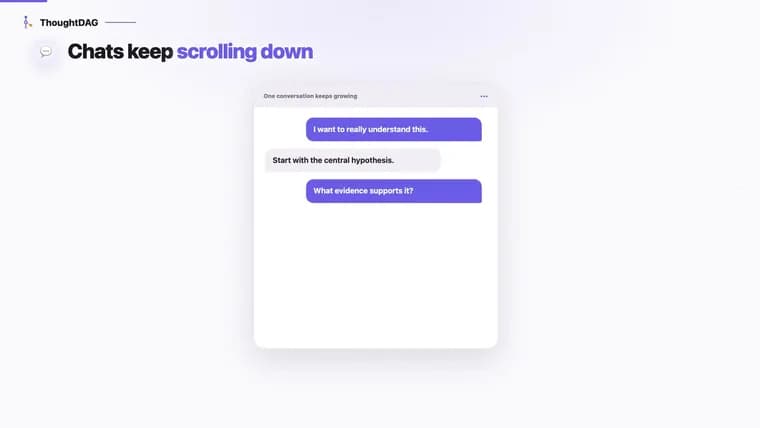
ThoughtDAG, posted to Hacker News as a Show HN project, presents LLM conversations as an editable graph rather than a linear chat log. Instead of continuing a single thread, a user can branch off to explore another interpretation of a result without overwriting the path that led there, so multiple lines of reasoning can coexist as separate paths through the same history.
Before a request goes out, the tool previews exactly which parts of the history will be sent as context, listed as the request's 'incoming ancestors'. In the product's own walkthrough, a research question is tracked alongside a piece of evidence and, because of an earlier detour, an unrelated node about what to eat for dinner. Because that dinner branch was still wired into the graph, asking for a research summary produced an answer that also suggested hot pot for dinner, even though the prompt text itself was unchanged. Deleting the edge connecting the dinner branch to the research context removed the unrelated suggestion and updated the answer in place; the demo logs this single edit as a reduction of 47 tokens sent to the model.
The core claim is transparency: the product description states there is no hidden memory selector, and that what the model sees, why it sees it, and what was removed all stay visible in the graph. A companion example in the demo keeps a three-step, three-reviewer answer (record the database version, use independent reviewers, resolve conflicts with a third reviewer) unchanged when the prompt and the wired context are unchanged, with the line 'the words are identical, only one edge changed' used to argue that outputs track the graph's edges, not just the prompt text.
Key facts
- ThoughtDAG models an LLM conversation as an editable, branching graph instead of a linear chat thread.
- Before sending a request, the interface previews the 'incoming ancestors': the exact history nodes that will enter that request's context.
- In the product's demo, an unrelated 'dinner detour' branch stayed wired into a research context and caused the model's summary to also suggest hot pot for dinner.
- Deleting the edge connecting the dinner detour removed the unrelated suggestion, updated the answer in place, and cut the context sent to the model by 47 tokens in that example.
- The product description states there is no hidden memory selector: what the model sees, why, and what was removed remain visible in the graph.
Why it matters
Long, branching LLM sessions accumulate tangents that can silently ride along into later prompts, and most chat interfaces give no way to see or prune that accumulated context before it is sent. ThoughtDAG's pitch is to make that context visible and editable as a graph rather than leaving it implicit in a linear transcript, so that context pollution, an off-topic branch leaking into an unrelated answer, becomes something a user can see and fix by deleting one edge rather than starting a new conversation.
Who it affects
Anyone working with an LLM across a long, branching session where earlier detours can leak into later prompts. The tool is presented as a Show HN project aimed at people who use LLM chat interfaces and want visibility and control over exactly what enters each request, rather than trusting an opaque history mechanism.
How to use it
The product's own walkthrough is the available instructions: branch off from a point in the history to explore an alternate interpretation without overwriting the original path, use the preview to see which ancestor nodes would be sent with the next request, and delete an edge to drop unwanted context, after which the answer updates in place. The source does not state pricing, licensing, or which LLM providers or APIs the tool connects to.
How solid is it
The evidence for these claims is the product's own demo walkthrough on its Show HN page, not an independent benchmark or third-party review; the 47-token reduction is a single illustrative example from that demo, not a general measurement of typical savings. The submission had drawn 11 points and one comment on Hacker News at the time it was captured, so there is little outside discussion yet to weigh the claims against.
Risks and caveats
The source gives no information on who built ThoughtDAG, when it was released, its pricing or licensing, which LLM providers or APIs it integrates with, or how the underlying graph is implemented; it also offers no user numbers or comparison to other tools. All of the described behavior comes from the project's own demo copy rather than independent testing.
“No hidden memory selector. What the model sees, why, and what was removed stay visible in the graph.”
— ThoughtDAG product description