Trajectory2Gym trains tool-use agents on grounded decisions, lifting Tau1, Tau2 and BFCL
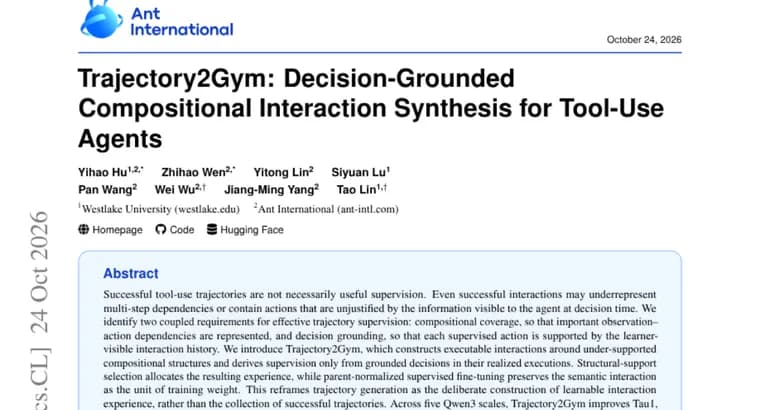
A paper on Hugging Face Papers, titled Trajectory2Gym, starts from a simple claim: successful tool-use trajectories are not necessarily useful supervision. Even a successful interaction may underrepresent multi-step dependencies, or contain actions that the information visible to the agent at decision time does not justify.
The authors name two coupled requirements for effective trajectory supervision. The first is compositional coverage, so that important observation-action dependencies are represented. The second is decision grounding, so that each supervised action is supported by the interaction history the learner can see.
Trajectory2Gym is built around both. It constructs executable interactions around compositional structures that are under-supported in the data, and it derives supervision only from grounded decisions in their realized executions. Two further pieces complete the recipe: structural-support selection allocates the resulting experience, and parent-normalized supervised fine-tuning keeps the semantic interaction as the unit of training weight. The authors present this as a reframing: trajectory generation becomes the deliberate construction of learnable interaction experience, rather than the collection of successful trajectories.
On results, the authors report that across five Qwen3 scales, Trajectory2Gym improves Tau1, Tau2 and BFCL at every tested scale. The equal-weight mean of the three benchmarks rises by 16.9 to 29.8 percentage points, depending on scale. The gains are strongest in stateful and multi-turn interaction, where later decisions depend on earlier observations and feedback.
Their conclusion is stated with some restraint: the results suggest that scaling tool-use agents depends not only on collecting more successful trajectories, but on constructing interactions whose dependencies are represented and whose decisions are learnable from the agent's visible history.
Key facts
- The paper argues that successful tool-use trajectories are not necessarily useful supervision, since they can miss multi-step dependencies or include actions the agent could not justify from what it saw.
- Trajectory2Gym builds executable interactions around under-supported compositional structures and takes supervision only from grounded decisions in their realized executions.
- Training uses structural-support selection and parent-normalized supervised fine-tuning, which keeps the semantic interaction as the unit of training weight.
- Across five Qwen3 scales, the method improves Tau1, Tau2 and BFCL at every tested scale, raising the equal-weight three-benchmark mean by 16.9-29.8 percentage points.
- Gains are strongest in stateful and multi-turn interaction, where later decisions depend on earlier observations and feedback.
Why it matters
Much agent training data is collected by keeping trajectories that succeeded. This paper challenges that habit: a trajectory that reaches the goal may still teach little, either because it skips multi-step dependencies or because its actions rest on information the agent did not have. The authors recast trajectory generation as constructing learnable interaction experience, which shifts the question from how many successful runs you have to what each run actually teaches.
Who it affects
Teams that build training data for tool-use and function-calling agents are the direct audience, since the method concerns how to generate and weight that data. The evaluation covers Tau1, Tau2 and BFCL on five Qwen3 scales, so the findings speak most directly to people fine-tuning open models for multi-turn, stateful tool use.
How to use it
The source describes the method at the level of its components, not as a recipe to run. The pieces are: pick compositional structures that are under-supported, construct executable interactions around them, keep supervision only from decisions grounded in the learner-visible history, allocate experience by structural-support selection, and train with parent-normalized supervised fine-tuning. The source mentions no code or dataset release.
How solid is it
The headline number is the authors' own report: an improvement of 16.9-29.8 percentage points in the equal-weight mean of three benchmarks, with gains at every one of five Qwen3 scales. That is a consistent pattern across scales. The source gives no absolute benchmark scores or baseline values, only the range of gains, so the starting point of those gains cannot be judged from it. It also names no comparison against other trajectory-generation or data-synthesis methods. The authors themselves say the results suggest, not prove, their broader conclusion about scaling tool-use agents.
Risks and caveats
The gain is reported as a mean over three benchmarks, so it can hide differences between them. The source does not break results down by benchmark or say which scale gained least or most. The specific Qwen3 model sizes are not listed. The strongest gains are in stateful and multi-turn settings, so the benefit may be smaller elsewhere. The source does not state compute cost. This is a single paper's report and the source text offers no independent replication.
“Successful tool-use trajectories are not necessarily useful supervision.”
— Trajectory2Gym paper abstract