Tree-Ising repairs Qwen3.5 reasoning loops with bit-level Ising edits
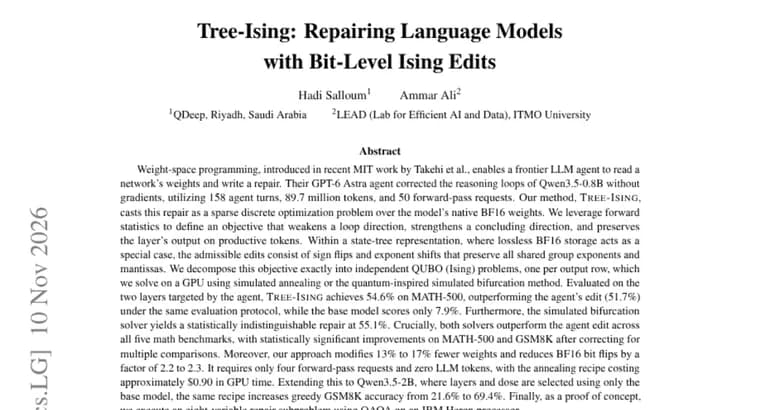
A paper on Hugging Face presents Tree-Ising, a way to repair a language model's reasoning loops by editing its own weights with a discrete optimizer instead of an LLM agent. It is positioned against weight-space programming, introduced in recent MIT work by Takehi et al., in which a frontier LLM agent reads a network's weights and writes a repair. As the Tree-Ising authors describe it, that agent, GPT-6 Astra, corrected the reasoning loops of Qwen3.5-0.8B without gradients, using 158 agent turns, 89.7 million tokens and 50 forward-pass requests.
Tree-Ising casts the same repair as a sparse discrete optimization problem over the model's BF16 weights. Forward statistics define an objective with three parts: it weakens a loop direction, strengthens a concluding direction, and preserves the layer's output on productive tokens. Within a state-tree representation, in which lossless BF16 storage is a special case, the allowed edits are sign flips and exponent shifts that keep all shared group exponents and mantissas unchanged. The objective decomposes exactly into independent QUBO (Ising) problems, one per output row. The authors solve them on a GPU with either simulated annealing or quantum-inspired simulated bifurcation.
On the agent's two layers, Tree-Ising reaches 54.6% on MATH-500, against 51.7% for the agent's edit under the same evaluation protocol. The base model scores 7.9%, a figure the paper gives as reported. The simulated bifurcation solver gives a repair the authors call statistically indistinguishable, at 55.1%. Both solvers beat the agent edit across all five math benchmarks, with statistically significant improvements on MATH-500 and GSM8K after correcting for multiple comparisons.
The method is also much cheaper in the resources the paper counts. It modifies 13% to 17% fewer weights than the agent's edit and reduces BF16 bit flips by a factor of 2.2 to 2.3. It needs only four forward-pass requests and zero LLM tokens, and the annealing recipe costs about $0.90 in GPU time.
The authors also test transfer to a larger model. On Qwen3.5-2B, with layers and dose selected using only the base model, the same recipe raises greedy GSM8K accuracy from 21.6% to 69.4%. As a proof of concept, they run an eight-variable repair subproblem using QAOA on an IBM Heron processor.
Key facts
- Tree-Ising frames repair of reasoning loops as per-row QUBO (Ising) problems over BF16 sign flips and exponent shifts, solved on a GPU with simulated annealing or simulated bifurcation.
- On the agent's two layers of Qwen3.5-0.8B it scores 54.6% on MATH-500 versus 51.7% for the GPT-6 Astra agent's edit; the base model scores 7.9% as reported.
- It uses four forward-pass requests and zero LLM tokens, against 158 agent turns, 89.7 million tokens and 50 forward-pass requests for the agent; the annealing recipe costs about $0.90 in GPU time.
- It modifies 13% to 17% fewer weights and cuts BF16 bit flips by a factor of 2.2 to 2.3.
- On Qwen3.5-2B the same recipe lifts greedy GSM8K accuracy from 21.6% to 69.4%; an eight-variable subproblem was also run with QAOA on an IBM Heron processor.
Why it matters
Weight-space programming showed that a frontier LLM agent can read a small model's weights and write a fix for its reasoning loops. Tree-Ising asks whether that expensive step is needed. Its answer, on the paper's numbers, is that a discrete optimizer can match or beat the agent's repair with no LLM tokens and a GPU bill of about $0.90 for the annealing recipe. The comparison is concrete: 158 agent turns and 89.7 million tokens on one side, four forward-pass requests on the other.
Who it affects
Researchers working on model editing, weight-level repair and reasoning-loop failures in small models, who now have a gradient-free, token-free baseline to compare against the agent approach. It also touches people following optimization hardware, since the paper expresses the problem as QUBO and runs one small instance on an IBM Heron quantum processor.
How to use it
The abstract describes the recipe rather than a package. Collect forward statistics from the model, build the objective that weakens a loop direction, strengthens a concluding direction and preserves productive-token output, and restrict edits to BF16 sign flips and exponent shifts. Split the problem into one QUBO per output row and solve each on a GPU with simulated annealing or quantum-inspired simulated bifurcation. For the Qwen3.5-2B result, layers and dose were chosen using only the base model. The annealing version is quoted at about $0.90 in GPU time.
How solid is it
The evidence is the authors' own benchmark results. On MATH-500 the gap is 54.6% against 51.7%, which is 2.9 percentage points, and the 7.9% base score is given as reported. The authors state that both solvers beat the agent edit across all five math benchmarks, with statistically significant gains on MATH-500 and GSM8K after multiple-comparison correction. The details of the agent's repair come from the Tree-Ising authors' description of the MIT work, not from that work itself.
Risks and caveats
The headline comparison is on the agent's two layers of Qwen3.5-0.8B, a very small model, and the larger Qwen3.5-2B result is a before-and-after measurement on greedy GSM8K rather than a comparison with the agent. The abstract does not name the five benchmarks beyond MATH-500 and GSM8K or give the agent's scores on the other four. It does not state the QAOA result, only that an eight-variable subproblem was executed, and it gives no cost for the simulated bifurcation solver or for the agent's repair.