U-Space maps token-level uncertainty in language models without training
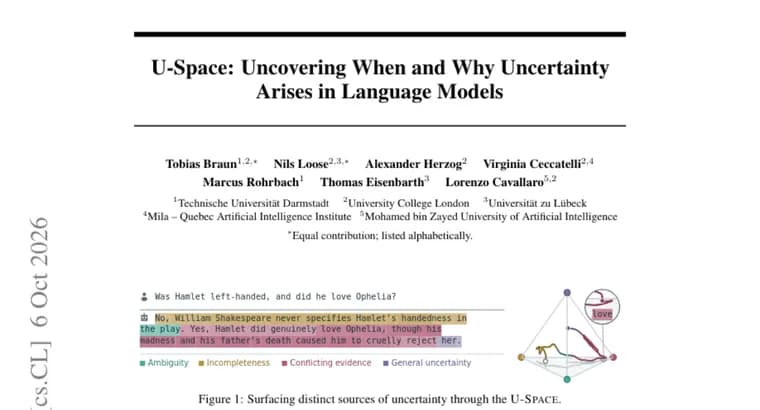
A research paper introduces the U-Space, a low-dimensional subspace of a language model's residual space built to make the model's evolving uncertainty measurable and interpretable. It is paired with the U-Lens, a tool that reads uncertainty off each token as the model generates.
The starting point is trust. Language models are informing decisions with ever-higher stakes, and they can present incorrect conclusions with fluent explanations and an authoritative tone, which makes it hard to know when to defer. Uncertainty quantification tries to estimate how reliable an individual prediction is. The authors say many existing methods require repeated generations or separately trained components, and that their scalar estimates do not reveal where uncertainty arises or how it evolves during reasoning. They also point to recent work showing that generation length can be strongly associated with uncertainty estimates and correctness. That raises the question of how much of an estimator's predictive power comes from uncertainty-specific information rather than output length alone.
Their answer draws on mechanistic interpretability, which connects human-interpretable concepts to intermediate model states. The construction has three steps: identify semantic anchors for doubt and certainty, map their unembedding directions back into the residual space, and combine their contrasts into an orthogonal basis. That basis is the U-Space.
The U-Lens then projects each token state onto these basis vectors. The result is a token-level uncertainty map that can be inspected directly, or aggregated into a single scalar uncertainty score.
The authors state that the approach requires no correctness labels, repeated generations, or training. Across reasoning benchmarks, they report that its confidence score outperforms established baselines under both standard and length-controlled evaluation, and that it transfers more reliably than supervised estimators. Code is released at github.com/s2labres/U-Space.
Key facts
- The U-Space is a low-dimensional subspace of a language model's residual space, built from semantic anchors for doubt and certainty whose unembedding directions are mapped back into the residual space and combined into an orthogonal basis.
- The U-Lens projects each token state onto the basis vectors, giving a token-level uncertainty map or, aggregated, a scalar uncertainty score.
- The authors say the method needs no correctness labels, repeated generations or training.
- Across reasoning benchmarks, the confidence score is reported to outperform established baselines under both standard and length-controlled evaluation, and to transfer more reliably than supervised estimators.
- Code is released at github.com/s2labres/U-Space.
Why it matters
Fluent, confident-sounding wrong answers are a core reliability problem for language models in high-stakes use. Many existing uncertainty methods need repeated generations or separately trained components, and a single score does not say where in a reasoning chain the doubt appears. The U-Space targets both gaps: it gives a per-token view of uncertainty as it evolves, and it needs no training. The paper also takes on the length confound, since generation length alone can be strongly associated with uncertainty estimates and correctness, by evaluating under length-controlled conditions as well as standard ones.
Who it affects
Researchers working on uncertainty quantification and mechanistic interpretability are the direct audience, since the method sits where the two meet. Teams that deploy language models in decisions where an individual answer must be trusted or deferred could be interested in a signal that avoids sampling many generations or training a separate estimator. The source itself frames the problem around models informing higher-stakes decisions.
How to use it
The code is released at github.com/s2labres/U-Space. The workflow described is: build the basis from doubt and certainty anchors in the model's residual space, run the U-Lens to project each token state onto it, then either inspect the resulting token-level uncertainty map or aggregate it into a scalar score. According to the authors, no correctness labels, repeated generations or training are needed.
How solid is it
This is the authors' own account of their method, and the results are stated in general terms. The source gives no benchmark names, model names or model sizes, and no numerical results, effect sizes or margins over the baselines. The baselines are not named. No publication venue, peer-review status or submission date is given. The claim of outperforming established baselines under both standard and length-controlled evaluation, and of transferring more reliably than supervised estimators, rests on that unquantified comparison. The code release means the claims can be checked.
Risks and caveats
The text does not say how much of the gain over baselines survives length control, only that the method outperforms under both evaluations. No limitations or failure cases are described, so where the method breaks down is unknown from this source. Without named benchmarks, models or margins, it is hard to judge how large or general the improvement is.
“Our approach requires no correctness labels, repeated generations, or training.”
— U-Space paper abstract