ULA's Vulcan rocket fails in flight, losing 40 Amazon Leo satellites
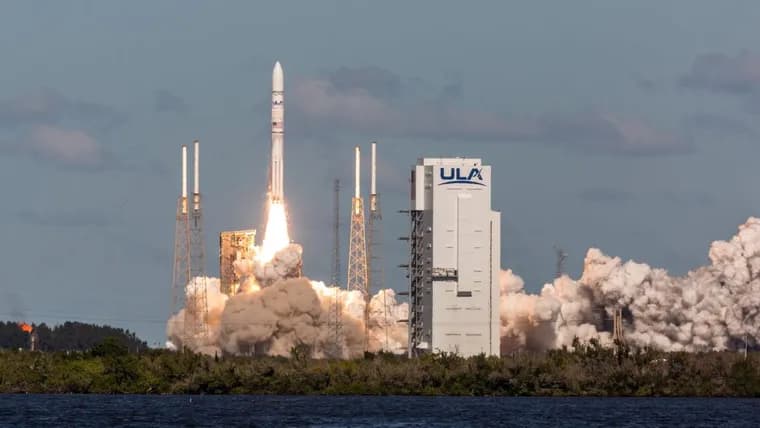
United Launch Alliance's Vulcan rocket and the 40 Amazon Leo broadband satellites it carried fell back to Earth minutes after liftoff on Sunday. Ars Technica calls it a crushing setback that will ripple across all sectors of the US space industry.
The stakes are large. Vulcan is on contract to launch roughly half of the US military's national security space missions in the next few years. Sunday's flight was also the first of 38 Vulcan launches booked by Amazon to build out its network of broadband Internet satellites, which is aimed at competing with SpaceX's Starlink. The article says the failure is expected to ground the rocket for an indefinite period of time.
Vulcan has had trouble before. On two of its four previous flights, its strap-on solid rocket boosters failed. Each time the rocket corrected for the problem and continued into orbit to deploy its payloads, but the incidents triggered months-long reviews and investigations before ULA could resume Vulcan flights.
Sunday's launch failed in a different way. The rocket lifted off from Cape Canaveral Space Force Station, Florida, at 12:40 pm EDT (17:40 UTC). The six solid rocket boosters appeared to perform well in the first two minutes. Then, in a statement, ULA said the rocket "suffered an anomaly 10 minutes into the flight and failed to deliver the Amazon mission to orbit." The company said it did not immediately have "any specific data to understand what occurred."
ULA's statement also said: "ULA exists to provide assured access to space for our nation and for the customers who depend on us. That purpose is why we take on some of the hardest missions in spaceflight, and why we hold ourselves to the standard of mission success. Today, we did not meet that standard." Engineers will investigate the failure to "find the cause, determine the appropriate corrective action, and return to flight as quickly as possible," ULA said.
Key facts
- ULA's Vulcan rocket and its 40 Amazon Leo broadband satellites fell back to Earth minutes after liftoff from Cape Canaveral on Sunday, at 12:40 pm EDT (17:40 UTC).
- ULA says the rocket suffered an anomaly 10 minutes into the flight; the six solid boosters appeared to perform well in the first two minutes, and the company had no specific data yet on the cause.
- It was the first of 38 Vulcan launches Amazon has booked for its Starlink competitor, and Vulcan is on contract for roughly half of the US military's national security space missions in the next few years.
- Two of Vulcan's four previous flights had solid booster failures, but the rocket still reached orbit both times; this failure was of a different kind.
- Ars Technica reports the failure is expected to ground Vulcan for an indefinite period, while ULA promises to find the cause and return to flight as quickly as possible.
Why it matters
Vulcan carries two large commitments at once: roughly half of the US military's national security space missions in the next few years, and 38 launches booked by Amazon for its Amazon Leo broadband network, which is aimed at competing with SpaceX's Starlink. Sunday's flight was the first of those 38. Ars Technica says a grounding for an indefinite period is expected and describes the loss as a crushing setback that will ripple across all sectors of the US space industry. The failure is also new in kind: earlier Vulcan problems involved the solid boosters and still ended in orbit, while this one came 10 minutes into the flight.
Who it affects
ULA is the most directly hit, as the operator of the rocket and the company that has to find the cause. Amazon lost 40 Leo satellites and now has 37 further Vulcan launches booked behind a grounded vehicle. The US military relies on Vulcan for roughly half of its national security space missions in the next few years. The article frames the wider effect as one on all sectors of the US space industry.
How to use it
There is nothing to adopt or buy here; this is a news event. The useful thing for a reader is knowing what to watch next: ULA's investigation into the cause, its corrective action, and the date Vulcan returns to flight. The source gives no timeline beyond ULA's "as quickly as possible" and the article's "indefinite period of time." Past precedent in the article: the two earlier booster incidents led to months-long reviews before Vulcan flew again.
How solid is it
The core facts come from an Ars Technica report that quotes a ULA statement: the anomaly 10 minutes into the flight, the failure to deliver the Amazon mission to orbit, and the company's own admission that it did not meet its standard. The launch time and site are stated. The grounding is the article's expectation, not an announcement from ULA. The cause of the failure is not stated; ULA said it did not immediately have specific data on what occurred. Which stage or engine failed is not stated either.
Risks and caveats
The cause is unknown, so any judgment about the severity or length of the grounding is provisional. The article's wording on impact ("crushing setback", "ripple across all sectors") is its own assessment, with no named source. No timescale for return to flight is given. No reaction from Amazon, the US military or SpaceX is quoted in the provided text, and no financial loss figure is given. The calendar date of the launch is given only as Sunday.
“Today, we did not meet that standard.”
— ULA, in a statement after the failed Vulcan launch