UniMate animates any rigged skeleton with one diffusion model
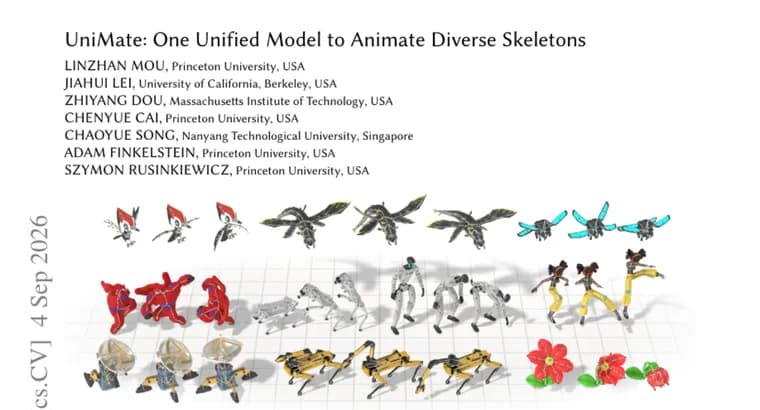
Researchers present UniMate, a unified foundation model that synthesizes articulated motion for arbitrary skeletons from a rigged 3D asset and a text prompt, with no test-time optimization or per-skeleton retraining. The paper frames this against a specific bottleneck: automatic rigging can now produce animation-ready 3D assets at scale, but the learned animators that generate motion for them are topology-constrained, meaning they rely on category-specific templates or need per-skeleton fine-tuning and reference motions supplied at inference. UniMate's core is a topology-aware diffusion transformer that folds skeletal topology into its attention mechanism through three components: a graph-aware attention bias built from pairwise joint relations and geodesic distances; a spectral rotary position embedding that generalizes RoPE to arbitrary kinematic trees via the graph Laplacian; and a global topological conditioner attention-pooled from the rest-pose skeleton. Alongside the model, the authors curated a new dataset, UniML3D, made up of 13,006 motion sequences spanning bipedal, quadrupedal, avian, marine, insectoid, serpentine, and articulated rigid-object skeletons, with unified canonicalization and text pairing across all of them. Trained on this dataset, UniMate is reported to outperform state-of-the-art baselines in quality, generalization, and efficiency, though the abstract states this only as a qualitative claim and gives no specific benchmark numbers. The model additionally supports zero-shot cross-topology transfer, motion in-betweening, motion expansion, and text-guided editing. A project page is linked at linzhanmou.com/unimate.
Key facts
- UniMate is one foundation model that generates motion for arbitrary rigged skeletons from a 3D asset and a text prompt, without per-skeleton retraining or test-time optimization.
- Its topology-aware diffusion transformer uses three mechanisms: a graph-aware attention bias, a spectral rotary position embedding generalizing RoPE via the graph Laplacian, and a global topological conditioner pooled from the rest-pose skeleton.
- The authors curated UniML3D, a companion dataset of 13,006 motion sequences covering bipedal, quadrupedal, avian, marine, insectoid, serpentine, and articulated rigid-object skeletons.
- UniMate is claimed to beat state-of-the-art baselines in quality, generalization, and efficiency, but the abstract gives no quantitative benchmark figures for that claim.
- The model also supports zero-shot cross-topology transfer, in-betweening, expansion, and text-guided editing.
Why it matters
Automatic rigging has made animation-ready 3D assets cheap to produce at scale, but generating the motion to drive them has stayed a bottleneck: existing learned animators are tied to a skeleton category, either through fixed templates or through fine-tuning and reference motion required for each new skeleton at inference time. UniMate targets that gap directly with a single model meant to work across skeleton types without retraining for each one.
Who it affects
The work is aimed at people building animation for non-human or non-standard characters: game and VFX studios, procedural-animation tool builders, and researchers working on creature or object rigs (quadrupeds, birds, fish, insects, snakes, even articulated rigid objects) who currently need separate models or per-skeleton setup to animate each type.
How to use it
The paper links a project page at linzhanmou.com/unimate. The abstract does not state a release date, license, or availability timeline for code, model weights, or the UniML3D dataset, so it is not yet clear from the source when or how the model or data can be obtained.
How solid is it
The technical claim is specific: a topology-aware diffusion transformer combining a graph-aware attention bias, a spectral rotary position embedding generalized via the graph Laplacian, and a global topological conditioner, trained on the newly curated 13,006-sequence UniML3D dataset. The authors state that UniMate outperforms state-of-the-art baselines in quality, generalization, and efficiency, but this is presented as a qualitative summary in the abstract; no accuracy, speed, or other quantitative benchmark numbers are given to back the comparison.
Risks and caveats
The abstract does not name the paper's authors or institutions, give a publication venue or date, or provide the quantitative results behind its stated performance claims. Readers should treat the superiority claim as the authors' own self-reported summary until independent evaluation or a full paper with benchmark numbers is available.