UniME-R1 reasons over failed candidates to fix multimodal retrieval
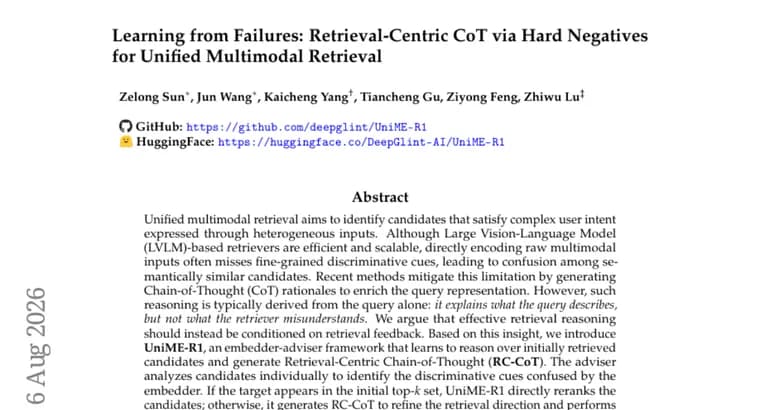
Unified multimodal retrieval systems that use large vision-language models (LVLMs) as the retriever are efficient and scale well, but encoding raw multimodal inputs directly often misses fine-grained discriminative cues, so the system confuses candidates that look or read similarly. Recent work tried to fix this by having the model generate chain-of-thought (CoT) reasoning to enrich its understanding of the query. Zelong Sun and co-authors argue that this kind of reasoning has a structural limit: it is derived from the query alone, so it explains what the query describes but not what the retriever actually misunderstands.
Their proposed fix is to condition the reasoning on retrieval feedback instead, that is, on what happens when the system actually searches, not just on the query text. They introduce UniME-R1, an embedder-adviser framework in which an adviser component analyzes the candidates the embedder initially retrieves, examining them individually to identify which discriminative cues caused the confusion. The framework then branches on the outcome: if the correct target already appears among the initial top-k candidates, UniME-R1 reranks that set directly; if it does not, the adviser generates Retrieval-Centric Chain-of-Thought (RC-CoT) reasoning to refine the retrieval direction, and the system performs a full-corpus re-retrieval using a dual-mode embedder.
To train the framework, the authors mine hard negatives, candidates deliberately chosen to simulate realistic retrieval failures rather than easy, obviously wrong distractors. They jointly optimize two objectives, direct retrieval and RC-CoT-augmented retrieval, and align the adviser's reasoning with actual retrieval outcomes through a combination of supervised learning and retrieval-oriented reinforcement learning.
In experiments on MMEB-V2 and a diverse set of other general multimodal retrieval benchmarks, the authors report that UniME-R1 consistently improves retrieval performance over strong baselines. The available text does not give specific accuracy figures, improvement percentages, or benchmark scores, and it does not state model size, dataset size, compute budget, or a publication venue.
Key facts
- UniME-R1 is an embedder-adviser framework for unified multimodal retrieval that conditions its reasoning on retrieval feedback rather than on the query alone.
- An adviser component analyzes, one by one, the candidates an LVLM-based embedder initially retrieves, to identify which discriminative cues caused confusion.
- If the correct target is already in the initial top-k, UniME-R1 reranks directly; otherwise it generates Retrieval-Centric Chain-of-Thought (RC-CoT) reasoning and performs full-corpus re-retrieval with a dual-mode embedder.
- Training combines mined hard negatives, joint optimization of direct and RC-CoT-augmented retrieval, and supervised plus retrieval-oriented reinforcement learning to align the adviser with actual outcomes.
- The authors report consistent improvement over strong baselines on MMEB-V2 and other multimodal retrieval benchmarks, though the text gives no specific figures.
Why it matters
Multimodal search systems built on large vision-language models are fast and scale well, but they struggle to tell apart candidates that look or read similarly, because reasoning generated from the query alone never reveals what the model specifically got wrong. UniME-R1's shift, reasoning about an actual failed retrieval attempt instead of just parsing the query, is a different way to close that gap: the system inspects its own mistakes and explains them before trying again.
Who it affects
Researchers and engineers building unified multimodal retrieval or search systems, ones that match a mixed image-and-text query against a large pool of candidates. Anyone working on retrieval-augmented generation or ranking pipelines that rely on LVLM-based embedders would find this relevant, since it targets a known failure mode of encoding raw multimodal inputs directly.
How to use it
The text names no public release, model weights, code repository, license or price. It describes a research method, an embedder-adviser architecture trained with hard-negative mining, joint optimization, and supervised plus retrieval-oriented reinforcement learning, rather than a shipped tool. Adopting the idea today means implementing the architecture and training recipe described, not downloading anything from the abstract.
How solid is it
The authors test UniME-R1 on MMEB-V2, a benchmark suite for multimodal embeddings, plus what they describe as a diverse set of general multimodal retrieval benchmarks, and report consistent improvement over strong baselines. The available text does not include the actual accuracy numbers, so the size of the improvement, and whether it holds evenly across benchmarks, cannot be checked from the abstract alone.
Risks and caveats
No quantitative results, author affiliations, model or dataset sizes, compute budget, or publication venue appear in the source text, so the claim of consistent improvement over strong baselines currently rests on the paper's own framing until fuller results are available. The hard-negative mining and reinforcement-learning alignment steps also add training complexity that a simpler query-only CoT retriever would not need.