UniSwap streams joint face and voice swaps in talking videos
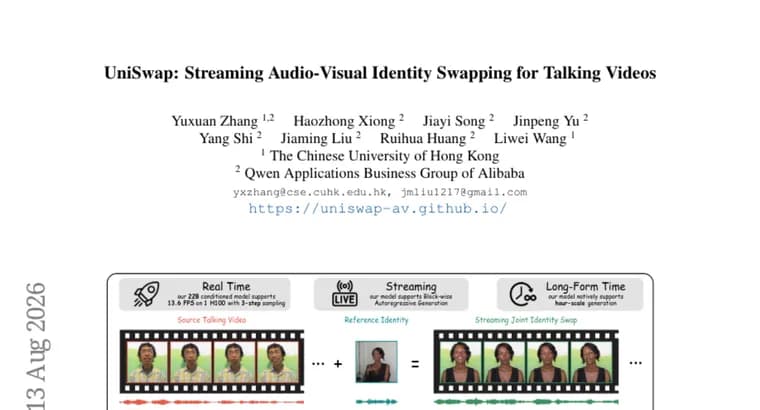
Researchers present UniSwap, which they describe as the first framework for streaming, joint audio-visual identity replacement in talking videos. Given a source video, a reference image, and a reference voice clip, UniSwap replaces the speaker's appearance and vocal timbre while preserving the source video's motion, scene, spoken content, and audio-video timing, all inside a single audio-visual diffusion transformer. The authors argue that existing methods handle the visual and audio swap with separately optimized models, which makes it hard to keep face and voice consistent with each other. Training such a system is complicated by the scarcity of aligned cross-identity pairs (real footage that shows the same performance with two different identities), so the team built a swap-and-reconstruct pipeline: it strips the visual and vocal identity out of real clips and then trains the model to reconstruct the original clips from that stripped version. The model is built from a bidirectional backbone and adapted in stages: in-context pretraining for the joint appearance-and-voice swap, conditional streaming adaptation for block-causal generation with a KV cache, and what the authors call Efficient Self-forcing DMD, which cuts sampling from 30 denoising steps per block down to 3 while addressing exposure bias (error buildup from training on ground truth but generating from the model's own imperfect output). A technique the authors call Efficient Multi-LoRA Switching lets the three DMD-related roles share one frozen backbone, and a Feature-RoPE Decomposition step keeps cached positions inside the model's trained range to keep long-form generation stable. The paper reports that experiments show strong audio-visual synchronization, competitive identity preservation, efficient streaming, and stable generation over long clips, but gives no numeric scores, benchmark comparisons, or named baseline systems to back those qualitative claims, and does not state a release timeline or whether code or model weights will be made available.
Key facts
- UniSwap is presented as the first framework to swap both face and voice in a talking video jointly, inside one streaming audio-visual diffusion transformer, rather than using separate models for each modality.
- A swap-and-reconstruct training pipeline strips real clips of their visual and vocal identity and trains the model to reconstruct the originals, working around the shortage of aligned cross-identity training pairs.
- Efficient Self-forcing DMD cuts denoising from 30 steps per block to 3, which the authors say enables streaming while limiting exposure bias.
- Efficient Multi-LoRA Switching lets three distinct DMD-related roles run on one shared, frozen backbone instead of separate models.
- The paper reports strong synchronization and stable long-form generation only in qualitative terms; no accuracy figures, benchmark comparisons, baseline names, or release plans are given.
Why it matters
Face-swapping and voice-cloning have mostly been treated as separate problems, stitched together after the fact, which tends to produce audio and video that drift out of sync or don't quite match in character. UniSwap's pitch is doing both inside one model that also runs in a streaming, block-by-block fashion rather than needing the whole clip up front. If the approach holds up, it points toward talking-video identity replacement that is faster to generate and more internally consistent between what a face does and what the voice says.
Who it affects
The immediate audience is researchers and engineers working on video synthesis, dubbing, avatar generation, and identity-swap tools, since UniSwap is a research framework rather than a shipped product. Anyone building on top of talking-head generation, from film dubbing to virtual presenters, is the likely downstream user if the techniques get adopted; the paper does not describe a consumer-facing release.
How to use it
The paper does not state whether code, model weights, or a demo will be released, and gives no pricing, licensing, or availability information, so there is nothing to use yet based on the text as stored.
How solid is it
The claims of strong synchronization, competitive identity preservation, and stable long-form output come from the authors' own stated experiments, but the abstract text as captured contains no numeric results, no named baseline methods, and no benchmark comparisons to substantiate them. The technical contributions (the swap-and-reconstruct pipeline, the staged adaptation to a streaming block-causal setup, the step reduction from 30 to 3 via Self-forcing DMD, the LoRA-sharing scheme, and the Feature-RoPE Decomposition for stable caching) are described in specific, checkable detail, which suggests real engineering work, but independent verification would need the full paper or released artifacts.
Risks and caveats
Streaming identity swaps for talking video sit squarely in deepfake territory: a system that convincingly replaces a speaker's face and voice together, in real time, is dual-use by construction. The paper gives no information on safeguards, watermarking, or consent mechanisms, and none of that is claimed to exist. Separately, the underlying quality claims are unverified here: no accuracy numbers, no comparison to prior systems, and no author names or institutional affiliation appear in the stored text, so provenance and independent scrutiny both rest on the full paper rather than what was captured.