Uranus: a diffusion-based robot simulator that streams video at 24 FPS
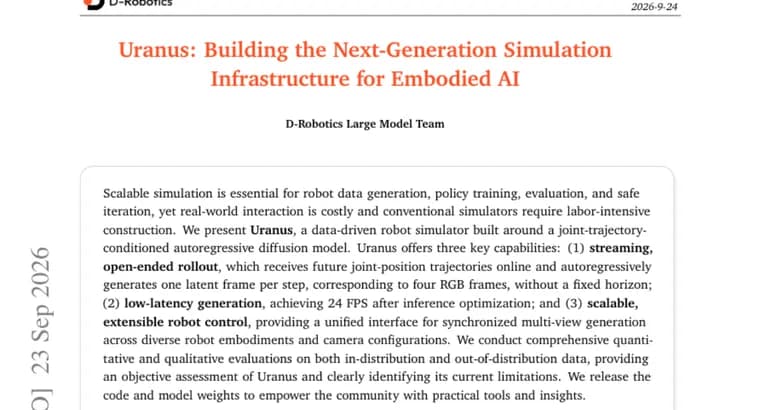
A team of researchers has presented Uranus, a data-driven robot simulator built around a joint-trajectory-conditioned autoregressive diffusion model. The motivation is practical: real-world robot interaction is costly, and conventional simulators require labor-intensive, hand-built environments, yet scalable simulation is described as essential for generating robot data, training policies, evaluating them, and iterating safely. Uranus is built to offer three capabilities. First, streaming, open-ended rollout: the model receives future joint-position trajectories online and autoregressively generates video without a fixed time horizon, producing one latent frame per step, which corresponds to four RGB frames. Second, low-latency generation: after inference optimization, the system reaches 24 FPS. Third, scalable and extensible robot control, through a unified interface that supports synchronized multi-view generation across different robot embodiments and camera configurations. The authors report comprehensive quantitative and qualitative evaluations on both in-distribution and out-of-distribution data, which they say give an objective assessment of Uranus and clearly identify its current limitations. They release the code and model weights alongside the paper, framed as practical tools for the community. The source text does not name the authors or their institutions, does not give a publication or release date, does not compare Uranus against specific existing simulators or benchmark figures, and does not specify which robot embodiments or camera setups were used in testing.
Key facts
- Uranus is a data-driven robot simulator built on a joint-trajectory-conditioned autoregressive diffusion model.
- It supports streaming, open-ended rollout: it takes future joint-position trajectories online and generates video without a fixed horizon, one latent frame per step corresponding to four RGB frames.
- After inference optimization, generation runs at 24 FPS, described as low-latency.
- It provides a unified interface for synchronized multi-view generation across diverse robot embodiments and camera configurations.
- The authors evaluated Uranus on in-distribution and out-of-distribution data and released code and model weights.
Why it matters
Training and testing robot policies normally requires either costly real-world interaction or conventional simulators that must be laboriously hand-built for each environment and robot. Uranus proposes replacing that construction step with a data-driven video-generation model conditioned on joint trajectories, so a simulated environment can be produced by the model rather than hand-authored.
Who it affects
The intended audience is robotics researchers and engineers who need to generate robot data, train and evaluate control policies, and iterate on robot behavior without constant real-world testing; the released code and weights make the system directly usable by that community.
How to use it
The authors release the code and model weights alongside the paper. The model takes future joint-position trajectories as input and autoregressively produces video, generating one latent frame per step (equal to four RGB frames), without needing to predefine a fixed time horizon for the rollout, and it exposes a unified interface for synchronized multi-view output across different robot embodiments and camera configurations.
How solid is it
The claims come from the paper's own abstract; it states that comprehensive quantitative and qualitative evaluations were run on both in-distribution and out-of-distribution data to objectively assess the system and identify its limitations, but the available text does not give specific benchmark numbers, comparisons to named existing simulators, or details of which robot embodiments and camera setups were tested, and it does not name the authors, their institutions, or a publication date.
Risks and caveats
Because the underlying text does not disclose comparative benchmarks or the specific embodiments tested, the real-world accuracy and generality of Uranus relative to existing simulators cannot be assessed from what is available here; the authors themselves say the evaluations were designed in part to surface the system's current limitations, implying constraints exist beyond what the abstract describes.