VAD isolates visual evidence in multimodal knowledge distillation
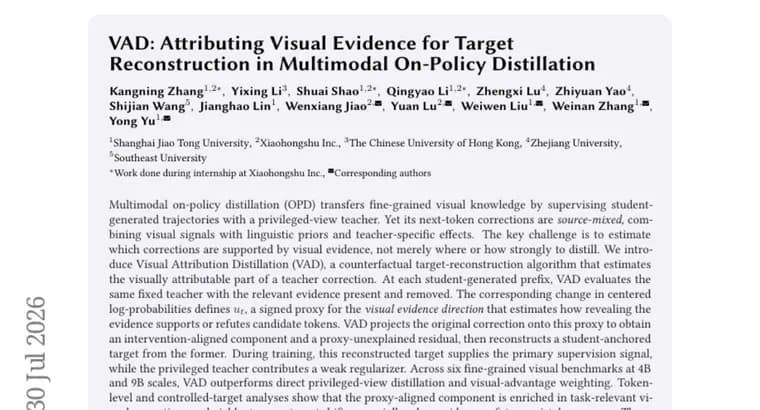
Multimodal on-policy distillation trains a smaller student model by having a larger teacher model, one that sees a privileged view unavailable to the student, correct the student's own generated text token by token. The problem researchers identify is that these corrections are source-mixed: a single correction can reflect genuine visual signal, the teacher's linguistic priors, or quirks specific to that particular teacher, all tangled together. The paper argues the real challenge is not deciding where or how strongly to distill, but figuring out which corrections are actually backed by visual evidence in the first place.
To separate the two, the authors introduce Visual Attribution Distillation (VAD), a counterfactual target-reconstruction algorithm. At each partial output the student generates, VAD runs the same fixed teacher model twice: once with the relevant visual evidence present, once with it removed. The resulting shift in the teacher's centered log-probabilities defines a signed value the paper calls ut, a proxy for the direction of visual evidence that shows whether the evidence supports or refutes each candidate next token.
VAD then projects the teacher's original correction onto this proxy, splitting it into two parts: an intervention-aligned component, the portion actually explained by visual evidence, and a proxy-unexplained residual. Only the aligned component is used to reconstruct a new, student-anchored training target. During training, this reconstructed target becomes the primary supervision signal, while the original privileged teacher is demoted to a weak regularizer rather than the main source of correction.
The authors tested VAD across six fine-grained visual benchmarks at both 4B and 9B model scales, reporting that it outperforms both direct privileged-view distillation and visual-advantage weighting, two existing approaches to the same problem. Token-level and controlled-target analyses show the proxy-aligned component concentrates in corrections that are genuinely task-relevant and produces stronger shifts in the training target, particularly in cases where the visual evidence contradicts a mistaken answer the student had already produced. The paper does not name the six benchmarks or report specific accuracy figures, and gives no detail on the teacher model or the privileged-view setup used in testing. The authors conclude the results support counterfactual target reconstruction as an effective alternative to training directly on source-mixed corrections.
Key facts
- Visual Attribution Distillation (VAD) is a counterfactual algorithm for multimodal on-policy distillation that separates visually grounded corrections from language-prior and teacher-specific noise.
- For each student-generated prefix, VAD evaluates the same teacher with visual evidence present and removed, and the resulting change in log-probabilities (ut) proxies the direction of visual evidence.
- The original correction is projected onto this proxy into an intervention-aligned component and a residual; only the aligned component is reconstructed into the training target, with the teacher reduced to a weak regularizer.
- Across six fine-grained visual benchmarks at 4B and 9B scales, VAD outperforms direct privileged-view distillation and visual-advantage weighting.
- The effect is strongest when visual evidence refutes an answer the student got wrong; the paper does not name the benchmarks or give numeric accuracy margins.
Why it matters
Distilling a vision-language student from a privileged-view teacher normally means training on whatever correction the teacher happens to produce, without checking whether that correction reflects real visual evidence or just the teacher's own language habits. VAD's counterfactual test, comparing the teacher's output with and without the relevant evidence, gives a way to isolate the visually grounded part of a correction before it enters training, rather than treating every correction as equally trustworthy.
Who it affects
This is a research contribution aimed at people building or training multimodal (vision-language) models through on-policy distillation from a stronger, privileged-view teacher model. It is not a consumer product or a released tool; the paper reports method and benchmark results rather than a public model or codebase.
How to use it
VAD is a training-time technique: it changes how the supervision target is constructed during distillation, requiring two teacher evaluations per student prefix (with and without evidence) to compute the proxy signal. The paper gives no information on code or model availability, pricing, or licensing.
How solid is it
The authors report VAD beating two named baselines, direct privileged-view distillation and visual-advantage weighting, across six fine-grained visual benchmarks at both 4B and 9B model scales, with supporting token-level and controlled-target analyses. The paper does not disclose which six benchmarks were used, does not give specific accuracy numbers or improvement margins, and does not name the authors' institutions or the teacher model used in testing, which limits independent verification.
Risks and caveats
Because the source text omits benchmark names, quantitative results, teacher model details and author affiliations, the claims here rest on the paper's own description of its method and stated outcome rather than independently checkable figures. It also appears to be a preprint without indication of peer review.
“These results support counterfactual target reconstruction as an effective alternative to source-mixed supervision.”
— the paper's authors