WCM adds world modeling to robot-manipulation critic models
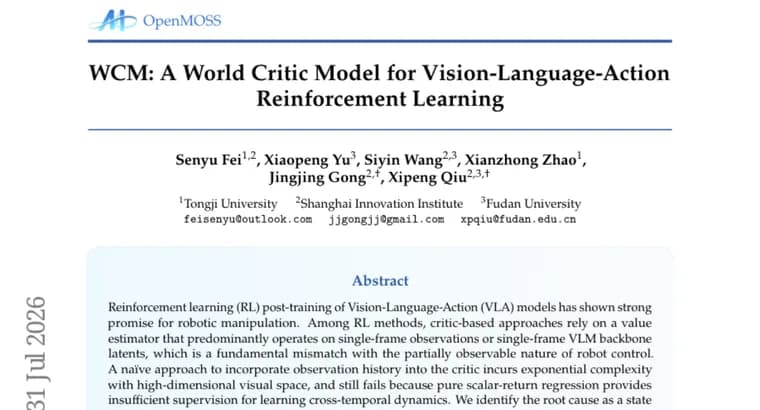
A group of researchers describes a critic architecture called the World Critic Model (WCM) for reinforcement learning post-training of Vision-Language-Action (VLA) robotic manipulation models. The paper starts from a specific weakness in existing critic-based RL methods: their value estimators mostly work on single-frame observations or single-frame VLM backbone latents, which the authors call a fundamental mismatch with the partially observable nature of robot control, since a single frame cannot capture what changed over time. A straightforward fix, feeding observation history into the critic, runs into exponential complexity once the visual input is high-dimensional, and even then underperforms, because training the critic with plain scalar-return regression gives it too little signal to learn how the scene evolves across time steps. The researchers trace the failure to a state approximation problem: without an explicit objective for modeling the world, the critic's internal representation never learns the temporal structure it needs for accurate value estimates. WCM addresses this by building on a lightweight LeJEPA architecture and training the critic to do two things at once: predict the future latent state of the scene and estimate the value of an action. Forcing the same representation to support both tasks pushes it to encode temporal dynamics rather than only regress a scalar return. WCM is designed to slot into both on-policy and off-policy training pipelines and works with established VLA backbones, including Pi0, Pi0.5, and OpenVLA-OFT. The researchers ran experiments on 149 tasks spanning four benchmarks and report that WCM consistently reaches state-of-the-art performance in both in-distribution and out-of-distribution settings, with particularly strong gains in generalization to conditions not seen during training. Beyond simulation, they validated WCM on seven real-world manipulation tasks, using the OpenVLA-OFT and Pi0.5 backbones trained with off-policy RL, and report stable deployment across the different setups tested. The abstract text does not include author names, an institutional affiliation, a publication date, or a numeric margin showing by how much WCM beats prior baselines; it also does not explain what LeJEPA is beyond naming it as the base architecture.
Key facts
- WCM is a critic model for RL post-training of Vision-Language-Action robotic manipulation models, built on a lightweight LeJEPA architecture.
- It jointly predicts the future latent state of the scene and estimates action values, instead of relying on single-frame value estimation or plain scalar-return regression.
- It integrates into both on-policy and off-policy training pipelines and works with VLA backbones Pi0, Pi0.5, and OpenVLA-OFT.
- Across 149 tasks on four benchmarks it reaches state-of-the-art performance in-distribution and out-of-distribution, with particularly strong generalization gains.
- It was further validated on seven real-world manipulation tasks with OpenVLA-OFT and Pi0.5 under off-policy RL, with stable deployment reported across settings.
Why it matters
Critic-based reinforcement learning is a common way to post-train Vision-Language-Action robot models, but the paper argues that existing critics are built on a flawed foundation: they estimate value from a single observation frame or a single-frame VLM latent, which does not fit robot control, where the state is only partially observable and depends on what happened over time. Simply adding observation history to the critic does not solve this, since it explodes in complexity with high-dimensional visual input and still under-trains, because scalar-return regression alone does not teach the critic to track how a scene changes. WCM's fix is to give the critic an explicit world-modeling objective, predicting future latent states alongside value estimates, so its internal representation is pushed to capture temporal dynamics directly rather than as a side effect of return prediction.
Who it affects
The work targets researchers and engineers building or training VLA models for robotic manipulation through reinforcement learning. WCM is described as compatible with several established backbones, Pi0, Pi0.5, and OpenVLA-OFT, and as integrating into both on-policy and off-policy training setups, which points at teams already working with these specific model families rather than a general robotics audience.
How to use it
WCM is built on a lightweight LeJEPA architecture and is presented as a drop-in critic component: it slots into existing on-policy or off-policy RL training pipelines for VLA models and is compatible with the Pi0, Pi0.5, and OpenVLA-OFT backbones. The abstract gives no further implementation, licensing, or release details beyond this compatibility claim.
How solid is it
The researchers report extensive experiments on 149 tasks across four benchmarks, covering both in-distribution and out-of-distribution conditions, with WCM consistently reaching state-of-the-art performance and particularly strong generalization gains. They also validated WCM outside simulation, on seven real-world manipulation tasks using the OpenVLA-OFT and Pi0.5 backbones trained with off-policy RL, reporting stable deployment across the settings tested. The abstract does not state a numeric margin over baseline methods, so the size of the improvement is not quantified in the source text.
Risks and caveats
The abstract text carries no author names, institutional affiliation, or publication date, and it does not explain what the underlying LeJEPA architecture is beyond naming it. The real-world validation is limited to seven tasks using two of the three compatible backbones, OpenVLA-OFT and Pi0.5, and only under off-policy RL, a narrower test than the 149-task, four-benchmark simulated evaluation.