VenusOCR2.0, a 1B document parser, reports 96.45 on OmniDocBench
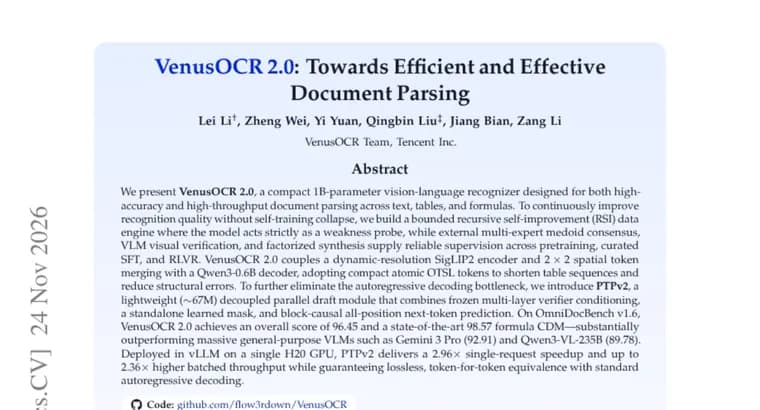
A paper listed on Hugging Face presents VenusOCR2.0, a compact 1B-parameter vision-language recognizer for document parsing. The authors say it is designed for both high accuracy and high throughput across text, tables and formulas.
The model pairs a dynamic-resolution SigLIP2 encoder and 2x2 spatial token merging with a Qwen3-0.6B decoder. For tables it adopts compact atomic OTSL tokens, which the authors use to shorten table sequences and reduce structural errors.
To keep improving recognition quality without self-training collapse, the authors built what they call a bounded recursive self-improvement (RSI) data engine. In it, the model acts strictly as a weakness probe. Reliable supervision comes from elsewhere: a medoid consensus among multiple external experts, visual verification by a vision-language model, and factorized synthesis. These supply supervision across pretraining, curated supervised fine-tuning and RLVR.
The second addition targets the bottleneck of autoregressive decoding. PTPv2 is a lightweight, decoupled parallel draft module of about 67M. It combines frozen multi-layer verifier conditioning, a standalone learned mask and block-causal next-token prediction at all positions.
On OmniDocBench v1.6, the authors report an overall score of 96.45 and a formula CDM score of 98.57, which they describe as state of the art. They say the model substantially outperforms much larger general-purpose vision-language models, citing Gemini-3-Pro at 92.91 and Qwen3-VL-235B at 89.78. Deployed in vLLM on a single H20 GPU, PTPv2 delivers a 2.96x single-request speedup and up to 2.36x higher batched throughput. The authors state that it guarantees lossless, token-for-token equivalence with standard autoregressive decoding.
Key facts
- VenusOCR2.0 is a 1B-parameter recognizer for text, tables and formulas, built from a SigLIP2 encoder with 2x2 spatial token merging and a Qwen3-0.6B decoder.
- On OmniDocBench v1.6 the authors report 96.45 overall and a 98.57 formula CDM score that they call state of the art.
- The comparison figures cited are 92.91 for Gemini-3-Pro and 89.78 for Qwen3-VL-235B.
- The PTPv2 draft module (about 67M) gives a 2.96x single-request speedup and up to 2.36x higher batched throughput in vLLM on one H20 GPU.
- In the bounded self-improvement data engine, the model only probes for weaknesses, while external checks and synthesis provide the supervision.
Why it matters
The paper's argument is that a small specialised model can parse documents both accurately and quickly. At 1B parameters, VenusOCR2.0 is reported to score above Gemini-3-Pro and Qwen3-VL-235B, which the authors describe as massive general-purpose models.
The data engine is the other point of interest. It addresses self-training collapse by limiting the model to exposing its own weak spots and taking supervision from outside sources.
Who it affects
The work is most relevant to teams that parse documents containing text, tables and formulas, and to researchers building compact OCR models. People who serve models through vLLM may also care about the parallel decoding results, which were measured in that setup on a single H20 GPU.
How to use it
The abstract gives the building blocks: a dynamic-resolution SigLIP2 encoder, 2x2 spatial token merging, a Qwen3-0.6B decoder, OTSL tokens for tables and the PTPv2 draft module for faster decoding. It says nothing about whether code, weights or data are released, or under what license. For now, treat it as a design to study.
How solid is it
All the results are the authors' own claims, taken here from the paper's abstract. The accuracy figures refer to OmniDocBench v1.6: 96.45 overall and 98.57 on formula CDM. The state-of-the-art wording is attached to the formula score only.
The speed figures are multipliers measured in vLLM on one H20 GPU. The claim of token-for-token equivalence with standard decoding is also the authors' statement.
Risks and caveats
The abstract does not spell out which metric the Gemini-3-Pro and Qwen3-VL-235B numbers use, though their placement suggests the overall score. It gives no comparison with other specialised OCR or document-parsing models.
No absolute throughput or latency figures appear, and the batch size behind the 2.36x peak is not stated. The 2.36x figure is an upper bound. The abstract also does not say how much of the quality gain comes from the data engine.
“To continuously improve recognition quality without self-training collapse, we build a bounded recursive self-improvement (RSI) data engine where the model acts strictly as a weakness probe”
— VenusOCR2.0 paper abstract