Verge writer builds $50 Muse Charm lookalike with Claude Code
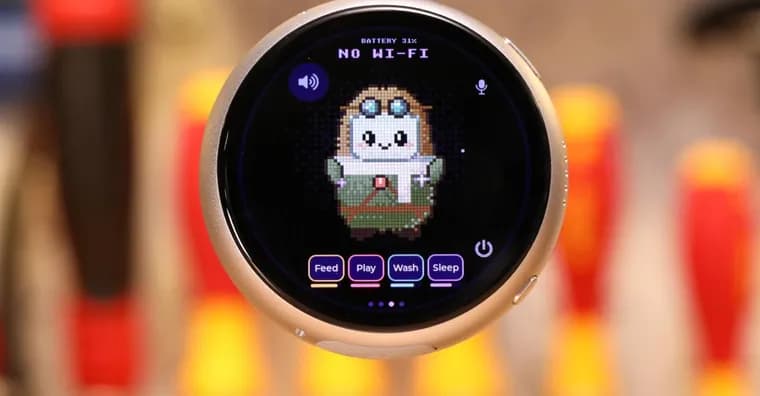
Meta plans to sell the Muse Charm this holiday season, a pocket-sized AI companion with a squishy animated face that you carry like a Tamagotchi. A writer at The Verge decided not to wait and built a home version for $50.
The hardware is a Waveshare ESP32-S3 1.75C, a 1.75-inch touchscreen push-to-talk pendant drop-shipped from China. It looks a lot like the Muse Charm, and Meta itself sanctions it: it is one of the company's first suggestions for anyone building a "Muse Gadget", meaning a device that uses Meta's open-source code and tokens to connect directly to its Muse AI cloud. Setup was simple. The writer plugged the pendant into a PC, pointed Claude at Meta's GitHub, and paired it with the Muse phone app.
The first result was useless. Muse initially treated the audio as clips to transcribe rather than commands. Once that was sorted out, replies were slow, nothing was spoken aloud, and the screen showed only a few words at a time, with no way to read a full message except on the phone's Muse app. Meta's build shipped with a single Jolly avatar that mostly sat there, and it would not automatically discover smart home gadgets the way Amazon Echo or Google Home devices do. Meta AI software engineers Anant Narayanan and Jeremy Payne include a sample app showing how Muse Gadgets can stream video from a phone camera, but with no remote shutter button it was not much use for taking photos.
A few sessions of Claude Code filled in almost all of those gaps. The writer plugged the pendant back into the PC and asked Claude to reprogram each thing in turn. Claude built a conversation history page, reachable by swiping right. The writer added a British AI voice from ElevenLabs's free tier that speaks the answers aloud (the least soul-sucking option there, the writer and the writer's wife agreed, even though it clashes with the avatars' cuddly look). Claude added a button to make the phone take a picture from across the room with a high-quality live preview, fixed the phone's front camera showing upside down, and added a lower-quality preview over Bluetooth, so photos no longer need home Wi-Fi.
The writer also had Claude make a batch of avatars like those Meta showed at Meta Connect, plus a Tamagotchi-like minigame where they need food, play, sleep and a bath. When the game seemed too simple, Claude added four levels each of hunger, boredom and dirt. Treats make a crunchy mess and leave avatars dirtier, and too much play tires a pet out. A push-to-talk problem, where releasing the button too early sent Muse almost-empty audio, was fixed within minutes by sending only audio longer than one second. The one obvious lag left comes from Meta's own servers, which are sometimes responsive and sometimes lag quite a bit.
For the video that accompanies the story, the writer asked for more: a working pocket watch face with three hands, which took Claude 15 minutes, and a video player loaded with clips of Mark Zuckerberg introducing the Muse Charm, which Claude found, downloaded and trimmed itself. The finished device also works as a remote camera viewfinder and can theoretically control a smart home, though only with a lot of extra vibe code. It has no cameras and no 5G cellular radio.
The writer is frank about the limits. They have no coding experience and cannot say whether the code is any good; it might be fatally flawed. They do not trust Meta or Muse with email or the home network, partly after hearing that Muse leaked one reviewer's home address, so the pendant went on guest Wi-Fi from the start. The conclusion: Muse itself is not the reason to buy a dedicated pocket device, since the pendant adds no more Muse functionality than a phone. The reason would be doing what a phone cannot, such as coding the whole gadget to do whatever you want. That leaves an open question: will the real Muse Charm be this freely programmable, or would its likely buyers be better off with a development kit? The writer says that will be clear when it ships.
Key facts
- The writer paid $50 for a Waveshare ESP32-S3 1.75C, a 1.75-inch touchscreen pendant that Meta officially suggests as a base for a "Muse Gadget" connecting to its Muse AI cloud.
- Out of the box it was slow, silent and showed a few words at a time; Claude Code added a conversation history page, ElevenLabs voice, camera preview and remote shutter, extra avatars and a Tamagotchi-like minigame.
- Claude built a three-handed working pocket watch face in 15 minutes; a fix for accidental early push-to-talk release sends only audio longer than one second.
- The writer has no coding experience, does not know if the code is good, and keeps the device on guest Wi-Fi because of distrust of Meta and Muse.
- Meta wants to sell the Muse Charm this holiday season; the writer asks whether it will be as freely programmable as this DIY version.
Why it matters
Meta is preparing to sell the Muse Charm this holiday season as a Tamagotchi-style AI companion. This piece shows what a near-identical, officially sanctioned $50 device does today, and how far a non-programmer can push it with an AI coding tool. The writer's takeaway is that a dedicated gadget earns its place only if you can make it do things your phone cannot, and that Muse alone does not justify one.
Who it affects
Anyone weighing a Muse Charm, and hobbyists who might build a Muse Gadget on the Waveshare board or similar hardware. It also speaks to non-programmers curious about vibe coding: the writer with no coding experience got a working device from a few Claude Code sessions.
How to use it
The route described: buy the Waveshare ESP32-S3 1.75C (about $50 for the writer, drop-shipped from China), plug it into a PC, point Claude at Meta's GitHub, put Meta's keys on the device and pair it with the Muse phone app. From there, ask Claude to reprogram individual features, such as a history page, avatars or a watch face. The ElevenLabs voice the writer used came from its free tier. The source does not say the writer's code is published.
How solid is it
This is a first-person hands-on account, not a test. Every claim rests on the writer's own experience. No benchmarks or measured latency figures are given; lag is described only as sometimes responsive and sometimes quite slow on Meta's servers. Smart home control is described only as working "theoretically".
Risks and caveats
The writer cannot say whether the code is good and warns it might be fatally flawed. They do not trust Meta or Muse with email or the home network, citing a report that it leaked one reviewer's home address, and kept the device on guest Wi-Fi. The Muse Charm's price, specs and release date are not given, so the comparison with the real product is open; whether it will be as freely programmable is unknown until it ships.
“I have no coding experience, and so I have no idea if any of this code is good. It might be fatally flawed.”
— The Verge writer, on the code Claude produced