Verus-Insight detects AI-generated video by checking artifacts step by step
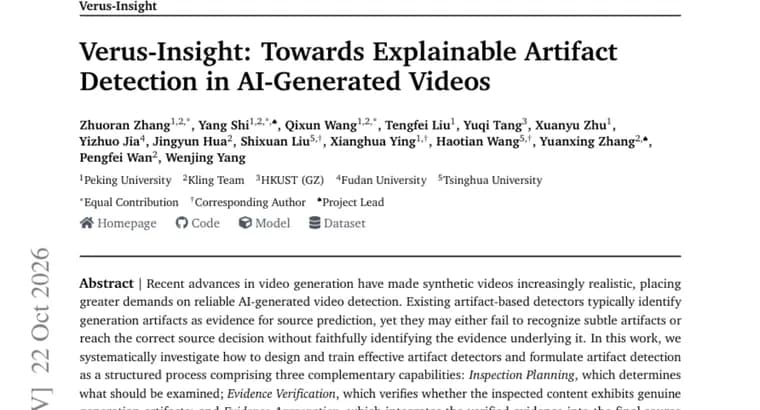
A paper listed on Hugging Face Papers takes on a growing problem: video generators now produce synthetic clips realistic enough that reliable detection of AI-generated video is harder and more needed. The paper starts from a weakness in existing artifact-based detectors. These systems find generation artifacts and use them as evidence to predict whether a video is real or generated. The authors say they may either miss subtle artifacts, or reach the correct source decision without faithfully identifying the evidence behind it.
The authors set out to study how to design and train effective artifact detectors. Their answer is to treat artifact detection as a structured process with three complementary capabilities. Inspection Planning determines what should be examined. Evidence Verification checks whether the inspected content shows genuine generation artifacts. Evidence Aggregation integrates the verified evidence into the final decision about the video's source.
Building on this formulation, the paper introduces Verus-Insight. It is trained with human-anchored full-process supervision and progressive capability training, meant to strengthen both fine-grained artifact detection and video-level detection. The paper also introduces Verus-Bench, a benchmark with fine-grained human annotations of perceptible artifacts, built for evaluating artifact detection.
The authors report extensive experiments across diverse benchmarks. They say Verus-Insight achieves strong performance in both fine-grained artifact analysis and AI-generated video detection, with substantial gains in recovering human-perceived artifacts. Further analyses, they say, show that the three capabilities are complementary yet distinct, and that Verus-Insight more reliably converts relevant inspection targets into supported artifact evidence without increasing spurious artifact claims.
Key facts
- Verus-Insight is a detector of generation artifacts in AI-generated videos, aimed at making the evidence behind a decision faithful rather than just the decision correct.
- Artifact detection is framed as three capabilities: Inspection Planning, Evidence Verification and Evidence Aggregation.
- Training uses human-anchored full-process supervision and progressive capability training, to strengthen both fine-grained artifact detection and video-level detection.
- Verus-Bench is a new benchmark with fine-grained human annotations of perceptible artifacts.
- The authors report strong performance and substantial gains in recovering human-perceived artifacts, without giving numbers in the abstract.
Why it matters
As video generation gets more realistic, detectors that only output a verdict are hard to trust. The paper targets a specific gap: a detector can reach the right source decision without identifying the evidence that supports it. Verus-Insight is built to tie the decision to verified artifacts, and Verus-Bench gives a human-annotated way to measure whether detectors find the artifacts people can actually perceive.
Who it affects
Researchers working on AI-generated video detection and on explainable detection are the direct audience, since the paper offers both a method and a benchmark. Anyone who needs a detector to show what it found, not just a score, is the intended beneficiary of the approach.
How to use it
The abstract describes the three-stage framing (plan what to inspect, verify the artifacts, aggregate the evidence) and the training recipe of human-anchored full-process supervision with progressive capability training. Verus-Bench is meant for evaluating artifact detection against fine-grained human annotations.
How solid is it
This is a preprint listed on Hugging Face Papers, and the claims come from the authors' own abstract. They report extensive experiments across diverse benchmarks and further analyses showing the three capabilities are complementary yet distinct. The abstract does not quantify 'strong performance' or 'substantial gains'. The abstract names no authors or institutions.
Risks and caveats
The abstract gives no accuracy figures, does not name the benchmarks or the video generators tested, does not say how large Verus-Bench is, and does not describe the base model, training data or compute. It makes no comparison with specific existing detectors and mentions no release of code, weights or data. Claims of gains therefore cannot be checked from the abstract alone.