Vidu S2 adds real-time interactive video generation and editing
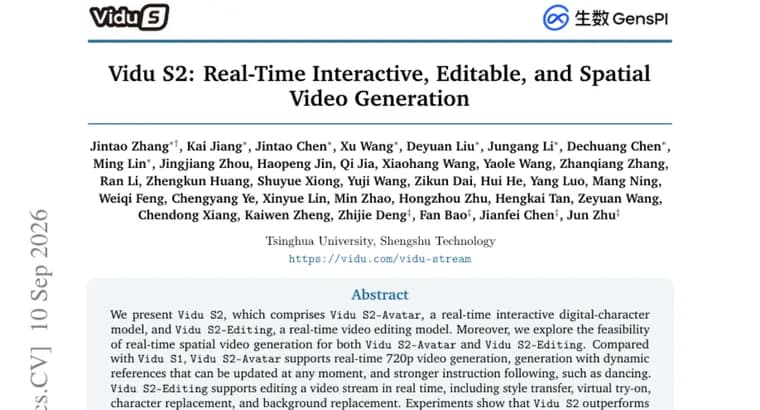
Researchers have presented Vidu S2, a pair of real-time video models built for interaction rather than one-shot clip generation. The first, Vidu S2-Avatar, is a real-time interactive digital-character model: compared with the earlier Vidu S1, it generates video in real time at 720p, accepts dynamic reference inputs that can be updated at any moment during generation, and follows instructions more reliably, with dancing given as an example. The second, Vidu S2-Editing, edits a live video stream in real time rather than a finished file, supporting style rendering, clothing replacement, character replacement, and background replacement. On top of both models, the team explored the feasibility of real-time spatial video generation, without detailing what that spatial capability produces beyond naming it as an area they tested. The authors report that experiments show Vidu S2 outperforms all baselines, though the paper text does not name those baselines or give specific benchmark figures. A playable online demo of the system is available at vidu.com/vidu-stream.
Key facts
- Vidu S2 comprises two real-time models: Vidu S2-Avatar for interactive digital characters and Vidu S2-Editing for live video-stream editing
- Compared with Vidu S1, Vidu S2-Avatar generates real-time 720p video, takes dynamic reference updates at any moment, and follows instructions more reliably, including dancing
- Vidu S2-Editing supports real-time style rendering, clothing replacement, character replacement, and background replacement on a live video stream
- The team also tested real-time spatial video generation for both models
- A playable online demo is live at vidu.com/vidu-stream, and the authors say Vidu S2 outperforms all baselines in their experiments
Why it matters
Most video-generation tools work in batches: you submit a prompt, wait, and get a clip back. Vidu S2 targets a different problem, generation and editing that respond live, with references and instructions that can change mid-stream. That interactivity, plus an early exploration of real-time spatial video generation, points at video models built for real-time use such as live avatars and streamed edits rather than offline rendering.
Who it affects
Builders of virtual avatars, live-streaming tools, and video-editing products get a concrete example of what real-time generation and editing can do today. Researchers working on video diffusion or generation models get a comparison point for real-time performance at 720p and for stream-based editing.
How to use it
A playable online demo is available at vidu.com/vidu-stream, so the capabilities can be tried directly rather than taken on faith. The paper gives no pricing, licensing, or access terms beyond the demo link.
How solid is it
The claims come from a single research paper reporting the authors' own experiments; it states that Vidu S2 outperforms all baselines but does not name those baselines or give specific benchmark scores in the available text, so the win is asserted rather than shown with numbers here. The presence of a live, playable demo is a stronger signal than the prose claim, since it lets outsiders test the real-time behavior directly.
Risks and caveats
The available text does not quantify how much stronger the instruction-following or dancing performance is, does not give a release timeline, and does not detail what the real-time spatial video generation actually produces beyond naming it as explored. Treat the outperformance claim as the authors' own until independent benchmarks or hands-on tests of the demo confirm it.