ZGCM-1: 7B open model rivals 235B-scale Qwen3 on math and agentic search
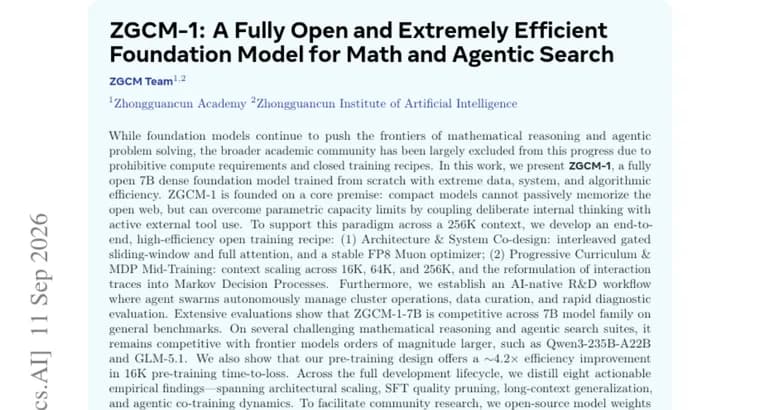
A team has released ZGCM-1, a fully open 7B dense foundation model trained from scratch around a specific bet: a compact model cannot passively memorize the open web the way huge models can, but it can get past that capacity limit by pairing deliberate internal thinking with active use of external tools. The paper builds an end-to-end training recipe meant to make that pairing work across a 256K token context.
On the architecture and systems side, ZGCM-1 interleaves gated sliding-window attention with full attention and trains with a stable FP8 version of the Muon optimizer. Training follows a progressive curriculum that scales context across three stages, 16K, then 64K, then 256K tokens, and a mid-training phase reformulates interaction traces as Markov Decision Processes. The team also describes an AI-native research workflow in which agent swarms handle cluster operations, data curation and rapid diagnostic evaluation, without detailing exactly how those agents operate or how their contribution was measured.
The authors report ZGCM-1-7B as competitive within the 7B model class on general benchmarks, and, on several demanding math-reasoning and agentic-search test suites, as remaining competitive with frontier models that are orders of magnitude larger, naming Qwen3-235B-A22B and GLM-5.1 specifically. No numeric benchmark scores are given for either comparison, only this qualitative claim. Separately, the paper states that its pre-training design cuts 16K pre-training time-to-loss by about 4.2x, and the team distills eight empirical findings from the full development cycle, spanning architectural scaling, SFT quality pruning, long-context generalization and agentic co-training dynamics.
To let others check and build on the work, the team has open-sourced model weights from the pre-training, mid-training and post-training stages, intermediate checkpoints, the training code, the per-stage data and data recipes, and the W&B logs.
Key facts
- ZGCM-1 is a 7B dense foundation model trained from scratch on the premise that compact models should couple internal reasoning with active external tool use instead of trying to memorize the open web.
- The recipe pairs interleaved gated sliding-window and full attention with a stable FP8 Muon optimizer, and scales context through a curriculum of 16K, 64K and 256K tokens, with interaction traces reformulated as Markov Decision Processes at mid-training.
- On several math-reasoning and agentic-search benchmarks, the team reports ZGCM-1-7B as competitive with far larger frontier models, naming Qwen3-235B-A22B and GLM-5.1, though without stating specific scores.
- The pre-training design is reported to cut 16K pre-training time-to-loss by about 4.2x, alongside eight distilled findings on architecture scaling, SFT quality pruning, long-context generalization and agentic co-training.
- Weights from all three training stages, intermediate checkpoints, training code, per-stage data and recipes, and W&B logs are all released publicly.
Why it matters
Most gains in reasoning and agentic capability have come from scaling parameter counts. ZGCM-1 argues the opposite path: keep a model small and compensate with deliberate reasoning plus tool use, an architecture and training co-design, and heavy efficiency work in pre-training. If a 7B model genuinely holds up against 235B-class systems on math and agentic search, that is a real data point for efficiency-first model design, not just scale-first.
Who it affects
Researchers and engineering teams working on small, efficient foundation models; anyone building agentic or search-oriented applications who wants strong reasoning without frontier-scale compute costs; and academic or independent labs with limited training budgets who want a fully documented recipe to study or reproduce.
How to use it
The team has published model weights from each of the three training stages, pre-training, mid-training and post-training, along with intermediate checkpoints, the training code itself, the per-stage training data and data recipes, and the W&B training logs. That combination lets others inspect or rerun the whole pipeline rather than just download a finished checkpoint. No pricing, license terms or release date are stated in the text.
How solid is it
The claims come from the paper's own evaluations, reported qualitatively as "competitive" against Qwen3-235B-A22B and GLM-5.1 on math and agentic-search suites, without accompanying numeric scores for either the general benchmarks or these comparisons. The 4.2x efficiency figure is specific to 16K pre-training time-to-loss, not training speed overall. There is no independent replication yet, and the source text does not name a release date.
Risks and caveats
The source text names no authors or institution; that detail sits only in the source page's listing metadata, not in the paper's own text. The claim that agent swarms "autonomously manage cluster operations, data curation, and rapid diagnostic evaluation" is not explained further, so its actual scope and how it was measured are unclear. GLM-5.1 is cited as a comparison point with no parameter count given, unlike Qwen3-235B-A22B, making the two comparisons uneven. No license or specific benchmark numbers accompany the competitiveness claims.