W2-VLA predicts future wrist views for finer robot grasping
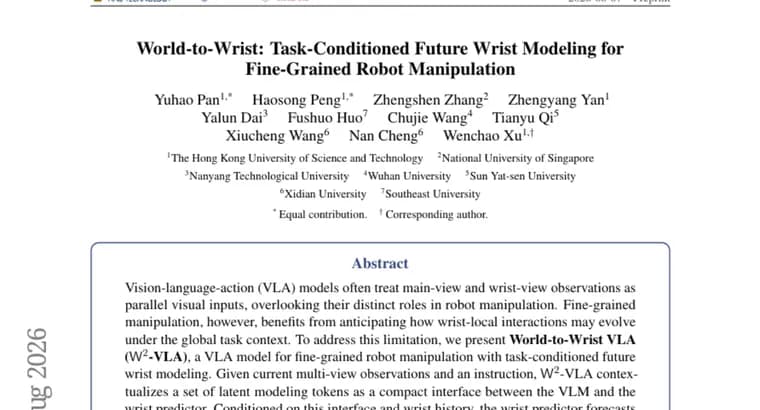
Researchers present World-to-Wrist VLA (W2-VLA), a vision-language-action (VLA) model built for fine-grained robot manipulation. Their starting observation: most VLA models feed a robot's main camera view and its wrist camera view into the model as if they were interchangeable, parallel inputs, even though the two play different roles in a manipulation task. The authors argue that fine, contact-sensitive manipulation benefits from anticipating how the wrist-local view will change under the broader task context, not just reading it alongside the main view. W2-VLA addresses this by taking current multi-view observations and a task instruction and contextualizing a set of latent modeling tokens that act as a compact interface between the vision-language model and a separate wrist predictor. That predictor, conditioned on the interface and the robot's observed wrist history, forecasts future wrist latents, which are then turned into future-aware context that feeds action prediction. Alongside the model, the team introduces W2-CoT, a synthesis pipeline that generates structured annotations covering manipulation progress, physical transition cues, and wrist-local evidence; these annotations serve as auxiliary supervision that shapes the task-conditioned latent interface during training. The authors report experiments on the LIBERO and RoboTwin 2.0 benchmarks plus real-world manipulation tasks, covering both single-arm and bimanual robot settings. They describe improved fine-grained and contact-sensitive manipulation across these settings while the system keeps action-generation rates above 80 Hz.
Key facts
- W2-VLA is a vision-language-action model that forecasts future wrist-camera latents conditioned on the task, rather than treating wrist and main-view images as parallel inputs.
- A set of latent modeling tokens forms the interface between the vision-language model and a wrist predictor, which uses observed wrist history to project future wrist-local context into action prediction.
- W2-CoT is a companion annotation pipeline generating structured labels for manipulation progress, physical transition cues, and wrist-local evidence, used as auxiliary supervision during training.
- The authors tested the approach on LIBERO, RoboTwin 2.0, and real-world tasks, in both single-arm and bimanual robot settings.
- The system reportedly keeps action-generation rates above 80 Hz while showing improved fine-grained, contact-sensitive manipulation.
Why it matters
Most VLA models treat a robot's main-view and wrist-view camera feeds as parallel, interchangeable inputs. The authors argue this misses the distinct role each view plays: the wrist camera captures the close, contact-level detail that matters most during fine manipulation, and that detail changes as the task unfolds. W2-VLA's core idea is to predict how the wrist view will evolve under the task context, rather than only reading its current state, so the model can plan for the contact and alignment moments that fine manipulation depends on.
Who it affects
The work targets researchers and engineers building manipulation policies for robot arms, particularly tasks requiring precise, contact-sensitive movements such as grasping, insertion, or assembly. It applies to both single-arm and bimanual robot configurations, based on the settings the authors tested.
How to use it
This is a research paper describing a model architecture (W2-VLA) and an accompanying annotation pipeline (W2-CoT) rather than a released product. The source text does not mention a code release, license, or availability, so none of that can be stated here.
How solid is it
The authors report results on two established manipulation benchmarks, LIBERO and RoboTwin 2.0, plus real-world tasks, and across both single-arm and bimanual settings, which spans simulated and physical evaluation. The source text names one concrete performance figure: action-generation rates above 80 Hz. It does not give specific accuracy or success-rate numbers for the benchmark results, nor does it include comparison figures against baseline models, so the size of the reported improvement cannot be quantified from this description.
Risks and caveats
The abstract text does not name the paper's authors or their institutions, so authorship cannot be attributed here beyond calling them the authors. Beyond the 80 Hz figure, the source gives no specific accuracy or success-rate numbers and no baseline comparisons, so claims of 'improved' manipulation rest on the authors' own description rather than figures that can be checked in this text.