Why simple up/down buttons often beat smart elevator kiosks
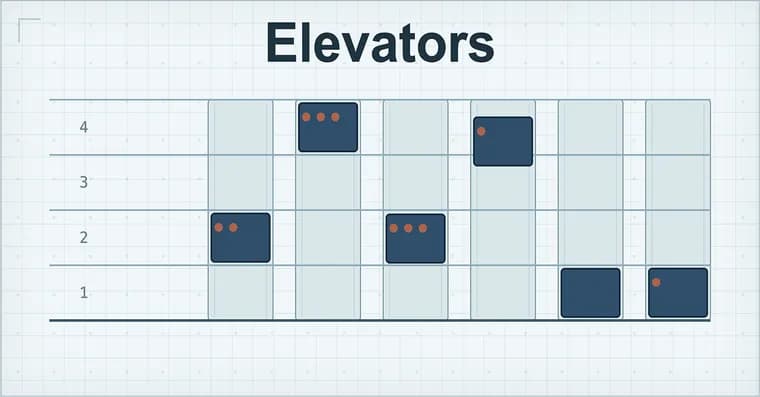
An article on john.fun explains how elevator dispatch actually works, starting from the simplest case of a single car. SCAN, patented in 1961, sends the elevator all the way to the top floor before it reverses, picking up and dropping off riders along the way. LOOK, the version most people actually experience, reverses as soon as the highest requested floor is served instead of continuing to the top.
With multiple cars, a central scheduler has to decide which elevator answers each call. The naive approach assigns every request to the nearest car, but the article argues a more sophisticated scheme does better: Otis' RSR (Relative System Response) algorithm scores every car for how well suited it is to take a given passenger, with lower scores winning. RSR penalizes a car if another car is already heading to the same floor in the same direction, and rewards idle cars sitting within two floors of the caller. Crucially, RSR re-optimizes every 5 seconds, so a passenger initially assigned to one car can be handed off to another if the first runs into delays.
The article measures elevator performance through the distribution of wait times rather than a single average, using percentiles such as p50 (the median wait) and p90 (the wait that 90 percent of riders beat). It notes that riders do not usually remember the average wait; they fixate on the p90 case, the times the elevator took forever. Traffic patterns also shift through the day: mornings are dominated by lobby-to-upper-floor trips, evenings reverse that flow, and mornings notoriously produce the worst wait statistics of any period.
Comparing LOOK against RSR head to head, the article reports a counterintuitive crossover: as the flow rate of passengers increases, LOOK starts to catch up to and outperform RSR, because when every car is full and stopping on nearly every floor, RSR's extra scoring rules stop mattering. LOOK also tends to win in small buildings with fewer elevators per bank, where there is less room for smarter coordination to pay off.
The piece then turns to Destination Dispatch, the newer kiosk-based systems where riders key in their target floor before boarding and get routed to a specific car rather than pressing a simple up or down button. Despite having far more information about where everyone is going, the article argues these systems are in general worse for wait times than traditional buttons. The reason is the same 5-second rebalancing step that makes RSR effective: it depends on being able to reroute a rider to a different car as conditions change, and a destination-dispatch kiosk locks a rider into one assigned car, trading away exactly the flexibility that made the button-based system adaptive. The article does identify a specific exception: in extremely tall buildings with 8 or more cars per elevator bank, kiosks can outperform buttons. For the majority of buildings, though, it says simple up and down buttons still win. The piece links to a full interactive simulation for readers to experiment with the algorithms themselves.
Key facts
- The SCAN elevator algorithm was patented in 1961; its LOOK variant reverses at the highest requested floor instead of always going to the top.
- Otis' RSR algorithm re-optimizes car assignments every 5 seconds, penalizing cars already headed to the same floor and rewarding idle cars within two floors of a caller.
- As passenger flow rate rises, and in small buildings with fewer cars per bank, the simpler LOOK algorithm starts to outperform RSR.
- Destination Dispatch kiosks are generally worse for wait times than traditional up/down buttons, except in extremely tall buildings with 8 or more cars per elevator bank.
- Riders tend to remember the p90 (worst-case) wait rather than the average, which is why the article measures elevator performance as a wait-time distribution rather than a single number.
Why it matters
The article turns something as mundane as waiting for an elevator into a case study in dispatch and queuing design, and lands on a genuinely counterintuitive result: giving an optimizer more information, as Destination Dispatch kiosks do by knowing every rider's target floor in advance, can make performance worse rather than better if it costs the system its ability to adapt. The reason is a rigidity trade-off, a kiosk locks a rider to one assigned car for the length of the trip, while a button-based system can reroute a rider to a different car mid-wait as conditions change. That trade-off between more information and less flexibility generalizes well beyond elevators.
Who it affects
Anyone who has waited for an elevator in a multi-car building, plus the engineers, building owners and vendors who choose between conventional buttons and destination-dispatch kiosks when specifying a new elevator bank. It also speaks to readers interested in dispatch and scheduling problems generally, since the article frames elevators as a concrete, everyday instance of a coordination problem.
How to use it
There is no product or price here; the practical takeaway is a design lesson. Building operators comparing elevator systems should weigh Otis-style RSR dispatch and simple buttons against Destination Dispatch kiosks with the article's finding in mind: kiosks only tend to win in extremely tall buildings with 8 or more cars per bank, and buttons are the safer default elsewhere. The article also links a full interactive simulation so readers can try the algorithms themselves rather than take the claims on faith.
How solid is it
The piece is a single independently published technical explainer on john.fun; it names no author and gives no publication date, and it is not a peer-reviewed study. Its wait-time percentile figures, a p90 of 2 minutes and a p50 of 1 minute, are explicitly illustrative example values used to explain how to read a histogram, not measurements from a real building. The comparisons between LOOK, RSR and Destination Dispatch are described qualitatively, stating which approach wins and under what conditions, without a numeric performance gap attached, and no elevator company besides Otis, and no specific building or deployment, is named as a source for the claims.
Risks and caveats
The conclusions are presented as general tendencies rather than universal rules, and the article itself flags the main exception: destination-dispatch kiosks can outperform buttons in extremely tall buildings with 8 or more cars per elevator bank. Real-world performance depends heavily on building height, car count and traffic pattern, so the article's qualitative comparisons should not be read as guaranteed outcomes for any specific building.
“It turns out these fancy kiosks are in general worse for wait times compared to the traditional good ol' up and down buttons.”
— the elevators article on john.fun