WithEveryone framework preserves identity in group images with up to 10 people
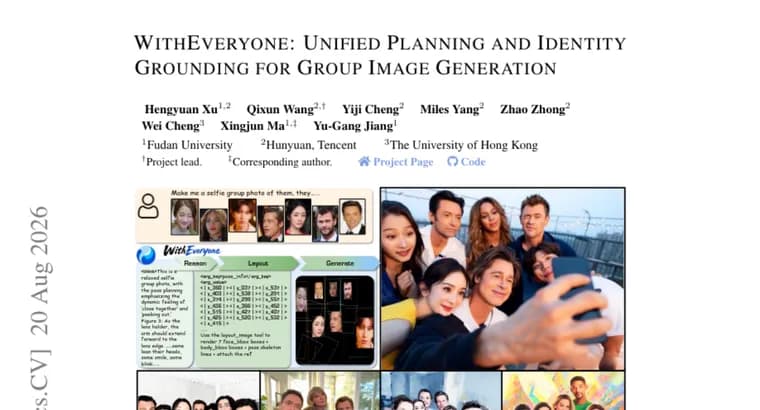
Identity-preserving image generation, producing an image that includes specific, recognizable people, gets harder as more named individuals share one scene. Beyond keeping each face recognizable, the generating model has to bind every reference to a distinct person and a distinct spot in the image, and training methods that must match up several predicted faces at once run into unstable correspondence problems.
Researchers introduce WithEveryone, a framework built to generate group images containing up to ten reference identities in a single scene. The system gives each selected identity its own addressed token, first predicts a structured identity-layout plan of who goes where, then renders that plan as a visual condition that guides the final image. Its main new component, Layout-Grounded ID Loss, uses annotated face regions to supervise each intended identity directly instead of relying on embedding-based face matching, which the authors describe as unstable. A second component, ID Representation Forcing, trains the model to predict a representation for each identity before the image itself is generated.
On an identity-disjoint benchmark, WithEveryone reached the highest target-context identity similarity among the methods compared. Face similarity rose from 0.462 for GPT-Image-2 to 0.499 for WithEveryone. In the same comparison, copy-paste artifacts, cases where a reference face looks pasted into the scene rather than newly rendered, fell from 0.169 to 0.055. WithEveryone also covered 97.3% of the identities a prompt requested, with a duplicate rate, the same identity appearing more than once, of only 2.8%.
The authors conclude that explicit identity-layout grounding lets identity-preserving generation scale to larger groups without depending on directly copying reference faces into the output.
Key facts
- WithEveryone is a new framework that generates a single image containing up to ten specified people while keeping each individual's identity distinct, tackling a known weak point in current identity-preserving generators.
- Its main technique, Layout-Grounded ID Loss, supervises each intended identity using annotated face regions instead of relying on unstable embedding-based face matching.
- A second component, ID Representation Forcing, trains the model to predict each identity's representation before the image itself is generated.
- On an identity-disjoint benchmark, WithEveryone raised target-context face similarity from 0.462 (GPT-Image-2) to 0.499, the highest among the methods compared, while cutting copy-paste artifacts from 0.169 to 0.055.
- The framework covers 97.3% of requested identities in its outputs, with a duplicate rate of only 2.8%.
Why it matters
Identity-preserving image generation, producing an image that includes specific, recognizable people, gets harder as more named individuals share one scene. Beyond keeping each face recognizable, the model has to bind every reference to a distinct person and a distinct spot in the image, and training methods that must match up several predicted faces at once run into unstable correspondence problems. WithEveryone addresses this with explicit identity-layout planning: it assigns each selected identity its own token, predicts a structured plan of who goes where, and renders that plan as a visual condition for the final image, with a new loss, Layout-Grounded ID Loss, that supervises each identity against an annotated face region rather than through embedding-based face matching. The authors present this combination as what lets identity-preserving generation scale to larger groups, up to ten people, without depending on directly copying reference faces into the output.
Who it affects
This work speaks to researchers and engineers building identity-preserving or personalized image generation, the technology behind AI avatar makers, multi-person portrait tools, and any system that has to render several specific, named people accurately in one scene rather than just one face at a time. It is a research contribution, not a shipped product, so the immediate audience is people building or evaluating generative image models rather than end users.
How to use it
The paper does not mention whether code, model weights, or a dataset will be released, so there is currently no way to run WithEveryone directly; it exists as a described method and a set of benchmark results, not as a released tool. Anyone wanting to use the approach would, for now, have to reimplement it from the description: identity tokens for each person, a predicted identity-layout plan, and the two training losses, Layout-Grounded ID Loss and ID Representation Forcing.
How solid is it
The headline numbers come from one reported comparison: on an identity-disjoint benchmark, WithEveryone's target-context identity similarity of 0.499 beats GPT-Image-2's 0.462, and its copy-paste artifact rate improves from 0.169 to 0.055. The paper says WithEveryone reached the highest identity similarity among the methods it was measured against, which implies other systems were tested too, but none besides GPT-Image-2 is named, so the size of that field is unclear. It is also not stated whether the 0.169 copy-paste baseline belongs to GPT-Image-2 specifically or to a different comparison point in the same test. The text does not name the authors, an institution, a venue, or a publication date, and it does not describe the training data or exactly how the identity-disjoint benchmark was built, so there is no way from this text alone to check the team's track record or how demanding that benchmark actually is.
Risks and caveats
Even with these improvements, the system is not perfect: it still misses 2.7% of the identities a prompt requests, since coverage is 97.3% rather than 100%, and it still produces a duplicate identity in 2.8% of cases. The failure modes the paper targets, mismatched or duplicated identities, are reduced by WithEveryone's approach, not eliminated.
“These results show that explicit identity-layout grounding enables identity-preserving generation to scale to larger groups without relying on direct reference-face copying.”
— the paper's authors