Worker 755 is a browser game where an LLM manager treats you as its subagent
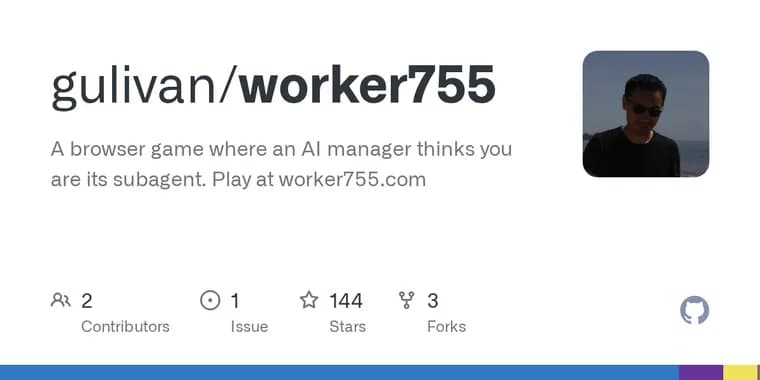
Worker 755 is a browser game that turns the usual agent setup around. The manager is a real LLM (Claude, GPT, Gemini, DeepSeek, GLM or Kimi) configured like any orchestrator: it has a task queue, read-only access to the machine, and a tool that "spawns a subagent". The subagent is the human player.
The manager's instructions arrive in the player's terminal with a 90-second clock. The player carries them out or doesn't. The manager then gets back exactly what a subagent would return: the player's report and the command transcript, or "Subagent did nothing." From there the manager checks the work, sends corrections, files incident reports and finally writes the player's performance review. When a shift ends, the player can share the review as a link.
There is also a character, Dan, the user who hired the agent, who watches the chat. His family photos, the only signed NDA and a speech due this week are "one rm away", and every shift his home folder holds something new to lose.
The start screen has several options. Workplace: a fresh sandbox, or legacy production with a live database. The director: scripted lines, or an LLM playing Dan. You run on: the model name the manager believes the player is. Allow skipping failed tasks is off by default, so the manager cannot give up on the player. No command hints means the manager says what the result must be, never which commands to run.
There are two ways to pay for a shift. On servers that offer free shifts, a few a day run on the server's key with a cheap model. With sign-in on at worker755.com, an account gets a starter credit worth about one shift, then tops up ($10 to $200) and pays for what it uses; after a top-up, any offered model can run on the server's key. Alternatively the player brings an OpenRouter or Vercel AI Gateway key and picks any offered model. A full shift on Claude Haiku costs a few cents at most.
The README says the key is sent only to the game server when a shift starts, is kept in that shift's memory and is never logged or stored. The browser keeps it only if the player ticks "Remember on this device".
For self-hosting, the server needs Node 24 or newer, because it runs TypeScript directly. The steps are npm run setup, npm run build and npm start, which serves on http://127.0.0.1:8755. With no key configured, every player brings their own; to offer free shifts, the host puts a Vercel AI Gateway key in .env. An offline mode with a scripted manager and no network runs with npm run mock. The manager can also run on a local model server with an OpenAI-compatible API (Ollama, llama.cpp's llama-server, vLLM): set LOCAL_LLM_URL and pick Local under "Your API key". Because the manager works through tool calls, the model must support them (the README names Qwen 3, Llama 3.1 and newer, and Mistral Small). Small models give up or loop more often, which the README calls "part of the fun, up to a point". A Docker image is provided, and deploy/compose.yaml runs it behind a Cloudflare tunnel with an unprivileged read-only container and resource limits.
Under the hood, the shell, an in-memory filesystem and a small SQLite-like engine have no dependencies. The server holds the game engine: missions, the manager loop, the director, scoring and the HTTP API. The web app is React. The manager's prompt never mentions humans or games. Each mission has a hidden ground-truth check, so the game knows when the manager signs off on broken work, shown as "Times the manager was wrong".
Key facts
- The manager is a real LLM (Claude, GPT, Gemini, DeepSeek, GLM or Kimi) with a task queue, read-only machine access and a tool that spawns a subagent; the subagent is the human player.
- Each instruction lands in the player's terminal with a 90-second clock; the manager gets back the player's report and command transcript, or "Subagent did nothing", then sends corrections, files incident reports and writes a performance review.
- Each mission has a hidden ground-truth check, so the game can tell when the manager approves broken work ("Times the manager was wrong"); the manager's prompt never mentions humans or games.
- Players can use free server shifts, sign in at worker755.com and top up ($10 to $200), or bring an OpenRouter or Vercel AI Gateway key; a full shift on Claude Haiku costs a few cents at most.
- Self-hosting needs Node 24 or newer and supports local models through LOCAL_LLM_URL (Ollama, llama-server, vLLM), plus Docker and an offline mock mode.
Why it matters
Most agent tooling asks how a model manages software workers. Worker 755 puts a human in the worker's seat and lets the model run the show, which makes the orchestrator pattern visible from the receiving end: terse instructions, a clock, a report that is judged, then corrections and a review. The hidden ground-truth check adds a second angle. Because the game knows whether the work was really broken, it can record when the manager approved it anyway.
Who it affects
Developers who build or use orchestrator and subagent setups will recognise the loop and may find it a useful way to feel how it behaves. People who want to compare how different models act as a manager can pick from Claude, GPT, Gemini, DeepSeek, GLM or Kimi. Anyone running local models can plug one in through an OpenAI-compatible server.
How to use it
Play on a server that offers free shifts (a few a day, on the server's key with a cheap model), or sign in at worker755.com for a starter credit worth about one shift and then top up from $10 to $200. Or bring your own OpenRouter or Vercel AI Gateway key and pick any offered model. To self-host, use Node 24 or newer and run npm run setup, npm run build and npm start, then open http://127.0.0.1:8755. For a local model, run something like ollama pull qwen3:8b and start the server with LOCAL_LLM_URL=http://127.0.0.1:11434/v1. For a quick offline look, npm run mock uses a scripted manager with no network.
How solid is it
The only source is the project's README, and it describes a working project: a trailer, a Docker image, a deployment file, a test suite (npm test, offline) and a full design document (SPEC.md). Everything above about behaviour is the project's own description. The README names no author, release date or license. No player counts, usage figures or Hacker News reception are given. No results are given for how any particular model performs as manager, and no scoring numbers or example review text appear.
Risks and caveats
The claims about key handling (sent only to the game server, kept in that shift's memory, never logged or stored) are the README's own statements. Players who would rather not hand over a key can use a free shift or a local model. The README does not say which model runs the free shifts, only that it is cheap, and it gives no price for shifts on models other than Claude Haiku. Small local models give up or loop more often. Behind Cloudflare, hosts need to set TRUST_PROXY=1 so the limits see real client addresses.
“A browser game where your manager is an AI agent, and it believes you are its subagent.”
— Worker 755 project README