WorldCycle cuts video world model drift using reversible action cycles
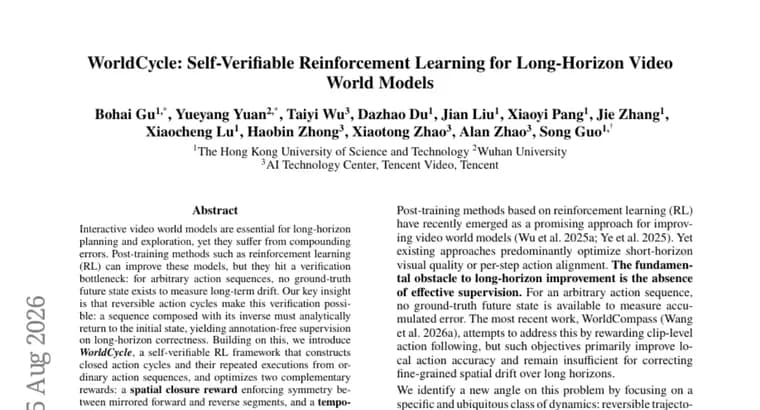
Interactive video world models are meant to support long-horizon planning and exploration, but they suffer from compounding errors over time. Reinforcement learning can sharpen a pretrained model, yet it runs into a verification bottleneck: for an arbitrary sequence of actions there is no ground-truth future state to compare against, so long-term drift could not previously be measured or optimized directly.
The key insight behind WorldCycle is that reversible action cycles solve this. If a sequence of actions is composed with its own inverse, the model must analytically return to the state it started from; any deviation from that return is itself a usable training signal, without any human annotation of the correct future state.
Building on this, WorldCycle constructs closed action cycles, and repeated executions of them, out of ordinary action sequences, then optimizes two rewards together: a spatial closure reward that enforces symmetry between the mirrored forward and reverse segments of a cycle, and a temporal consistency reward that aligns states across repeated executions of the same cycle. Together these push the model to treat actions as consistent operators on the world state rather than as memorized temporal patterns, and the approach extends naturally to out-of-distribution composite action cycles that the base model handles poorly.
The researchers also release CycleBench, a diagnostic benchmark for testing state-returning ability under complex, composite action structures.
On the reported results, WorldCycle reduces state-returning drift by up to 44% and lifts composite-action accuracy nearly 4x over the base model, which the authors present as a foundation for physically grounded world models.
Key facts
- WorldCycle is a self-verifiable RL framework for long-horizon video world models that uses reversible action cycles as annotation-free supervision.
- It optimizes a spatial closure reward (symmetry between forward and reverse segments of a cycle) together with a temporal consistency reward (state alignment across repeated cycle executions).
- WorldCycle reduces state-returning drift by up to 44% compared with the base model.
- It lifts composite-action accuracy nearly 4x over the base model, including on out-of-distribution composite action cycles the base model struggles with.
- The team releases CycleBench, a diagnostic benchmark for state-returning ability under complex action structures.
Why it matters
Interactive video world models underpin long-horizon planning and exploration, but errors compound as the horizon grows. Reinforcement learning can refine such a model after pretraining, yet for an arbitrary action sequence there is no ground-truth future state to check the outcome against, so long-term drift had no direct way to be measured or optimized. WorldCycle's answer is to exploit reversibility: composing an action sequence with its inverse must analytically bring the model back to its starting state, and any gap between the two is itself the training signal, with no human annotation required.
Who it affects
The work is aimed at researchers and engineers building interactive video world models for long-horizon planning and exploration, and more broadly at anyone pursuing physically grounded world models, since the state-returning problem it addresses sits underneath that whole line of work. The source text gives no author names or institutional affiliation, and names no company or product beyond the WorldCycle framework itself; this is a research contribution, not a released product.
How to use it
As described, WorldCycle is a post-training recipe applied on top of an existing base video world model, not a new architecture in its own right: construct closed action cycles and their repeated executions from ordinary action sequences, then optimize the spatial closure and temporal consistency rewards together. The accompanying CycleBench benchmark is offered for evaluating state-returning ability under complex action structures. The source text gives no details on code or dataset release, model size, or the compute used for training.
How solid is it
The claims rest on a single paper's abstract. Results are reported only as relative improvements, up to 44% drift reduction and nearly 4x accuracy gain, without the baseline or absolute accuracy figures needed to independently gauge the scale of either number. The headline gains are also measured on CycleBench, a benchmark built by the same researchers, so the text describes no independent replication of the results.
Risks and caveats
The benchmark used to demonstrate the largest gains was built by the same team that built WorldCycle, which is worth flagging as a source of possible bias. No baseline numbers, training setup, or compute budget are given, which limits comparison against other approaches. No author names, institutional affiliation, or publication venue appear in the source text, so provenance cannot be independently checked from what is provided here.
“a sequence composed with its inverse must analytically return to the initial state, yielding annotation-free supervision on long-horizon correctness”
— WorldCycle paper