Xiaomi-Lens-0, a 4B model on Qwen3.5, decodes masks from its own visual latents
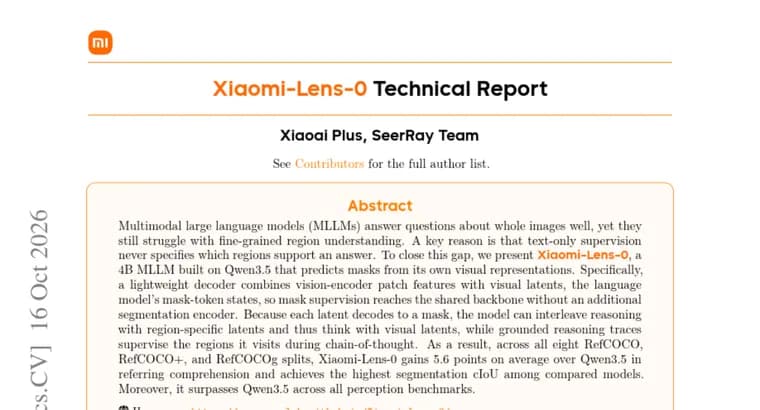
Multimodal large language models answer questions about whole images well, but they still struggle with fine-grained region understanding. The authors of the Xiaomi-Lens-0 technical report say a key reason is that text-only supervision never specifies which regions support an answer.
Their fix is Xiaomi-Lens-0, a 4B multimodal model built on Qwen3.5 that predicts masks from its own visual representations. A lightweight decoder combines patch features from the vision encoder with what the report calls visual latents, meaning the language model's mask-token states. Because of this, mask supervision reaches the shared backbone without a separate segmentation encoder.
Each latent decodes to a mask, so the model can interleave its reasoning with region-specific latents and, in the authors' words, think with visual latents. Grounded reasoning traces supervise the regions the model visits during chain-of-thought.
The reported results: across all eight RefCOCO, RefCOCO+ and RefCOCOg splits, Xiaomi-Lens-0 gains 5.6 points on average over Qwen3.5 in referring comprehension. It also achieves the highest segmentation cIoU among the compared models, and it surpasses Qwen3.5 across all perception benchmarks. A project homepage is linked from the abstract.
Key facts
- Xiaomi-Lens-0 is a 4B multimodal LLM built on Qwen3.5 that predicts masks from its own visual representations.
- A lightweight decoder combines vision-encoder patch features with the language model's mask-token states (visual latents), so no additional segmentation encoder is needed.
- Because each latent decodes to a mask, the model can interleave reasoning with region-specific latents, and grounded reasoning traces supervise the regions it visits during chain-of-thought.
- Across all eight RefCOCO, RefCOCO+ and RefCOCOg splits it gains 5.6 points on average over Qwen3.5 in referring comprehension.
- The authors report the highest segmentation cIoU among compared models and gains over Qwen3.5 across all perception benchmarks.
Why it matters
The report targets a known weak spot: models that describe a whole image well but are poor at fine-grained region understanding. The authors blame text-only supervision, which never says which regions support an answer. Their approach ties reasoning to explicit masks, and it does so inside the same backbone rather than by bolting on a separate segmentation encoder.
Who it affects
Mainly researchers and engineers working on multimodal models, referring expression comprehension and segmentation, especially those building on Qwen3.5. The abstract does not describe any product use.
How to use it
The abstract links a project homepage (seerray-lab.github.io/Xiaomi-Lens-0). It does not state a release date, licence or weights availability, so anyone interested should start from that page.
How solid is it
This is a technical report, and what is summarised here comes from its abstract. The only quantified result is the 5.6-point average gain over Qwen3.5 on referring comprehension, taken across all eight RefCOCO, RefCOCO+ and RefCOCOg splits. That is a difference in points, not a percentage. The other claims (highest segmentation cIoU among compared models, better than Qwen3.5 on all perception benchmarks) are given without scores, named competitors or named benchmarks.
Risks and caveats
The abstract gives no absolute scores, so the size of the segmentation lead cannot be judged. The compared models and the perception benchmarks are not named, and the Qwen3.5 variant used as the baseline is not stated. The claims are the authors' own, and nothing here covers compute cost, inference speed or the training procedure.