YouTube Music launches labels for AI-generated songs, with creator declarations
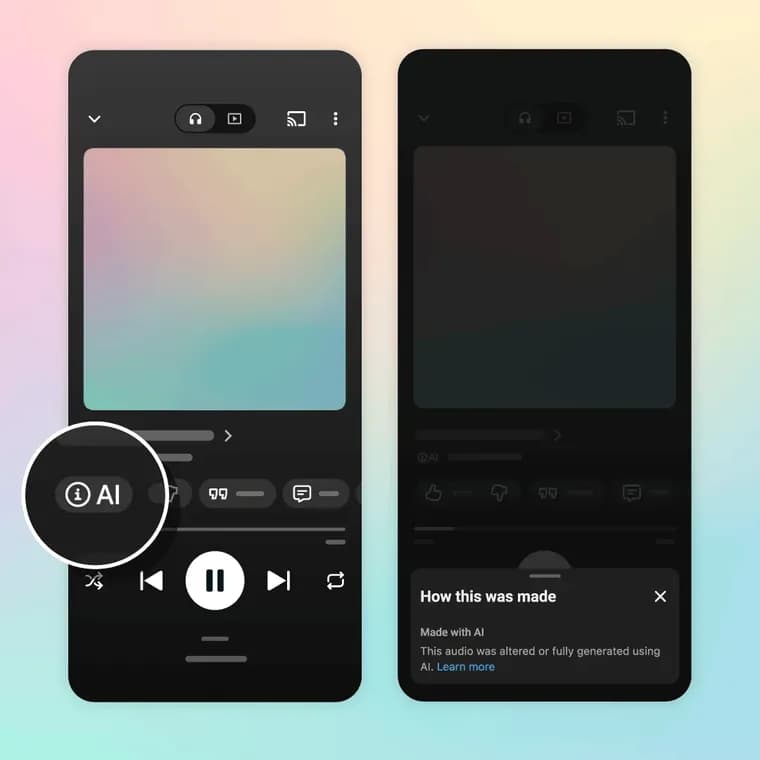
YouTube Music announced on Wednesday the rollout of a new labeling system meant to improve transparency around songs created with the help of generative AI. Listeners will be able to identify tracks made using AI, including those where AI was involved in composition and vocals.
The label appears on the player page. Clicking it opens additional information about the specific role AI played in the track's creation. The labels will also extend to the main YouTube app.
YouTube said it worked with various music partners and deployed its own detection tools to identify AI-generated music. According to its help page, partners using YouTube can declare their work's use of generative AI through one of three designations: Fully Gen AI, Partly Gen AI, or No Gen AI. "Fully Gen AI" applies to tracks entirely generated by AI. "Partly Gen AI" refers to works where artists may have incorporated AI-generated components but added their own live elements. Tracks edited with pitch-correction tools such as Auto-Tune fall under "No Gen AI".
The move comes as AI-generated music spreads quickly across streaming services, and platforms are taking different approaches. Apple Music plans to introduce "Made With AI" labels as part of its AI Transparency Tags later this year. Spotify already has AI labels and a music spam filter. Deezer has taken one of the stricter stances: in July it reported receiving nearly 90,000 fully AI-generated tracks daily. It labels detected AI-generated music, excludes it from algorithmic recommendations and editorial playlists, and withholds royalties from fraudulent streams. It is also working on an option to let users filter out AI-generated music. TIDAL labels recordings it identifies as entirely AI-generated, lets listeners disable them, and excludes them from royalty attribution.
YouTube, by contrast, is focusing on disclosure rather than blanket restrictions. The new labels are meant to inform listeners about AI's role in music creation, but AI involvement alone does not make a track ineligible for monetization. YouTube also experiments with AI-powered music creation itself, including Dream Track, which lets select creators generate soundtracks featuring AI-generated versions of participating artists' voices.
Key facts
- YouTube Music announced on Wednesday a labeling system for songs created with the help of generative AI; the label appears on the player page and opens details on AI's specific role in the track.
- The labels will also extend to the main YouTube app.
- Partners can declare generative AI use through one of three designations: Fully Gen AI, Partly Gen AI, or No Gen AI; tracks edited with pitch-correction tools such as Auto-Tune count as No Gen AI.
- YouTube says it worked with music partners and deployed its own detection tools to identify AI-generated music.
- YouTube is choosing disclosure over blanket restrictions: AI involvement alone does not make a track ineligible for monetization, whereas Deezer and TIDAL exclude fully AI-generated tracks from royalties or recommendations.
Why it matters
AI-generated music is flooding streaming services, and each platform is choosing its own response. Deezer reported in July that it was receiving nearly 90,000 fully AI-generated tracks daily. YouTube Music picks disclosure over restriction: tracks get labeled, but AI involvement alone does not block monetization. That puts it at the lighter end of the range, away from Deezer's stricter stance and TIDAL's opt-out and royalty exclusion.
Who it affects
Listeners on YouTube Music, who get a label on the player page and, later, in the main YouTube app. Partners and artists who use YouTube, who can declare their work's use of generative AI through the three designations. Musicians who use pitch correction such as Auto-Tune, whose tracks fall under No Gen AI. Competing streaming services such as Apple Music, Spotify, Deezer and TIDAL, which handle AI music in their own ways.
How to use it
As a listener, look for the label on the player page and click it to see the specific role AI played in the track. As a partner, declare generative AI use with one of the three designations on YouTube: Fully Gen AI for tracks entirely generated by AI, Partly Gen AI for works that mix AI-generated components with the artist's own live elements, and No Gen AI, which includes tracks edited with pitch-correction tools such as Auto-Tune. The source does not say whether listeners can filter or disable AI-labeled music on YouTube Music.
How solid is it
The account is a news report on YouTube Music's announcement, and the designation definitions come from YouTube's help page as the article cites it. YouTube's statements about working with music partners and deploying detection tools are attributed to YouTube. The announcement is dated only as "Wednesday", and no timeline is given for the rollout to the main YouTube app. The source does not name the partners.
Risks and caveats
The source does not say how YouTube's detection tools work or how accurate they are, and gives no figures on how many tracks YouTube has labeled or receives. Because partners declare AI use themselves, the labels depend on those declarations alongside detection. The categories are broad: "Partly Gen AI" covers works where artists may have incorporated AI-generated components. Labeling does not limit monetization, and YouTube also runs AI music experiments such as Dream Track, so disclosure sits alongside the company's own AI music tools.