Zetta harness hits state-of-the-art on robot benchmarks with 11.1x faster inference
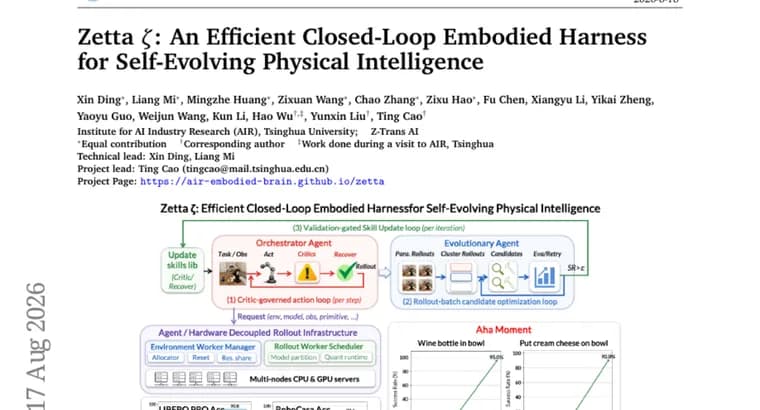
Robot systems built as agentic harnesses on top of end-to-end policy models have a structural problem, according to the authors: they are open-loop. During a rollout the harness follows a fixed set of skills and only reflects on what went wrong after the episode ends. That kind of after-the-fact reflection cannot steer execution while it is happening, because physical interaction changes the robot-environment state faster than today's large agentic models can track and respond to in real time.
The authors present Zetta, a closed-loop embodied harness meant to fix this by evolving online while the underlying base policy is kept frozen. Instead of one feedback loop, Zetta runs three loops operating on different timescales: one for action-frequency governance, deciding how fast the harness itself needs to act; one that proposes critic and recovery updates at the level of a rollout; and one that gates any skill update behind validation before it is adopted. Alongside Zetta, the authors built Z-Infra, a rollout infrastructure that separates the agent's decision-making logic from the specific, heterogeneous hardware it runs on.
On evaluation, Zetta reaches 90.8% and 93.6% success respectively on the LIBERO-Pro and RoboCasa robotics benchmarks, which the authors describe as state-of-the-art under their current rollout budget, alongside an 11.1x speedup in inference; the abstract does not name what baseline the speedup is measured against. The authors also report three further findings without elaborating on any of them: success keeps improving as the system accumulates more self-exploration experience, skills it learns transfer to new situations zero-shot, and the system displays what they call clear robotic 'Aha Moments', a term the abstract does not define or explain how it was observed.
Key facts
- Zetta keeps the underlying robot policy frozen and instead evolves its own code-based runtime critics and recovery skills online, through three loops that run on different timescales: action-frequency governance, rollout-level critic-recovery proposals, and validation-gated skill updates.
- Paired with Z-Infra, an infrastructure layer that separates the agent's decision logic from the specific hardware running each rollout, Zetta reaches 90.8% and 93.6% success on the LIBERO-Pro and RoboCasa benchmarks respectively, which the authors call state-of-the-art under their current rollout budget.
- Inference runs 11.1x faster with Zetta and Z-Infra together, though the abstract does not name the baseline system or configuration the speedup is measured against.
- The authors report three further findings without elaborating on them: success keeps improving with more self-exploration experience, learned skills transfer to new situations zero-shot, and the system shows what they call "Aha Moments".
Why it matters
Most agentic layers built on top of robot policy models are open-loop: they run a fixed skill during a rollout and only reflect on the outcome once the episode is over, which is too slow to correct behavior while it is happening. Zetta closes that loop. It evolves its own runtime critics and recovery skills online, while leaving the underlying policy untouched, through three loops running on different timescales rather than one single feedback cycle. If the approach holds up beyond the two benchmarks tested here, it points at a way to make agentic robot control genuinely responsive during execution rather than just self-critiquing after the fact.
Who it affects
This is a research contribution aimed at people building agentic harnesses for robot manipulation, not an end-user product. Teams working on embodied AI, robot learning infrastructure, or anyone pairing a frozen policy model with an agent layer for execution-time decisions are the direct audience. The benchmarks used, LIBERO-Pro and RoboCasa, are both robot manipulation testbeds, so the immediate relevance is to manipulation tasks rather than robotics broadly.
How to use it
This abstract describes an architecture, not a product with pricing or a release process. The reusable idea is the split between a frozen base policy and a separate harness that evolves three things on three different timescales: how fast it governs actions, what critic-and-recovery updates it proposes after a rollout, and which skill updates pass validation before being kept. The companion piece, Z-Infra, addresses a practical engineering problem for anyone trying to reproduce this kind of system: it decouples the agent's decision logic from the specific, heterogeneous hardware running the rollouts.
How solid is it
The headline numbers are concrete: 90.8% and 93.6% success on LIBERO-Pro and RoboCasa respectively, and an 11.1x inference speedup, all from the authors' own reporting in the abstract. Two things temper that: the state-of-the-art claim is explicitly scoped to "our current rollout budget," meaning the comparison may not hold under a different budget or resource constraint, and the abstract does not say what system or configuration the 11.1x speedup is measured against. The additional claims, that success keeps scaling with self-exploration experience, that learned skills transfer zero-shot, and that the system shows "Aha Moments," are stated but not elaborated on in this text: no method for observing or measuring an "Aha Moment" is given here.
Risks and caveats
The clearest caveat is the scoping language: results are described as state-of-the-art "under our current rollout budget," which is the authors' own framing, not an unconditional claim over all conditions. The 11.1x speedup figure lacks a stated baseline, so its practical meaning depends on a comparison not given in this text. The abstract also introduces evocative terms, like robotic "Aha Moments," borrowed from language usually applied to human learning, without defining what qualifies as one or how it was detected. As with any single-paper abstract, this describes the authors' own evaluation on two specific benchmarks, not an independent replication.