Zing-0.5 world model lets you steer generated worlds in real time
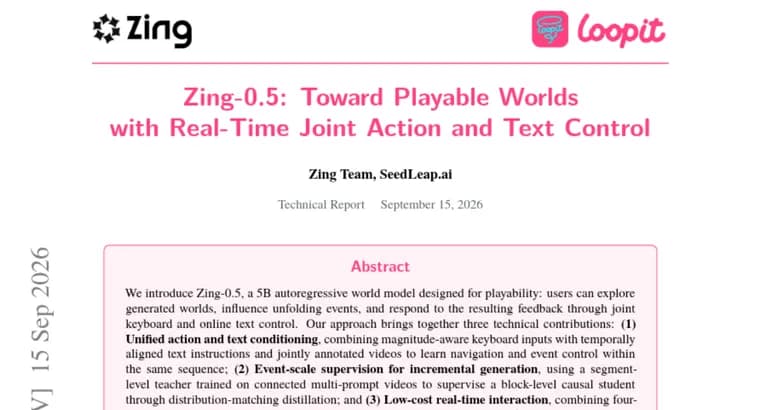
A team has introduced Zing-0.5, a 5 billion parameter autoregressive world model built for playability: rather than only watching a generated video, users can explore the world it produces, influence how events unfold, and get responses back through a combination of keyboard input and typed text instructions issued while the simulation runs.
The system rests on three technical pieces. First, unified action and text conditioning trains the model on jointly annotated videos that pair magnitude-aware keyboard inputs with text instructions aligned in time, so navigation and event control are learned within the same sequence rather than as separate systems. Second, event-scale supervision for incremental generation uses a larger segment-level teacher model, trained on videos stitched together from multiple prompts, to supervise a smaller block-level causal student through distribution-matching distillation. Third, a low-cost real-time interaction setup combines four-step generation with context-preserving streaming, which is what lets the model run inference at 832 x 480 resolution and 24 FPS, at an estimated server rental cost of about USD 0.009 per stream-minute.
On the WBench Navigation benchmark, evaluated across 158 cases, Zing-0.5 scores 81.0 overall and 88.5 on consistency. The team also shows a joint-control demonstration in which a typed instruction changes an in-progress event while navigation continues, without restarting generation.
The model weights, the inference code, and a serving implementation called Zing-SGLang are released publicly, aimed at supporting further work on playable generated worlds.
Key facts
- Zing-0.5 is a 5B-parameter autoregressive world model that supports real-time joint keyboard and text control of generated worlds.
- It runs inference at 832 x 480 resolution and 24 FPS using four-step generation and context-preserving streaming, at an estimated server cost of about USD 0.009 per stream-minute.
- On WBench Navigation, across 158 cases, Zing-0.5 scores 81.0 overall and 88.5 on consistency.
- A joint-control demonstration shows a text-directed event change mid-navigation without restarting generation.
- The model weights, the inference code, and the Zing-SGLang serving implementation are released publicly.
Why it matters
Most generated video and world models are watched, not used: once generation starts, a viewer cannot change what happens next. Zing-0.5 targets the harder problem of playability, combining keyboard-style navigation with typed text instructions inside a single model, and doing it fast enough (24 FPS, with real-time streaming) to feel like an interactive session rather than a rendered clip. Releasing the weights, the inference code and a dedicated serving stack, Zing-SGLang, lowers the bar for other groups to build on interactive world models instead of starting from scratch.
Who it affects
Researchers working on generative world models and playable video generation gain a released model, a training recipe built around event-scale distillation, and a serving implementation to build on. It also speaks to anyone prototyping interactive AI-generated environments, since the reported cost, about USD 0.009 per stream-minute, puts real-time sessions within reach without building specialized inference infrastructure from scratch.
How to use it
The team releases the model weights, the inference code, and Zing-SGLang, a serving implementation built for this model, so others can run Zing-0.5 directly instead of reimplementing the streaming pipeline themselves.
How solid is it
The main quantitative evidence is a pair of scores on WBench Navigation: 81.0 overall and 88.5 on consistency, measured across 158 cases. No comparison to any other world model or baseline is given, and no description of how WBench Navigation is scored is provided beyond the two named figures, so it is not possible to judge from this material how strong those scores are relative to competing systems. The joint-control demonstration is a single qualitative example, not a benchmarked capability.
Risks and caveats
The abstract names no authors, institution or publication venue, so the work cannot be attributed or independently checked here. There is also no comparison against other world models, so claims about playability or real-time performance cannot be weighed against existing systems from this material alone. The cost and speed figures are the team's own estimates, not an independently measured result.
“A joint-control demonstration shows a text-directed event change during continued navigation without restarting generation.”
— the authors