Zotero at 20: Dan Cohen says slow formation made it durable
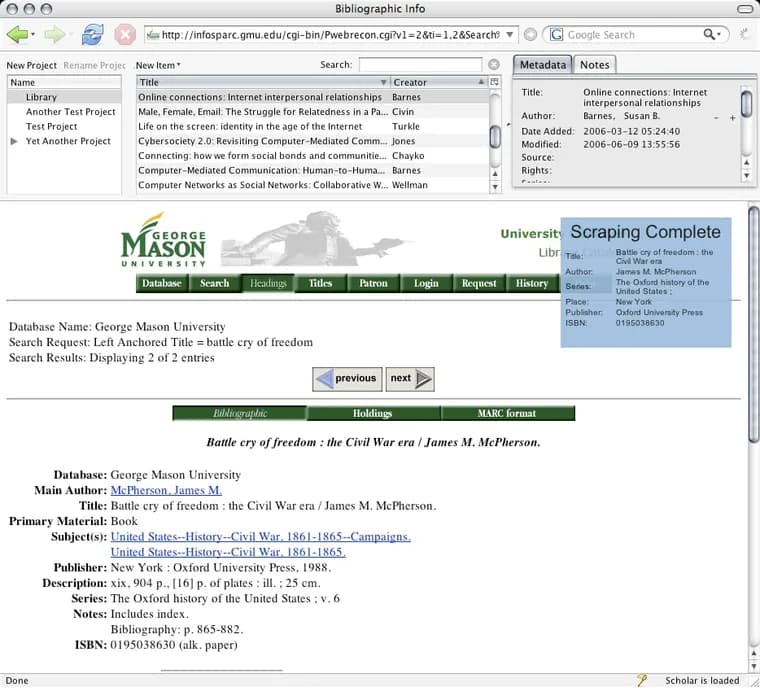
Dan Cohen wrote this essay for the 20th anniversary of Zotero's launch on October 5, 2006. He sets it against a present in which, as he puts it, software can be created more or less instantly with AI, and he cites Robin Sloan's line to "ask for what you want." Zotero, which describes itself as a "free, easy-to-use tool to help you collect, organize, annotate, cite, and share research" and which Cohen says is used by over 20 million people, came about the opposite way. By his account it took five years, not five minutes, to produce a rough initial prototype, and years more to refine and expand it.
His central claim is that AI would not have helped at the start. Had it existed in the early 2000s, he writes, the team could not have accelerated Zotero's conception, because they did not know exactly what they wanted and so could not have written coherent prompts for an LLM. It took a great deal of time and collaboration to develop a clear vision. That slow formation, he says, produced software that was durable rather than ephemeral, with a strong foundation to build on. He adds that as programming increasingly becomes "a caffeinated bender with magical bots," this measured pace and emphasis on communal thinking likely holds an important lesson. He frames the piece as a personal account, not a full history: it is from his own perspective, and he points readers to Zotero's Credits and Acknowledgments page for the wider group of contributors.
Cohen's role dates to the years before and just after the 1.0 beta, when he was an Assistant Professor of History and Director of Research at the Center for History and New Media at George Mason University. The center is now named for its founder Roy Rosenzweig, whom Cohen calls the visionary historian behind the center and the field of digital history. Rosenzweig died in 2007 at 57; Cohen later succeeded him as director and handed day-to-day work to others, including lead developer Dan Stillman and Sean Takats, who has overseen the project's growth for much of the last two decades.
The pre-history starts with a center that had not planned to write software. Founded in 1994, it mostly built websites. Cohen joined in January 2001 as a new Ph.D. and, with Jim Sparrow, built ECHO (Exploring and Collecting History Online), funded by the Alfred P. Sloan Foundation. To let scientists document their own work online, the site needed interactive "tools," so Cohen wrote several PHP web apps. One, Web Scrapbook, let students capture images, links and other resources from the browser, via a bookmark with embedded JavaScript, into a shared collection. It gained traction in classes but was not rigorous: his first version sent passwords unencrypted across the internet, and it paid little attention to the metadata needed for a proper footnote.
Meanwhile Elena Razlogova, the center's webmaster while pursuing her Ph.D., built Scribe in FileMaker, a note-taking and citation app that users downloaded and ran on their own computers. It became popular with historians as a free replacement for commercial software such as EndNote, and had the organizing, search, metadata and annotation features Zotero later expanded on.
By 2003 the team knew how to write both web apps and standalone apps and found both insufficient. They wanted a research tool that could work independently of the web yet be aware of what happened in the browser as a researcher moved through digital collections and library catalogs. On November 29, 2003, Rosenzweig asked Razlogova what she wanted in a next version of Scribe, as the group prepared a grant proposal for a new stage of ECHO. Her December 1 reply was a nine-item list: connection to online bibliographic databases, more citation styles (at least APA and legal), custom citation styles, more fields and reference types, shared and co-edited online bibliographies, working locally then publishing online, foreign language support, a better manual, and an online discussion list. Tom Scheinfeldt answered that it would be nice to "update and 'webify' Scribe." Cohen quotes his own later journal article: "We wanted the best of both worlds: the best parts of standalone applications and Web applications." How to merge them, he says, was not at all clear in 2003.
The center kept a large whiteboard of vague ideas and talked over group lunches about new technology. In summer 2004 it was joined by Josh Greenberg, Sharon Leon and Simon Kornblith, then a young teenager gifted at software development. Kornblith later earned a Ph.D. at MIT, wrote AI papers with Geoffrey Hinton and worked at Anthropic. The team noticed Firefox, then in beta, and especially its XUL interface language, which they realized let them customize and extend the browser in any way they wanted. On November 9, 2004, the day Firefox was released, Cohen emailed Greenberg, Razlogova, Scheinfeldt and Rosenzweig with the subject line "Firefox + XUL + AWS = OpenScribe/Online Scribe?" The AWS was an Amazon API for retrieving book information, not the later cloud service. He proposed a Firefox extension that would "automatically load citation info into the fields." Greenberg replied just before midnight: "Holy crap, that's cool!" The text available here ends there, before the 1.0 build is described.
Key facts
- Dan Cohen marks Zotero's 20th anniversary (launched October 5, 2006) with a first-person account of its pre-history at the Center for History and New Media at George Mason University.
- He says it took five years, not five minutes, to produce a rough initial prototype, and argues AI could not have sped up its conception because the team did not yet know what it wanted.
- Zotero grew from two earlier tools: Web Scrapbook, a PHP web app by Cohen, and Scribe, a FileMaker app by Elena Razlogova that historians used as a free alternative to EndNote.
- Elena Razlogova's December 1, 2003 wish list for Scribe and Firefox's XUL, noticed in 2004, pushed the team toward a research tool living inside the browser.
- Cohen's lesson, hedged with "likely": the measured pace and communal thinking behind Zotero hold an important lesson for AI-driven programming.
Why it matters
The essay answers a live question: does fast, prompt-driven software creation replace the slow work of deciding what to build? Cohen's case is that for Zotero the hard part was not writing code but working out the vision, and that took years of conversation at a big table, some of it, he admits, wasted time. He says that slow formation gave Zotero a strong foundation that could be built upon, and that the tool is now used by over 20 million people. The piece also records the concrete lineage behind a widely used research tool: Web Scrapbook, Scribe, the ECHO project and the Firefox XUL discovery.
Who it affects
Mainly people who build software and those who lead such teams, since Cohen draws a lesson for AI-driven programming. It also touches researchers and historians who use Zotero or tools like it, and the digital humanities community around the Roy Rosenzweig Center for History and New Media. Cohen's own users in the story were students, instructors and fellow historians, who adopted Web Scrapbook and Scribe long before Zotero existed.
How to use it
This is an essay, not a release, so there is nothing to install. A reader can take it as a case study: the team started from real tools people already used, gathered concrete requests (Razlogova's nine-item list), kept ideas visible on a shared whiteboard, and tested new platforms the day they appeared. Cohen also directs readers to Zotero's Credits and Acknowledgments page and to a post by Sean Takats on Zotero's continual improvement and influence since launch.
How solid is it
It is a first-person retrospective by someone who was there, and Cohen says plainly that it is from his own perspective and not a full accounting. Dates, emails and quotes from the 2003 and 2004 exchanges are given in detail. The central claims about AI and durability are his reading, not measured results. The portion available ends on November 9, 2004, before the 1.0 beta's design and build are described.
Risks and caveats
The argument is an inference from one project's history; Cohen hedges his own conclusion with "likely." The source does not claim AI tools cannot help build software today; the claim is only that AI would not have sped up Zotero's conception, because the team could not have written coherent prompts. The 20 million user figure is the author's statement, without a breakdown or date. The five-year prototype timeline is not tied to specific start and end dates in the text available.
“It took five years, not five minutes, to produce a rough initial prototype”
— Dan Cohen, The Slow Formation of Durable Software