A new metric for 'interesting' math theorems cuts overlap with Mathlib from 91.9% to 30.6%
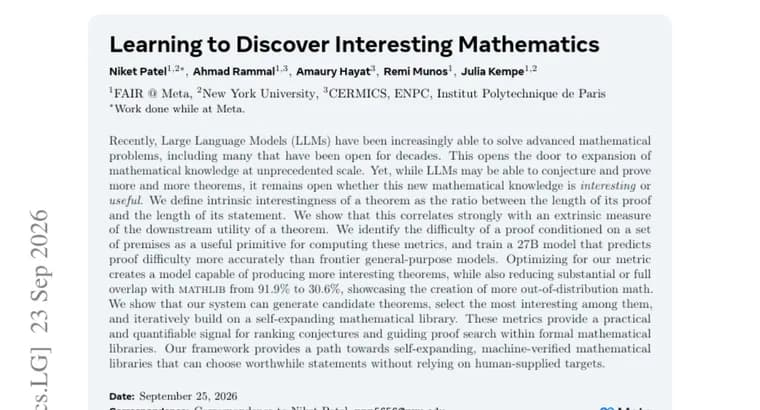
Large language models can now solve advanced math problems, including some open for decades, raising the possibility of expanding mathematical knowledge at large scale. But the researchers behind this work point out that it remains open whether the new theorems LLMs produce are actually interesting or useful, rather than trivial restatements of existing results. To address that, they propose a concrete metric: intrinsic interestingness is defined as the ratio between the length of a theorem's proof and the length of its statement. They show this simple ratio correlates strongly with an extrinsic measure of a theorem's downstream utility, meaning it tracks whether a theorem turns out to be actually useful later, not just whether it looks complex. The key building block behind this metric is the difficulty of a proof conditioned on a set of premises. To estimate that difficulty, the team trained a 27B-parameter model, which they report predicts proof difficulty more accurately than frontier general-purpose models. Optimizing a theorem-generation system for this interestingness metric produces a model capable of generating more interesting theorems, and it substantially reduces redundancy with the existing Mathlib formal math library: overlap with Mathlib (theorems judged to have substantial or full overlap with what is already in the library) drops from 91.9% to 30.6% once the system optimizes for the new metric, indicating the generated theorems are more out-of-distribution rather than restatements of known results. The researchers demonstrate that the resulting system can generate candidate theorems, select the most interesting ones among them, and iteratively build on a self-expanding mathematical library, using the metric as a practical, quantifiable signal for ranking conjectures and guiding proof search inside formal math libraries. They frame this as a path toward self-expanding, machine-verified mathematical libraries that can choose which statements are worth pursuing on their own, without depending on human-supplied targets to steer them.
Key facts
- Intrinsic interestingness of a theorem is defined as the ratio between the length of its proof and the length of its statement, and correlates strongly with an extrinsic measure of the theorem's downstream utility
- A 27B model was trained to predict proof difficulty conditioned on a set of premises, reportedly more accurately than frontier general-purpose models
- Optimizing for the interestingness metric cuts substantial-or-full overlap with the Mathlib formal library from 91.9% to 30.6%, indicating more out-of-distribution, less redundant theorems
- The resulting system can generate candidate theorems, select the most interesting ones, and iteratively build a self-expanding mathematical library
- The authors present this as a step toward machine-verified math libraries that choose worthwhile statements without relying on human-supplied targets
Why it matters
As LLMs get better at proving advanced theorems, the bottleneck shifts from 'can a model prove things' to 'are the things it proves worth proving.' This work proposes one of the first concrete, computable answers to that question: a ratio of proof length to statement length that correlates with real downstream usefulness, rather than relying on human judgment to filter machine-generated math.
Who it affects
The work is aimed at researchers building automated theorem-proving and formal-verification systems, and anyone maintaining or extending formal math libraries like Mathlib, where flooding the library with redundant or trivial theorems would undermine its value.
How to use it
The metric is described as a practical, quantifiable signal that can be plugged into a system to rank candidate conjectures and guide proof search, letting an automated pipeline select which generated theorems are worth keeping or building on next.
How solid is it
The claims come from the paper itself, including a specific before/after figure (91.9% to 30.6% Mathlib overlap) and a comparison of the 27B difficulty-prediction model against unnamed 'frontier general-purpose models'; the source text does not name the models compared against, the authors, their institution, or a publication date, so those specifics cannot be independently checked here.
Risks and caveats
The authors themselves frame the underlying question as open: whether machine-generated mathematical knowledge is interesting or useful at all. Their metric is one proposed proxy for that judgment, and the paper does not detail exactly how proof difficulty is computed beyond being conditioned on a set of premises, leaving the mechanics of the difficulty estimate underspecified.
“We define intrinsic interestingness of a theorem as the ratio between the length of its proof and the length of its statement.”
— the authors