ABSeeker, a 4B search agent, matches 30B rivals on BrowseComp
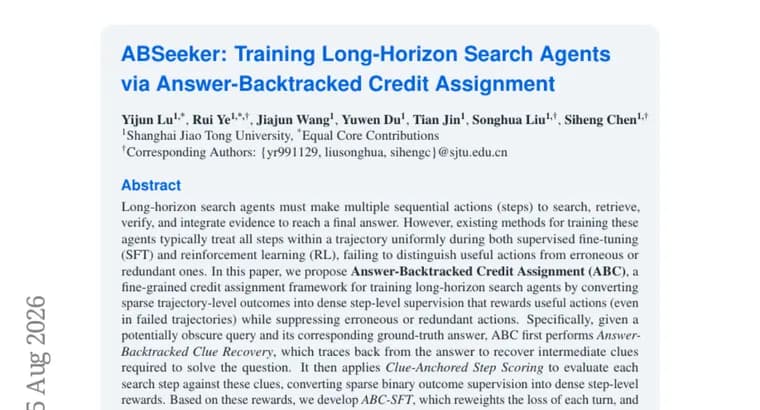
Long-horizon search agents have to take many sequential actions, searching, retrieving, verifying and integrating evidence, before they reach a final answer. The authors argue that existing training methods for these agents, whether supervised fine-tuning (SFT) or reinforcement learning (RL), treat every step in a trajectory the same way, so they cannot tell a useful action apart from an erroneous or redundant one.
To fix this, they propose Answer-Backtracked Credit Assignment (ABC), a framework that converts a sparse trajectory-level outcome (right or wrong at the end) into dense, step-level supervision. It rewards useful actions even inside trajectories that end in failure, while suppressing erroneous or redundant ones. ABC works in two stages. Answer-Backtracked Clue Recovery starts from the known ground-truth answer and traces backward to recover the intermediate clues a correct search would need to find. Clue-Anchored Step Scoring then checks each of the agent's actual search steps against those recovered clues, turning the original binary outcome signal into a reward for each individual step. On top of these step-level scores, the authors build two training methods: ABC-SFT, which reweights the loss contributed by each turn according to its score, and ABC-GRPO, which feeds the step-level scores in as rewards inside GRPO reinforcement learning.
Using this framework, the authors train a model called ABSeeker, based on Qwen3.5-4B, with only 8.5k examples. ABSeeker scores 37.3% on the BrowseComp benchmark and 39.1% on BrowseComp-ZH. With context management, whose specifics are not detailed beyond the scores it produces, those numbers rise to 55.3% and 52.9% respectively. At that level, ABSeeker significantly outperforms other agents at the same 4B parameter scale and matches the performance of larger agents of roughly 30B parameters. The authors present these results as evidence that answer-backtracked, step-level credit assignment is effective for training long-horizon search agents.
Key facts
- ABC (Answer-Backtracked Credit Assignment) converts sparse, trajectory-level right/wrong outcomes into dense step-level rewards via Answer-Backtracked Clue Recovery and Clue-Anchored Step Scoring.
- Two training methods build on this: ABC-SFT, which reweights each turn's loss by its step score, and ABC-GRPO, which uses the step scores as rewards in GRPO reinforcement learning.
- ABSeeker, trained on Qwen3.5-4B with only 8.5k examples, scores 37.3% on BrowseComp and 39.1% on BrowseComp-ZH.
- With context management, those scores rise to 55.3% and 52.9% respectively, outperforming other 4B-scale agents and matching agents of roughly 30B parameters.
Why it matters
Training a search agent usually means grading an entire multi-step trajectory as simply right or wrong at the end, which gives no signal about which individual actions inside that trajectory actually helped. ABC's contribution is to assign credit at the step level instead: it works backward from the correct answer to recover the clues a good search needed to find, then scores each step the agent actually took against those clues. That turns one coarse outcome signal into many finer ones, letting both SFT and RL training reward good steps and suppress erroneous or redundant ones, even within trajectories that ultimately failed.
Who it affects
This is a training methodology aimed at researchers and engineers building long-horizon search and retrieval agents, the kind that chain search, retrieval, verification and evidence integration across many steps. It is not a consumer product or a general-purpose model release.
How to use it
The paper does not state a release date, code availability or license, so there is no indication yet of whether ABC or the ABSeeker checkpoint can be used outside the authors' own experiments.
How solid is it
The results rest on a single base model, Qwen3.5-4B, trained with a small dataset of 8.5k examples, and evaluated on two benchmarks, BrowseComp and BrowseComp-ZH, both with and without an added context-management step. The abstract gives no author names, institutional affiliations, or training compute and hardware details, and does not specify what the 30B-scale agents it compares against actually are.
Risks and caveats
The headline comparison to '~30B' agents is not tied to specific named models, so it is hard to independently check. The gains from context management are reported only as final scores, with no description of the technique itself. And with evaluation limited to two benchmarks and one base model, it is not yet clear how the approach generalizes to other agents or tasks.