Agent Lightning v1.0 raises Qwen3.5-9B's SWE-bench Verified score by 14.6 points
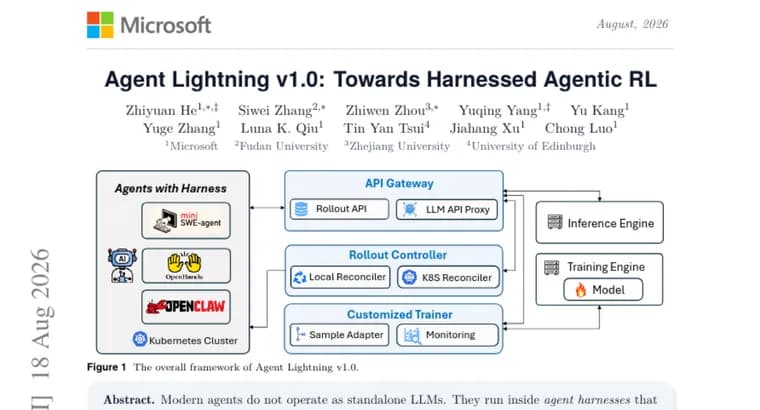
Agent Lightning v1.0 is a new, open source framework for training AI agents with reinforcement learning while they run inside their normal production harness, the layer that manages an agent's tools, context and control flow. The whole framework is implemented in roughly 3,500 lines of code. Its predecessor, the original Agent Lightning, introduced a disaggregated architecture that connects arbitrary agents to RL training through an LLM endpoint proxy, an approach the authors say has since been adopted by other frameworks, including verl Uni-Agent, AReaL 2.0, slime, and Polar. The authors call the general paradigm "harnessed agentic RL": the harness that runs an agent at deploy time participates directly in the model's post-training, instead of being set aside once training begins.
Harnessed agentic RL differs fundamentally from traditional agentic RL, the authors argue: the harness, not the training engine, owns the loop that interacts with the environment, while the training engine sees only sequences of LLM request-response pairs. That handoff creates specific engineering problems: retokenization, merging samples correctly, computing advantages, normalizing loss and scheduling the training backend, all of which the authors say can substantially affect how stable and effective training turns out to be. Agent Lightning v1.0 is built to support arbitrary agent harnesses and to work as a practical testbed for studying exactly these problems, rather than as a claim that they are already solved.
The authors evaluated the framework on instruction-following, search and coding agents, and built a complete, reproducible training pipeline for coding agents specifically. On that pipeline, using only 6,000 training examples and what the authors describe as modest compute, with no hardware or run-time figures given, reinforcement learning raised the Qwen3.5-9B model's score on the SWE-bench Verified coding benchmark from 41.8% to 56.4%, a gain of 14.6 percentage points. The abstract does not report comparable numeric results for the instruction-following or search agents it says were also evaluated.
The authors have released the complete workflow and training scripts behind the coding-agent pipeline, intending Agent Lightning v1.0 to serve as reproducible groundwork for further research into harnessed agentic RL.
Key facts
- Agent Lightning v1.0 is a roughly 3,500-line open source framework for "harnessed agentic RL," in which the deploy-time agent harness, not the training engine, owns the environment interaction loop during reinforcement learning.
- Using only 6,000 training examples, applying the framework to Qwen3.5-9B raised its SWE-bench Verified score from 41.8% to 56.4%, a gain of 14.6 percentage points.
- The original Agent Lightning's disaggregated architecture, which connects arbitrary agents to RL training through an LLM endpoint proxy, has already been adopted by other frameworks: verl Uni-Agent, AReaL 2.0, slime, and Polar.
- The handoff between harness and trainer introduces engineering challenges, including retokenization, sample merging, advantage calculation, loss normalization, and backend scheduling, that the authors say can substantially affect training stability.
- The authors released the complete workflow and training scripts for the coding-agent pipeline, though the abstract reports no comparable scores for the instruction-following and search agents it says were also evaluated.
Why it matters
The paper names and demonstrates a specific paradigm, "harnessed agentic RL," in which an agent is trained with reinforcement learning inside the exact harness that will run it in production, rather than in a separate training-only setup. It backs the idea with a concrete, external result: on SWE-bench Verified, a widely used coding-agent benchmark, applying this approach to Qwen3.5-9B raised the score from 41.8% to 56.4%, a gain of 14.6 percentage points, using only 6,000 training examples. A jump of that size from a comparatively small dataset is the kind of result that makes a training method worth attention on its own, and the disaggregated architecture behind the original Agent Lightning had already been adopted by several other RL frameworks before this release even shipped.
Who it affects
Anyone building or training AI coding agents and other agent harnesses, particularly teams already using or evaluating the frameworks that adopted the earlier Agent Lightning architecture: verl Uni-Agent, AReaL 2.0, slime, and Polar. It also matters to researchers benchmarking agents on SWE-bench Verified, since it adds a new, reproducible reference point on that benchmark.
How to use it
Agent Lightning v1.0 is released as open code, about 3,500 lines, built to plug into an existing agent harness through an LLM endpoint proxy rather than requiring a new one. The authors have released the complete workflow and training scripts for the coding-agent pipeline that produced the SWE-bench Verified result, so that pipeline can be reproduced or adapted directly. The framework is also built to support arbitrary agent harnesses beyond coding, which is what lets it double as a general testbed for the harnessed-RL problems described above rather than a single-purpose tool.
How solid is it
The central claim rests on one clearly stated, checkable comparison: Qwen3.5-9B's score on SWE-bench Verified, a fixed external benchmark, moved from 41.8% to 56.4% under this training method, reported as a plain absolute gain rather than inflated into a relative percentage. That the earlier Agent Lightning's architecture was independently adopted by four other frameworks, verl Uni-Agent, AReaL 2.0, slime, and Polar, is an outside signal of real technical traction rather than a self-reported number alone. Releasing the complete workflow and training scripts for the coding pipeline also means the result is, in principle, reproducible by others. Set against that, the source text names no individual authors or institutions, and it reports full numbers for only one of the three agent types it says were evaluated.
Risks and caveats
The abstract reports strong numbers on exactly one of the three agent types it says it evaluated: coding agents on SWE-bench Verified. Instruction-following and search agents are named as tested but not scored, so how well the method generalizes beyond coding is not established by this text. The authors themselves flag that the handoff between harness and trainer, covering retokenization, sample merging, advantage calculation, loss normalization, and backend scheduling, can substantially affect training stability and effectiveness, meaning results may be sensitive to how a given harness is implemented rather than guaranteed to transfer cleanly to other setups. "Modest compute" is not quantified in the text, so the efficiency behind the 6,000-example result cannot be independently checked from what is stated here.