Anthropic builds a biology lab where Claude guides robots through drug experiments
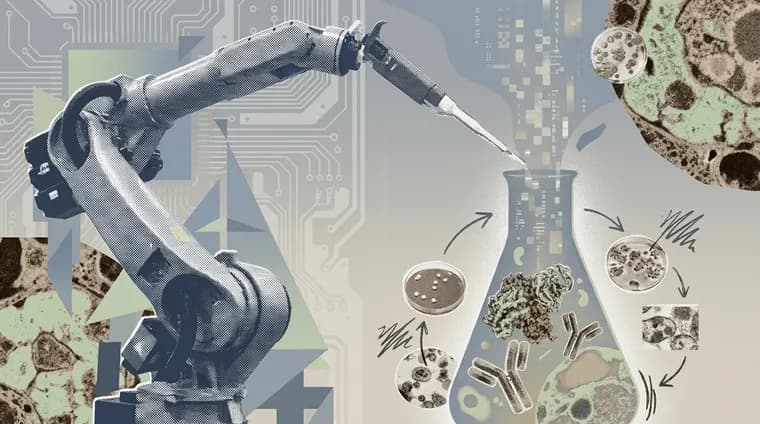
Anthropic is building its own biology lab in the San Francisco area to push AI-driven drug development beyond computer simulations and into physical experiments, according to a Reuters report cited by The Decoder.
The plan is for Claude to guide robots through the experiments with minimal human involvement, though the company says human oversight is still required for safety. To support the work, Anthropic has already shipped two tools: Claude Science, an AI workspace built for researchers, and the Model Hardware Standard, a specification for controlling lab equipment.
Eric Kauderer-Abrams, who runs Anthropic's life sciences division, sees the biggest opportunity in diseases long considered "undruggable" because no treatment for them exists. He says AI could speed up the design of complex antibodies that hit multiple targets at once.
The lab push builds on moves Anthropic made earlier this year: in April, the company acquired the startup Coefficient Bio for about $400 million and added Novartis CEO Vas Narasimhan to its board. Anthropic will not run its own clinical trials for now, according to the report, so as not to step on pharmaceutical companies' toes.
Key facts
- Anthropic is building a physical biology lab in the San Francisco area to run AI-guided drug-development experiments, not just simulations
- Claude is meant to guide robots through the experiments with minimal human involvement, though human oversight is still required for safety
- Anthropic has already shipped Claude Science, an AI workspace for researchers, and the Model Hardware Standard for controlling lab equipment
- In April, Anthropic acquired the startup Coefficient Bio for about $400 million and added Novartis CEO Vas Narasimhan to its board
- Anthropic will not run its own clinical trials for now, to avoid stepping on pharmaceutical companies' toes
Why it matters
Anthropic's business has so far been software: chat, coding and enterprise tools. A physical lab where Claude guides robots through experiments is a move into wet-lab work itself, not just analysis of results. Pairing that with the Coefficient Bio acquisition and a board seat for a sitting pharma CEO points to a deliberate push into drug discovery rather than a one-off research project.
Who it affects
Pharma researchers and drug-discovery teams are the direct audience for Claude Science and the Model Hardware Standard. Anthropic's own life sciences division, run by Eric Kauderer-Abrams, is building out around this lab. Patients with diseases currently labeled "undruggable" are the stated long-term target. Pharmaceutical companies are positioned as partners rather than competitors, since Anthropic says it will not run its own clinical trials for now.
How to use it
The two tools named in the report have already shipped: Claude Science, described as an AI workspace built for researchers, and the Model Hardware Standard, a specification for controlling lab equipment. The report gives no shipping date for either tool, no pricing or access details, and no opening date for the new lab itself.
How solid is it
The story comes from a Reuters report as relayed by The Decoder, a publication with an editorial team rather than a wire-only feed. The underlying facts, the $400 million Coefficient Bio deal and Narasimhan's board seat, are attributed to April of this year, though no year is stated outright. The report does not give an opening date for the lab or an address beyond "the San Francisco area," and it does not detail how the $400 million deal was structured or what Coefficient Bio's business was beyond calling it a startup.
Risks and caveats
"Minimal human involvement" sits next to a statement that human oversight is still required for safety, and the report does not spell out where that line falls in practice. Anthropic's decision to stay out of clinical trials for now reads as a deliberate limit on how far into pharma's territory it is willing to go, which also caps how much of the drug-development pipeline the lab can actually shorten on its own.