Aphanta finds image editing only sometimes aids AI reasoning
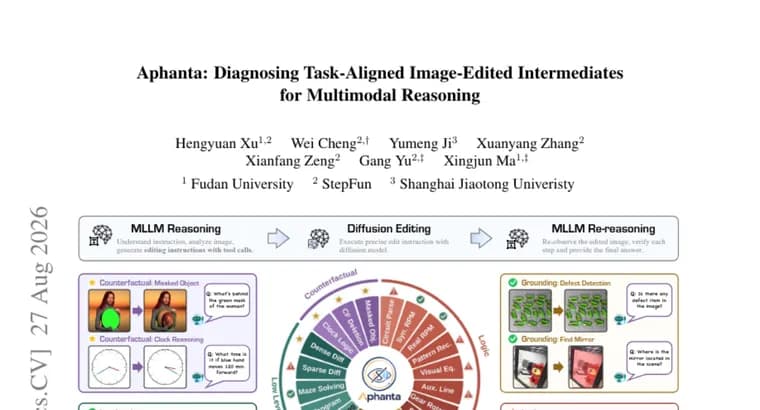
Researchers have introduced Aphanta, an automated task-discovery and closed-loop diagnostic framework for pipelines that chain a multimodal large language model (MLLM) to an image editor and back to an MLLM. The starting premise is that explicit visual intermediates, meaning images generated partway through a reasoning process to show updated spatial evidence or a changed visual state, can help an MLLM reason. But whether that help actually shows up depends on whether the image editor can faithfully produce the specific transformation a given task requires.
To test this, Aphanta evaluates three conditions on each task: direct reasoning with no generated image at all, reasoning using an intermediate image an editor actually produced, and reasoning using an idealized reference image that represents what a perfect edit would look like. Comparing the three separates two things that are usually conflated: how much visual headroom a task has in principle, and how much of that headroom current image editors can actually deliver.
The framework was run across 20 candidate tasks and multiple editor-MLLM combinations. The headline finding is that usefulness is strongly task-conditioned rather than general: gains concentrate in tasks involving visual cue injection, grounding, and counterfactual state realization, while tasks that require symbol-sensitive construction or structural extrapolation see substantially less reliable gains from editor-generated intermediates.
On the subset of tasks selected as positive cases, meaning the tasks where editing intermediates showed genuine promise, the consolidated Qwen pipeline raised the mean task score from 0.343 to 0.445, a gain of 10.2 points, or 29.7% in relative terms. The researchers say the full study deliberately keeps the filtered-out and unsuccessful tasks alongside the positive ones, specifically to expose where the approach breaks down rather than reporting only its best cases.
The authors conclude that image editing works as a specialized visual workspace for certain kinds of reasoning problems, not as a universal reasoning mechanism that helps across the board. They present Aphanta itself as a reusable protocol other researchers can apply to measure how well a task and its visual representation fit together, how faithfully an editor can realize the needed edit, and how much that translates into downstream pipeline utility.
Key facts
- Aphanta is an automated, closed-loop diagnostic framework built around the MLLM-to-image-editor-to-MLLM pipeline, designed to test whether an editor-generated image genuinely helps reasoning rather than assuming it does.
- It compares three conditions per task: reasoning with no generated image, reasoning with an editor's actual output, and reasoning with an idealized reference image, separating theoretical visual headroom from what current editors actually deliver.
- Testing covers 20 candidate tasks across multiple editor-MLLM combinations, and the benefit found is strongly task-conditioned rather than uniform.
- Gains concentrate in tasks needing visual cue injection, grounding, or counterfactual state realization; tasks needing symbol-sensitive construction or structural extrapolation show far less reliable gains.
- On the subset of tasks where editing helped, the consolidated Qwen pipeline raised the mean task score from 0.343 to 0.445, a gain of 10.2 points (29.7% relative).
Why it matters
Multimodal AI pipelines increasingly bolt an image editor onto a reasoning loop, generating a picture mid-task so the model has something concrete to reason over instead of relying on text alone. That design choice has mostly been adopted on faith, on the assumption that seeing an updated image helps the model reason better. Aphanta gives the field a way to actually check that assumption instead of taking it for granted, and its answer is a caution rather than an endorsement: the benefit is real but narrow. The authors frame image editing as a specialized workspace rather than a general reasoning booster, which pushes back against treating an editing step as a default addition to any multimodal pipeline.
Who it affects
This is aimed at researchers and engineers building or evaluating multimodal pipelines that call an image editor as an intermediate reasoning step, for example visual chain-of-thought or tool-use setups that generate an edited image before producing a final answer. It is a diagnostic methodology rather than a consumer product, so its direct audience is people deciding whether, and where, to add an image-editing step to their own MLLM pipeline, plus anyone benchmarking a specific editor-MLLM combination who wants to know if the pairing earns its cost.
How to use it
The paper's practical contribution is the protocol itself, not a released tool: run direct reasoning, reasoning with the editor's actual output, and reasoning with an idealized reference image side by side across a set of tasks, then treat the gap between the idealized and the actual conditions as a measure of how much headroom the editor is failing to capture. Applied to a candidate pipeline, that comparison flags where an image-editing step is worth keeping, such as cue injection, grounding, and counterfactual state realization, and where it is not, such as tasks that hinge on symbol-sensitive construction or structural extrapolation.
How solid is it
The claims rest on a single paper posted to Hugging Face's papers listing; the text gives no publication date, venue, or peer-review status. The tests span 20 candidate tasks and multiple editor-MLLM combinations, but the source does not name which image editors, which MLLMs, or which specific Qwen variant made up the consolidated Qwen pipeline, nor does it define the 20 tasks or specify which ones make up the positive-task subset behind the 0.343-to-0.445 result. That score improvement applies only to the selected positive subset, not the full task set; the study says it deliberately keeps the filtered-out and unsuccessful tasks too, a point in favor of its transparency about where the method fails, but also a reason the reported gain should not be read as an average across all 20 tasks.
Risks and caveats
The finding most likely to be over-read is the rise from 0.343 to 0.445: it describes a favorable subset of tasks chosen because editing helped there, not the full 20-task set, and treating it as a general claim that image editing improves AI reasoning by about 30% would misstate what was measured. The authors' own conclusion cuts the other way too: they explicitly frame image editing as a specialized workspace rather than a universal reasoning mechanism, warning against the very assumption their framework was built to test. Because the specific editors, MLLMs, and Qwen variant tested are not named in the source, it is also unclear how far the task-conditioned pattern generalizes beyond the setups Aphanta actually evaluated.
“These results position image editing as a specialized visual workspace rather than a universal reasoning mechanism.”
— the paper's authors